Stamping Die Punches
Complete range of precision stamping punches for progressive, compound, and transfer dies. 516 products spanning standard shoulder, straight, tapped, heavy-load, blanking, and specialty types in SKD11, SKH51, and SKH40 tool steels. Available from MISUMI and DAYTON with same-day shipping on standard catalog dimensions.
Punch Categories
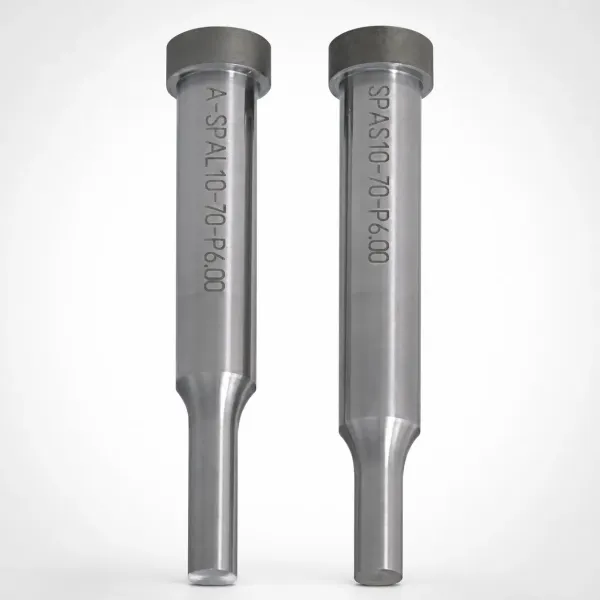
Standard Punches
Shoulder & Ejector Types for General Stamping. 159 products available.
View ProductsTapped Punches
Threaded Shank for Bolt-Through Retention. 9 products available.
View ProductsPunches with Key Grooves
Anti-Rotation Keyway Locking for Shaped Profiles. 8 products available.
View ProductsFlange Stopper Punches
Flanged Shoulder for Depth-Controlled Stamping. 2 products available.
View ProductsStraight Punches
Cylindrical Press-Fit Mounting (H7/m6). 76 products available.
View ProductsBlanking Punches
Specialized Cutoff & Separation Geometry. 2 products available.
View ProductsPunches with Locating Dowel Holes
Cross-Drilled Dowel Pin for Zero-Rotation Positioning. 51 products available.
View ProductsPunches for Heavy Load
Reinforced Shank Design for Thick Plate Stamping. 96 products available.
View ProductsStraight Punches for Heavy Load
Uniform Cylindrical Shank with Heavy-Duty Capability. 2 products available.
View ProductsPunches for Heavy Load with Dowel Holes
Heavy-Duty Reinforced + Dowel Pin Positioning. 44 products available.
View ProductsTapered Head Punches
Conical Head for Self-Aligning Quick Insertion. 17 products available.
View ProductsPunch Blanks
Semi-Finished Blanks for Custom In-House Grinding. 36 products available.
View ProductsComponents for Punches
Backing Plates, Retainers & Punch Accessories. 14 products available.
View ProductsSelect by Mounting Style
Punches are categorized by shank mounting style. Your die design determines which mounting method is required.
| Mounting Style | Shoulder (Stepped) | Straight (Press-Fit) | Tapped (Threaded) | Tapered Head |
|---|---|---|---|---|
| Retention | Head seats against backing plate | H7/m6 interference fit | Bolt through backing plate | Conical self-centering wedge |
| Removal | Push from face side | Press out from back | Unscrew bolt | Pull with taper puller |
| Plate Footprint | Large (stepped bore + counterbore) | Small (single bore) | Medium (bore + screw clearance) | Small (tapered bore) |
| Stripping Resistance | Excellent (mechanical lock) | Good (friction only) | Excellent (bolt preload) | Good (wedge friction) |
| Quick-Change | Moderate | Ball-lock compatible | Fast (hex key access) | Fast (self-aligning) |
| Best For | General purpose, default choice | Tight-pitch, ball-lock dies | High stripping, frequent change | SMED, high-volume plants |
Select by Application
Standard Piercing & Blanking
General-purpose hole piercing and blank separation in mild steel, aluminum, and copper up to 3mm thickness.
Start with: Standard shoulder punches in SKD11 for the best cost-to-life ratio. Add ejector mechanism if slug pulling is an issue.
Thick Plate & AHSS Stamping
Piercing materials thicker than 3mm or high-strength steels (DP590-DP980) that exceed standard punch load ratings.
Start with: Heavy load punches with reinforced shanks. Add SKH51 material for AHSS applications.
Non-Round Profiles (Anti-Rotation Needed)
D-shape, square, oblong, or custom profile punches that must maintain angular orientation in the punch plate.
Start with: Key groove punches for standard accuracy (+/-0.5 deg) or dowel hole punches for precision (+/-0.1 deg).
Custom Profiles & In-House Grinding
Non-standard punch profiles that require in-house CNC grinding or wire-EDM from semi-finished blanks.
Start with: Pre-hardened punch blanks in your required steel grade. Grind to your custom profile in-house.
Troubleshooting: Common Punch Problems
Punch Breakage / Chipping
Symptom: Punch tip breaks or chips within the first 50K hits. Root cause: Insufficient material grade for the application, excessive L/D ratio (buckling), or incorrect clearance (under-clearance causes compressive stress concentration). Solution: Upgrade to SKH51/SKH40 for material-related chipping. Switch to heavy load punches for L/D-related breakage. Verify die clearance per material type.
Slug Pulling (Slug Sticking to Punch)
Symptom: Punched slugs stick to the punch face on the upstroke, causing misfeeds or die damage. Root cause: Vacuum effect between punch face and slug, insufficient lubrication, or material springback gripping the punch. Solution: Switch to ejector punches with spring-loaded jector pins. Alternative: add a vacuum-relief hole to the punch face.
Punch Rotation in Plate
Symptom: Non-round punch rotates during operation, causing profile misalignment. Root cause: Set screw loosening (vibration), insufficient anti-rotation locking, or worn keyway/bore. Solution: Upgrade from key groove to dowel hole punches for permanent rotational lock. Re-torque set screws at every PM interval.
Excessive Burr on Stamped Part
Symptom: Burr height exceeds specification on the punched edge. Root cause: Worn punch edge (regrinding needed), excessive die clearance, or incorrect clearance for the material. Solution: Regrind the punch edge (remove 0.05-0.1mm). Verify clearance: 5-8% per side for mild steel, 7-10% for stainless. Consider TiCN coating to extend edge life between regrinds.
Frequently Asked Questions
What are the key differences between standard, straight, and heavy-load punches?+
How do I choose the correct shank mounting style for my press die?+
What is the typical lead time for bulk punch orders?+
How often should stamping die punches be replaced or sharpened?+
Engineering Resources
Need a Custom Quote?
Send your specifications and receive a quote. MOQ: 1 piece. Custom dimensions available.