Core Pins
Core Pin Categories
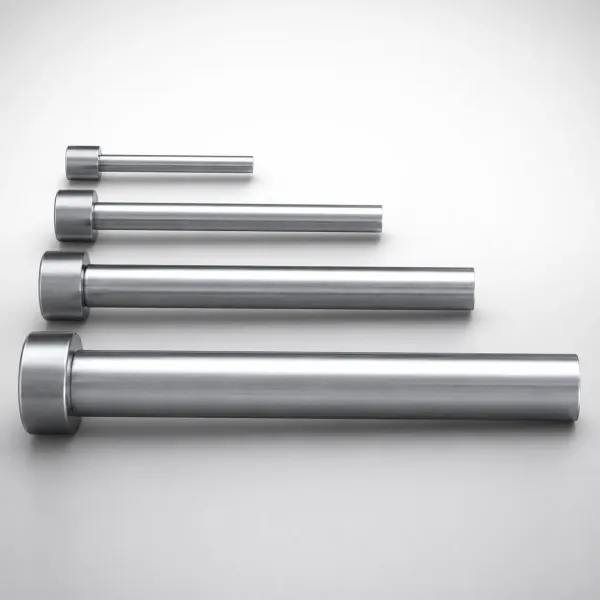
Straight Core Pins
The most widely used core pin type. Available with or without tip processing, gas release venting, and character engraving.
View Products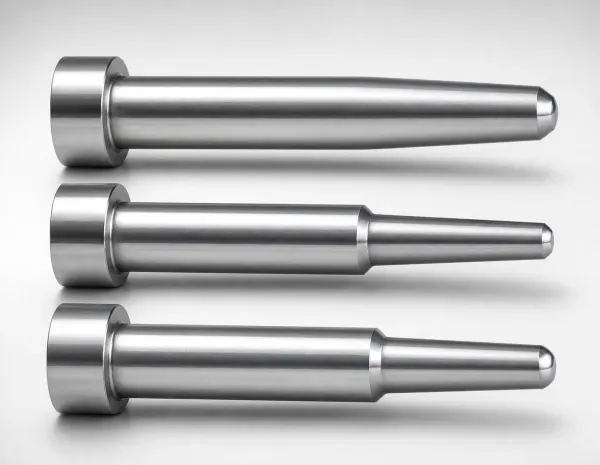
Stepped Round Core Pins
Feature one-step or two-step diameter transitions along the shaft for multi-section cavities.
View Products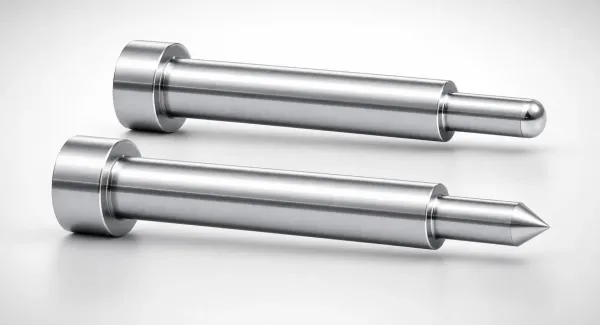
Taperless Core Pins
Precision outer-diameter tolerances rather than tapered fit. Simplify plate machining for precision molds.
View Products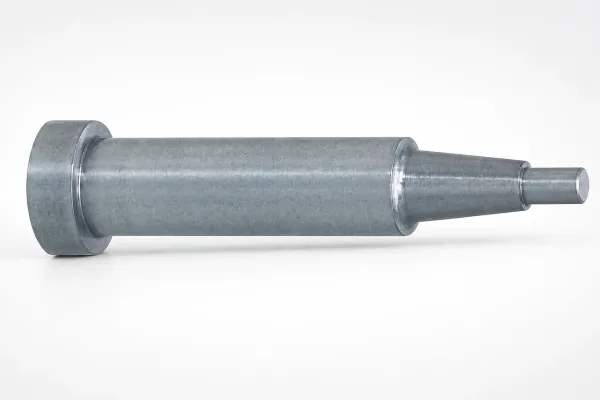
Boss, Round & Inlay Core Pins
Specialty core pins for complex geometries. Includes boss forming, inlay-type, large-diameter, and core sleeves.
View ProductsHow to Choose the Right Core Pin
Core pin selection follows two steps: match the structural type to your cavity geometry, then choose the material grade for your operating conditions.
Step 1: Select Structural Type
| Selection Criteria | Straight | Stepped Round | Taperless | Boss / Inlay |
|---|---|---|---|---|
| Internal Feature | Simple round hole, pin gate | Multi-diameter hole (counterbore, connector housing) | Same as Straight/Stepped | Boss pillar, oversized bore, modular tip |
| Shaft Geometry | Uniform diameter | 1 or 2 step transitions | Uniform or stepped, cylindrical shank | Application-specific profiles |
| Plate Machining | Standard taper bore | Standard taper bore | Straight bore only (no taper reaming) | Varies by type |
| Pin Replacement | Match taper angle | Match taper angle | Any same-diameter pin (universal) | Tip-only swap (Inlay) |
| Best For | 80% of standard molds | Multi-section cavities | High-cavity molds, fast maintenance | Specialty geometries, cost optimization |
| Cost Level | $ | $$ | $$ | $$ – $$$ |
Step 2: Select Material Grade
Material grade directly affects service life, heat resistance, and corrosion behavior. The operating temperature of the resin and the required cycle count determine the optimal steel.
| Material | Hardness (HRC) | Max. Temp. | Best Suited For |
|---|---|---|---|
| SKH51 (M2) | 60 – 62 | ~600°C | General-purpose precision molds, high-cycle production |
| SKD61 (H13) | 48 – 52 | ~600°C | High-temperature molds, die casting applications |
| STAVAX ESR | 48 – 52 | ~250°C | Medical and optical molds requiring corrosion resistance |
| Hotwork Steel | 44 – 48 | ~550°C | DIN-standard metric and inch-size tooling |
Solve a Manufacturing Problem
Not sure which core pin you need? Find the solution based on the problem you're experiencing:
| Problem | Likely Cause | Recommended Solution |
|---|---|---|
| Burn marks / diesel marks inside cavities | Trapped air has no escape path — compresses and ignites | Gas Release Core Pins |
| Core pin breakage before expected life | Material or geometry mismatch with stress conditions | Radiused Stepped Pins + SKD61 material |
| Excessive downtime during pin replacement | Taper fitting requires precision alignment each time | Taperless Core Pins (straight bore, drop-in) |
| High per-replacement cost on worn pins | Entire pin discarded when only the tip is worn | Inlay Core Pins (replaceable tip only) |
| Missing date codes / cavity numbers on parts | No marking mechanism on the forming surface | Engraved Core Pins |
| Poor surface finish on visible internal features | Standard as-machined pin tip too rough | Tip-Processed Core Pins (Ground / Lapped / TiCN) |
| Pin deflection causing uneven wall thickness | Long pin without lateral support in plate bore | Core Sleeves (precision guide bushings) |
About Core Pins
Core pins form the internal geometry of injection-molded parts — holes, cavities, bosses, and recessed features that cannot be shaped by the mold cavity alone. We supply a full range of straight, stepped, taperless, and specialty core pins manufactured from JIS and DIN standard tool steels including SKH51 (M2), SKD61 (H13), and STAVAX ESR. All pins are fully interchangeable with DME, HASCO, and MISUMI equivalents.
Our Core Pin Manufacturing Capabilities
| Machining Tolerance | ± 0.002 mm |
| Min. Shaft Diameter | 0.8 mm |
| Available Materials | SKH51, SKD61, STAVAX ESR, Hotwork Steel |
| Applicable Standards | JIS B 6131, DIN 9861 |
| Interchangeable With | DME, HASCO, MISUMI |
| Surface Treatments | Nitriding, TiCN Coating, Tip Lapping |
| Minimum Order Quantity | 1 piece |
Core Pins Across Industries
Application scenarios by industry vertical
Automotive
Connector housings, sensor enclosures, clip components. Heat-resistant steels (SKD61) and TiCN coatings for high-temp, long-run production.
Medical Devices
Syringe barrels, diagnostic housings, catheter fittings. Corrosion-resistant STAVAX ESR for cleanroom and biocompatibility requirements.
Consumer Electronics
Phone cases, charger shells, connector pin seats. Tight tolerances (0.002 mm) and high-gloss surfaces with SKH51 precision-lapped tips.
Packaging
Caps, closures, containers. High-volume multi-cavity molds require consistent dimensional accuracy and maximum wear resistance.
Frequently Asked Questions
What is a core pin in injection molding?+
What is the difference between a core pin and an ejector pin?+
When should I use gas release core pins?+
What materials are best for core pins?+
What is the difference between straight, stepped, and taperless core pins?+
Can you customize core pin dimensions?+
Related Product Categories
Engineering Resources
Case Studies
Burn Mark Elimination in 32-Cavity Connector Mold
Gas release core pins reduce defect rate by 98%.
STAVAX Core Pins for Cleanroom Compliance
6.6× longer service life, zero corrosion over 2M shots.
Inlay Pins Cut Maintenance Cost by 65%
Tip-only replacement on 24-cavity boss pillar mold.
Taperless Pins Reduce Mold Build Time 30%
64-cavity closure mold delivered 3 weeks early.
Need a Custom Quote?
Send your specifications — material, dimensions, quantity — and receive a quote. MOQ: 1 piece. Custom dimensions available.