Stepped Round Core Pins
One or two diameter transitions for multi-section cavities in a single pin.
Product Categories
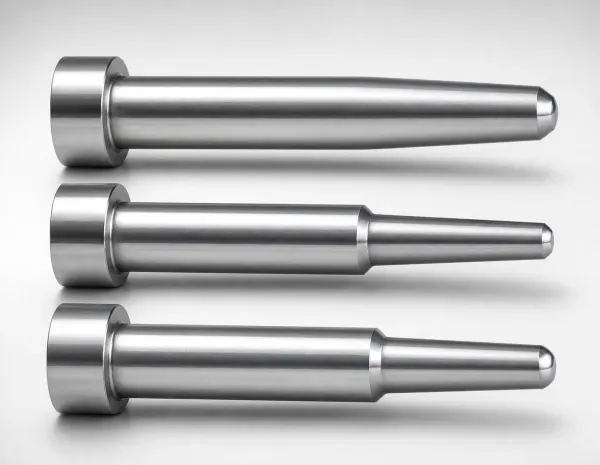
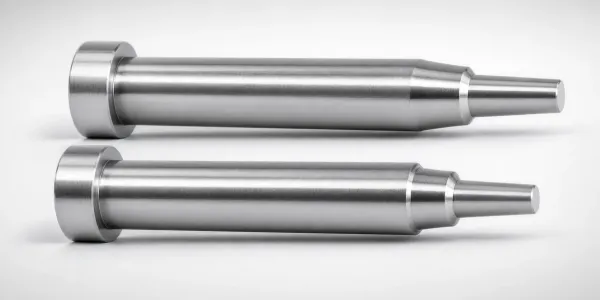
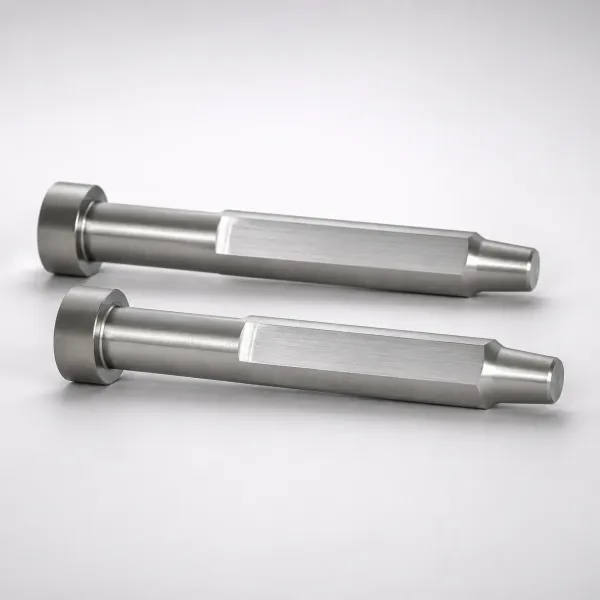
One-Step vs Two-Step: Configuration Guide
What is a stepped core pin?
A stepped core pin has one or more diameter transitions along its shaft, allowing a single pin to form a multi-diameter internal feature. A one-step pin creates two shaft sections (e.g., a counterbored screw hole). A two-step pin creates three sections (e.g., a connector housing with contact bore, alignment shoulder, and outer recess).
Why does the step transition matter?
Sharp transitions between diameters concentrate stress and may cause premature pin failure. All our stepped pins feature controlled transition radii to minimize stress while maintaining dimensional accuracy at each step.
Choose your configuration:
| Criteria | One-Step | Two-Step | Gas Release One-Step |
|---|---|---|---|
| Diameter Sections | 2 (one transition) | 3 (two transitions) | 2 + venting channel |
| Typical Application | Counterbored screw holes, single-step recesses | Connector housings, multi-recess features | Deep counterbores with gas trap risk |
| Complexity | Standard | Higher precision grinding required | Standard + vent machining |
| Lead Time | Standard | Standard | Standard |
Do You Need a Stepped Core Pin?
Stepped pins form multi-diameter features in a single pin. Confirm the geometry requirement:
✅ You're in the right place if:
- Your cavity has two or three concentric internal diameters formed by a single pin
- The feature is a counterbored hole, stepped recess, or connector housing bore
- Multiple diameter sections must maintain controlled concentricity
🔄 Consider switching to:
- Only need a single uniform diameter? → Straight Core Pins (simpler, lower cost)
- Have many identical stepped positions (16+)? → Taperless Core Pins for faster changes
- Feature is a boss pillar? → Boss Core Pins (optimized proportions)
Technical Overview
Stepped core pins eliminate the need for multiple separate pins or secondary machining operations when the molded part requires a hole with two or more internal diameters. A single one-step pin can form a counterbored screw hole — the larger section creates the counterbore while the smaller forms the through-hole.
The critical design parameter is the transition between diameters. Sharp transitions concentrate stress and may cause premature failure. Our stepped pins feature controlled transition radii to minimize stress concentration while maintaining dimensional accuracy at each step.
Two-step pins address cavity designs where a simple counterbore is insufficient — such as connector housings with a contact bore, alignment shoulder, and outer sealing recess. The additional step requires tighter process control during grinding.
Frequently Asked Questions
One-step vs two-step?+
Step transition tolerances?+
Gas release for two-step?+
Related Product Categories
Engineering Resources
Case Studies
Need a Custom Quote?
Send your specifications — material, dimensions, quantity — and receive a quote. MOQ: 1 piece. Custom dimensions available.