Precision Progressive Stamping Die Manufacturing China
High-speed terminal stamping tooling, motor core lamination dies, deep-drawing tooling, and multi-station progressive dies. Engineered with sub-micron tungsten carbide punches, automated in-die tapping, and speeds up to 1200 SPM.
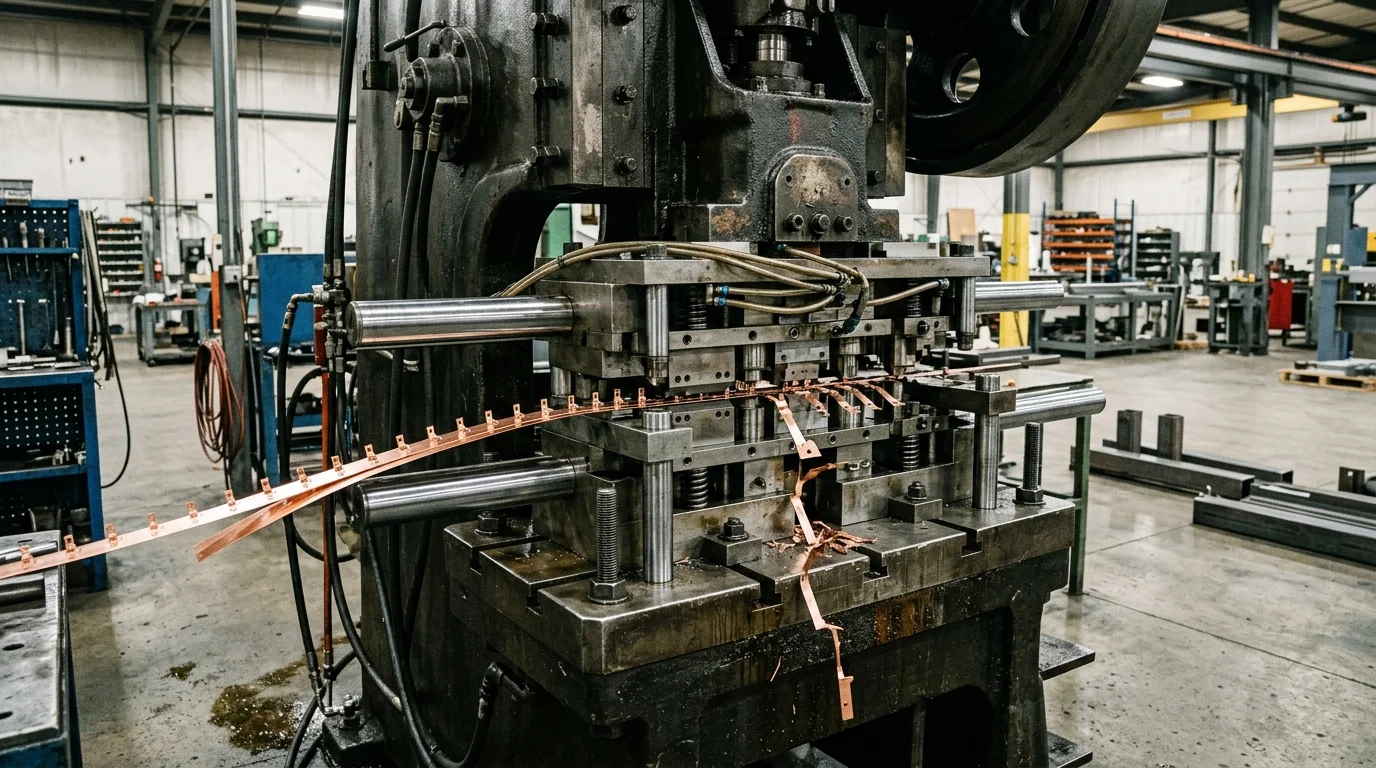
Progressive Die vs. Transfer Die Selection Matrix
Choosing between progressive and transfer die architecture depends on annual part production volume, raw material strip width, and part geometry complexity.
| Stamping Architecture | Strip Carrier & Feeding Mechanism | Production Speed (SPM) | Best Fit Application & Part Geometry |
|---|---|---|---|
| Progressive Stamping Die | Continuous coil carrier strip carries part through 10–40 stations | 300 to 1,200 SPM (High throughput) | Electronic connector terminals, automotive fuse blades, small brackets, high-volume contacts (>500K units/yr) |
| Transfer Stamping Die | Mechanical fingers transfer discrete blanks between independent die stations | 20 to 80 SPM (Medium throughput) | Deep-drawn cylindrical cans, large automotive chassis panels, parts requiring 360° deep flanging |
| Compound / Single Stage | Single station performs blanking and piercing simultaneously | 30 to 120 SPM (Batch production) | Flat washers, simple shims, low-to-medium volume flat stamped components |
🔗 Cross-Tooling Joint DFM: If your stamping terminals are destined for plastic housing assembly, independent tooling development risks burr interference and pin tilt. Read our technical whitepaper on how cross-tooling DFM prevents terminal-housing mismatch.
Strip Layout CAE & Springback Compensation
We perform full 3D strip layout design with AutoForm forming simulation, calculating non-linear material springback to guarantee dimensional accuracy on high-strength copper and stainless alloys.
Finite Element Forming CAE
Simulates thinning, wrinkling, and strain hardening across bending stations—see our guide on how to compensate for springback in progressive die design before cutting steel.
Reverse Springback Camber
Tool steel punch angles are pre-compensated by 1.5°–3.5° to achieve exact 90.0° ±0.2° post-forming bend angles.
Sub-Micron Wire-EDM
Seibu & Sodick slow-wire EDM cutting Ø0.05mm wire with ±0.0015mm punch-to-die clearance for burr-free edges.
Modular Quick-Swap Inserts
Carbide punch and die blocks are 100% interchangeable, enabling rapid on-press replacement in under 10 minutes.
🛠️ Assembly Troubleshooting: Experiencing terminal skiving or pin tilt during automatic stitching? Review our troubleshooting guide on how to prevent terminal-housing assembly failures.
High-Speed Stamping Economics & 50M+ Stroke Tooling ROI
High-speed progressive stamping dies dramatically reduce the amortized tooling cost per part while eliminating manual secondary assembly.
📈 Stamping Cost Amortization Formula
Cost Per Part = (Strip Material Cost) + (Press Hour Rate / (SPM × 60 × OEE)) + (Tooling Cost / Total Tool Life Strokes)
Stamping Press Fleet & Raw Material Matrix
Our stamping trial facility operates precision high-speed mechanical presses from 25 tons up to 400 tons:
| Raw Material Alloy Grade | Material Thickness Range | Compatible Stamping Presses | Tool Steel & Coating Specification |
|---|---|---|---|
| Phosphor Bronze (C5191 / C5210) | 0.08 mm – 1.2 mm | 25T–80T High-Speed (800–1200 SPM) | Tungsten Carbide (WF30 / CD650) + TiCN Coating |
| Beryllium Copper (C17200 / C17510) | 0.10 mm – 0.8 mm | 45T–125T Precision Press | Micro-grain Carbide + DLC Diamond-Like Carbon |
| Stainless Steel (SUS301 / SUS304 / SUS316) | 0.05 mm – 2.5 mm | 60T–250T Heavy Mechanical Press | Bohler K390 / Vanadis 4 Extra Powder Steel (64 HRC) |
| Cold-Rolled Steel (SPCC / SECC) | 0.30 mm – 4.0 mm | 110T–400T Progressive Stamping Line | SKD11 / DC53 / Cr12MoV Vacuum Hardened (60-62 HRC) |
💡 Punch Tooling Selection: For high-volume stamping over 5 million strokes, choosing between sub-micron tungsten carbide and powder metallurgy tool steels is crucial. Read our comparison of carbide vs HSS punches to evaluate wear resistance and regrind intervals.
High-Volume Stamping Applications We Serve
Explore high-volume stamped components engineered across multiple precision sectors:
🔌 Electronic Connector Terminals
Micro-pitch contact pins, USB-C stamped shells, high-speed backplane terminal strips with gold/tin selective plating.
⚡ Automotive Busbars & Fuse Blades
High-current EV copper busbars, fuse terminals, relay springs, and laminated motor core stator/rotor stampings.
🛡️ RF Shielding Cans & Brackets
Seamless deep-drawn EMI shielding covers, smartphone internal grounding clips, and precision spring contacts.
🔩 In-Die Tapped Fasteners
Progressive stamped chassis brackets with integrated M2.5–M6 in-die extruded tapped screw threads.
Related Engineering Guides & Technical Resources
How to Compensate for Springback in Progressive Die Design
FEA simulation models, overbending angle calculations, and optical profile grinding to hold tight stamping bend angles.
Carbide vs HSS Punches: Which Lasts Longer in Stamping Dies?
Tungsten carbide WF30/CD650 vs HSS punch tool life, chipping resistance, and cost per million stamping strokes.
How Cross-Tooling DFM Prevents Terminal-Housing Mismatch in Connector Projects
Joint tolerance stack-up analysis across progressive stamping dies and injection molds to eliminate field defects.
Frequently Asked Questions
What is the maximum press speed (SPM) your progressive dies support?+
Can you build dies with in-die tapping and in-die contact riveting?+
How long does a progressive stamping die last before it needs regrinding?+
Get a Custom Progressive Stamping Die Quote
Upload your 2D/3D component drawings for a complimentary strip layout review and precision tooling quotation within 24 hours.