Custom Insert Molding & Overmolding Tooling China
Specialized tooling for metal terminal encapsulation, automotive sensor potting, soft-touch ergonomic grips (TPE/TPU), and IP68 waterproof multi-material components. Featuring precision robotic insert indexing and zero-flash shut-off sealing.
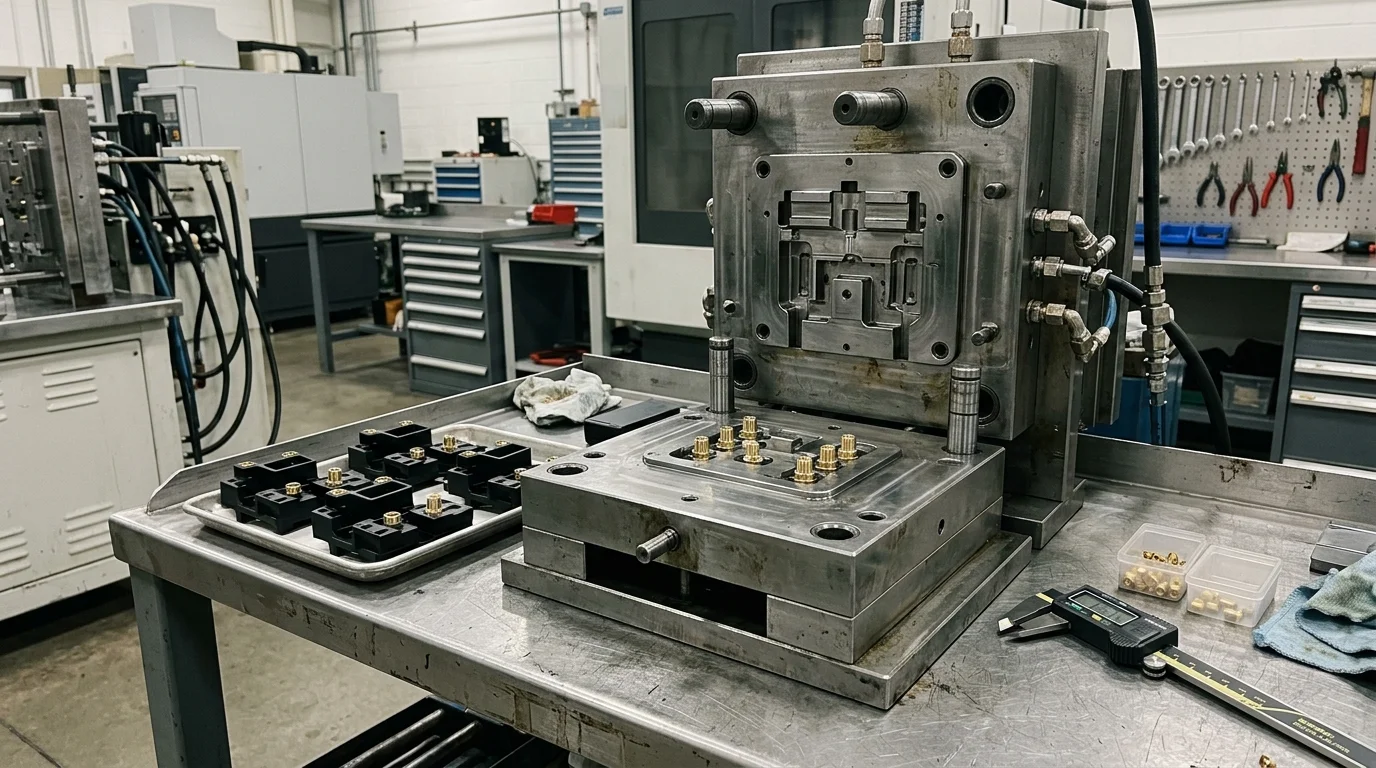
Insert Molding vs. Overmolding: Process Comparison Matrix
Understanding the differences between metal insert encapsulation and two-step polymer overmolding to choose the most cost-effective tooling strategy. Read our detailed comparison on insert molding vs overmolding vs two-shot to evaluate tooling capital versus part unit cost.
| Process Feature | Metal Insert Molding | Polymer Overmolding (Substrate + TPE) |
|---|---|---|
| Primary Objective | Integrate metal fasteners, conductive pins, or bushings into plastic | Add ergonomic soft grips, cosmetic two-color styling, or sealing gaskets |
| Substrate Material | Brass, Copper, Stainless Steel, Aluminum, PCB/FPC | Rigid Thermoplastics (PC, ABS, Nylon, PBT, Polypropylene) |
| Tooling Configuration | Single vertical press with shuttle/rotary table for safe insert loading | 2-shot rotary mold or 2-station transfer tooling (1st shot + 2nd shot) |
| Bonding Mechanism | Mechanical lock (undercuts, knurling, through-holes) + shrink wrap | Direct chemical molecular melt-fusion + mechanical interlocks |
| Critical Quality Risk | Insert floating/tilting, resin leaking into screw threads (flashing) | Layer delamination under thermal shock, sink marks on thick TPE sections |
💡 Preventing Terminal Deflection: For high-density micro-pitch pin encapsulation, visit our technical guide on cross-tooling DFM for terminal-housing fit.
Material Compatibility & Chemical Bonding Matrix
Selecting compatible substrate and elastomer combinations guarantees peel-resistant adhesion without requiring secondary adhesive primers:
| Rigid Substrate Plastic | Compatible Overmold Resin | Adhesion Strength & Mechanism | Typical Industry Application |
|---|---|---|---|
| PC / ABS Alloy | TPU (Thermoplastic Polyurethane) | Excellent Molecular Fusion (Cohesive substrate tear) | Power tool bodies, robotic vacuum bumpers, smart consumer electronics |
| PA66 / PA6 (Nylon) | Modified TPV / TPE (Bondable to Polyamide) | High Chemical Bond + mechanical dovetail | Automotive under-hood connectors, industrial sensors, power tools |
| Polypropylene (PP) | Olefin-Based TPE / SEBS | Excellent Homopolymer Fusion | Medical syringe plungers, toothbrush grips, kitchenware seals |
| PBT / PPS / LCP | Fluorosilicone / Specialty High-Temp Elastomer | Mechanical Undercut Locking | High-voltage EV automotive headers, aerospace wire harness glands |
To maximize mechanical and chemical adhesion, review our technical guide on how to ensure strong TPE-to-substrate bonding, or compare elastomer characteristics in our TPE vs TPU overmolding guide.
Insert Retention DFM & Anti-Flashing Shut-Off Engineering
Under 1,000+ bar injection pressures, unsupported metal inserts easily tilt, float, or allow resin to flash into female threads. See our engineering framework on how to prevent insert shift in overmolding using 4 robust tooling safeguards:
Dual-Datum Spring Pre-Loading
Spring-loaded locating pins in the core clamp metal inserts against fixed tool datums with ±0.003mm repeatable true position.
Zero-Flash Thread Collar Shut-Off
Tapered core shut-off collars apply 0.05mm elastic pre-load onto insert shoulders, guaranteeing 100% thread protection from melt ingress.
Pneumatic Vacuum Retention
Internal vacuum channels hold stamped metal busbars and delicate foils firmly against cavity walls during rapid vertical mold closing.
Symmetrical Melt Filling Flow
Dual-gate or ring-gate geometry equalizes dynamic injection pressure on both sides of long pin inserts, preventing pin bending.
Insert & Overmolding Industry Application Cases
Proven high-precision insert and overmolding tooling delivered across key industrial sectors:
800V High-Current Busbar Encapsulation
PA66+GF30 flame-retardant encapsulation of pre-formed stamped copper busbars. Zero air entrapment, 3000V AC dielectric insulation test passed.
IP68 Waterproof Smartwatch Case
High-strength PC chassis with liquid silicone rubber (LSR) integrated overmolded perimeter seal. Sub-micron shut-off prevents flash.
Cordless Impact Wrench Clamshell
PA66+GF50 rigid structural housing with shock-absorbing TPU grip overmold. Passed 2.0-meter drop impact test onto concrete at -20°C.
M12 Threaded Brass Collar Sensor Header
PBT+GF30 sensor body with threaded brass collar insert. Precision rotary table tooling with 100% automated optical verification.
Insert & Overmolding Troubleshooting Guide
Root causes and toolroom solutions for common insert molding and overmolding quality defects:
| Defect / Failure Mode | Root Cause Analysis | Toolroom Engineering Solution |
|---|---|---|
| Elastomer Delamination (Peeling) | Substrate surface contaminated or melt temp too low for chemical bonding | Add mechanical dovetail undercuts; optimize hot runner nozzle temperature to ensure interface fusion |
| Insert Flashing (Resin in Threads) | Insert dimensional tolerance out of spec (>±0.02mm) or worn shut-off land | Implement spring-loaded shut-off core pins with 0.05mm pre-load; specify tighter insert supplier tolerances |
| Pin Tilt / Displacement | Asymmetrical flow front pushing long metal pins during high-speed cavity filling | Rebalance gate placement for opposing flow; add support shut-off pins on non-functional pin areas |
| Micro-Bubbles at Metal Interface | Entrapped air or moisture on cold metal surface vaporizing during injection | Pre-heat metal inserts to 80°C–120°C; add 0.002mm micro-venting along the insert mounting datum |
Related Engineering Guides & Technical Resources
How to Prevent Insert Shift in Overmolding: 5 Engineering Solutions
Magnetic retention nests, pneumatic core pre-clamping, and shut-off pinch lands preventing high-pressure melt displacement.
Insert Molding vs Overmolding vs Two-Shot: Which Process to Choose
Engineering trade-offs between metal insert encapsulation, secondary overmolding, and 2K rotary platen injection.
How to Ensure Strong TPE-to-Substrate Bond in Overmolding
Interfacial diffusion thermodynamics, 90° shoulder shut-off lands, and ASTM D903 90-degree peel testing.
Frequently Asked Questions
What types of metal inserts can be molded into plastic?+
How do you prevent metal inserts from shifting under high injection pressure?+
How do you guarantee strong chemical/mechanical bonding in plastic overmolding?+
Plan Your Insert & Overmolding Project
Upload your 3D CAD files for a comprehensive DFM bonding evaluation and custom tooling quotation within 24 hours.