Two-Shot (2K) Multi-Material Mold Manufacturing
Engineered dual-injection tooling for seamless two-color aesthetics, integrated elastomeric seals (IP68), and soft-touch automotive control interfaces. Featuring rotary table, core-back, and index-plate mold architectures.
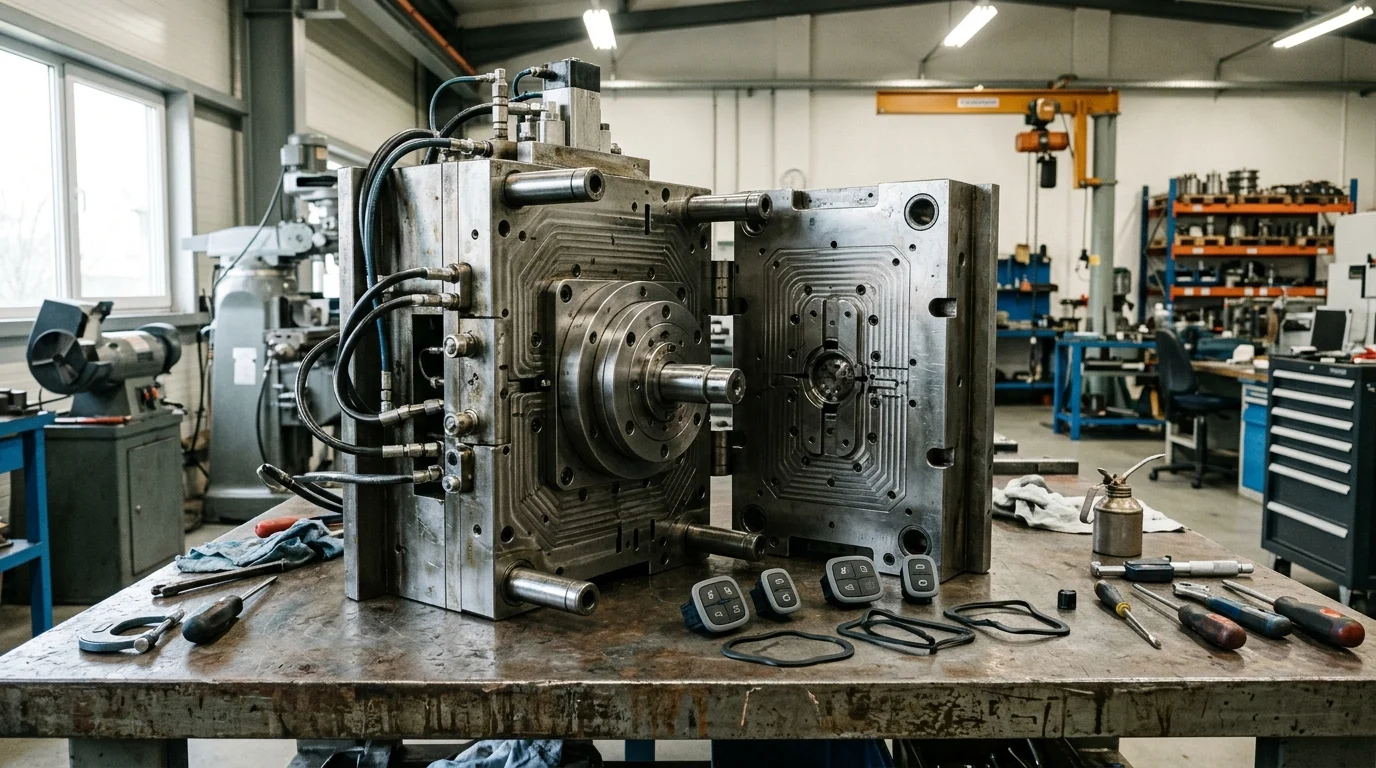
2K Tooling Mechanisms: Rotary Platen vs. Core-Back vs. Transfer
Comparing the three primary two-shot injection molding technologies to match your machine fleet and part geometry. Read our in-depth analysis on two-shot molding vs overmolding to evaluate machinery CapEx versus labor savings.
| 2K Tooling Mechanism | Kinematic Motion & Press Requirements | Tooling Complexity & Investment | Best Fit Geometry & Production Volume |
|---|---|---|---|
| Rotary Platen (180° Index) | Requires 2-barrel molding press with servo rotary table on moving platen | High (Dual independent runner manifolds, symmetrical cavities) | High-volume automotive buttons, medical housings, two-color enclosures (>100K units/yr) |
| Core-Back Retraction | Standard single-barrel or dual-barrel press with hydraulic core pulls | Moderate (Slide cores retract inside stationary mold base) | Parts with uniform TPE seal beads, internal gaskets, localized soft cushions |
| Robotic Transfer (2-Station) | Robotic arm transfers 1st shot substrate into 2nd shot cavity | Low-Moderate (Two separate tool stations in one mold base) | Complex 3D geometries where 180° platen rotation would cause undercuts |
💰 Multi-Process Selection Framework: For a comprehensive three-way breakdown of insert encapsulation, two-stage overmolding, and rotary 2K tooling, read our insert molding vs overmolding vs two-shot selection guide.
Critical 2K Tooling Design & Shut-Off Engineering
Two-shot tooling requires strict thermal isolation between high-temperature 1st shot manifolds and low-temperature 2nd shot elastomer gates. Learn how to verify polymer bonding pairs in our guide on two-shot material compatibility.
Symmetrical Cavity Matching
Station 1 and Station 2 mold halves are CNC ground to ±0.002mm absolute coordinate symmetry to prevent misalignment upon 180° rotation.
Pre-Crush Shut-Off Sealing
2nd shot steel cavities incorporate 0.08mm interference crush ribs on the 1st shot plastic edge to prevent high-pressure TPE flashing.
Dual-Zone Thermal Isolation
Thermal insulation plates isolate the 280°C engineering resin hot runner from the 40°C chilled water circuit on the TPE cavity side.
Integrated Ejection Timing
Selective hydraulic ejector pins fire only on the 2nd shot side, leaving the 1st shot substrate securely seated on the core during rotation.
2K Material Compatibility & Molecular Bonding Matrix
Achieving unbreakable cohesive bonding between 1st shot rigid plastics and 2nd shot elastomers requires matching thermodynamic solubility parameters:
| 1st Shot Rigid Substrate | 2nd Shot Flexible Elastomer | Adhesion Strength & Mechanism | Recommended Processing Window |
|---|---|---|---|
| PC / ABS Alloy (Black/White) | TPU (Thermoplastic Polyurethane 60A–85A) | Cohesive Molecular Fusion (Substrate failure before interface peel) | 1st Shot: 240°C–260°C | 2nd Shot: 200°C–220°C |
| PA66 + 30%GF / PA66 + 50%GF | Bondable TPV / Cross-Linked TPE | High Chemical Bond + Mechanical Dovetails | 1st Shot: 280°C–300°C | Tool Temp: 80°C–100°C |
| PCTG / Tritan (Clear Food-Grade) | ABS / Polycarbonate (Cosmetic Housing) | High Inter-Polymer Fusion (FDA Compliant) | 1st Shot: 260°C–280°C | 2nd Shot: 230°C–250°C |
| Polypropylene (PP Copolymer) | SEBS / Olefinic TPE (30A–70A) | Homopolymer Melt Chain Entanglement | 1st Shot: 210°C–230°C | 2nd Shot: 180°C–200°C |
When selecting elastomeric overmold resins for 2K tooling, compare Shore A hardness and wear characteristics in our TPE vs TPU overmolding guide, or review how to maximize TPE bond strength.
Two-Shot (2K) Multi-Material Engineering Cases
Real-world dual-material tooling delivered for global automotive, power tool, and consumer appliance brands:
Day/Night Backlit Control Buttons
Translucent optical PC light pipe (1st shot) + velvety matte black ABS bezel (2nd shot). Sharp 0.05mm shut-off boundary with zero light bleeding.
Rotary Hammer Clamshell & Soft Grip
Heavy PA66+GF50 motor housing (1st shot) + 65A vibration-dampening TPU handle (2nd shot). Passed 2.0-meter drop impact test.
Espresso Machine Housing & Water Tank
Food-contact PCTG / Tritan transparent fluid body + SPI A-1 high-gloss piano black ABS chassis. Seamless aesthetic transition.
IP68 Waterproof Smart Ring & Audio Enclosure
Rigid PC structural core + micro-molded soft silicone perimeter gasket. Pre-crush shut-off lands prevent elastomer flashing.
2K Tooling Troubleshooting & Failure Prevention Matrix
Root causes and toolroom solutions for the most frequent multi-material injection molding challenges:
| 2K Molding Defect | Root Cause Analysis | Toolroom Engineering Solution |
|---|---|---|
| 2nd Shot Flash at Boundary | Insufficient shut-off pre-load or deflection of 1st shot substrate under 2nd shot pressure | Incorporate 0.08mm interference crush beads; add solid core support lands beneath the 2nd shot shut-off line |
| 1st Shot Substrate Deformation | 2nd shot injection pressure or temperature too high, remelting thin substrate walls | Optimize 2nd shot gate position away from thin ribs; reduce injection speed; increase 1st shot cooling dwell time |
| Rotary Platen Index Misalignment | Thermal expansion difference between Station 1 and Station 2 mold halves | Install hardened tapered interlocks (HASCO Z08) on mold parting lines; balance water circuit delta-T within ±1.5°C |
| Inter-Layer Peeling / Blistering | Substrate surface cooled below crystallization point before 2nd shot injection | Shorten rotary table transfer speed (<2.5s); increase 2nd shot melt front temperature for optimal interfacial diffusion |
Related Engineering Guides & Technical Resources
Two-Shot Molding vs Overmolding: Cost, Quality & Design Comparison
Rotary table 2K machinery vs dual-station overmolding: part adhesion strength, cycle time, and tooling CapEx.
How to Check Material Compatibility for Two-Shot Injection Molding
Chemical adhesion matrix across rigid substrates (ABS, PC, PA, PBT) and soft elastomers (TPE, TPU, Silicone).
Insert Molding vs Overmolding vs Two-Shot: Which Process to Choose
Engineering trade-offs between metal insert encapsulation, secondary overmolding, and 2K rotary platen injection.
Frequently Asked Questions
What is the difference between rotary table 2K molds and core-back 2K molds?+
At what production volume does a 2K mold become more economical than 2-step manual overmolding?+
How do you prevent flash and shut-off damage during 2nd shot rotation?+
Get a 2K Two-Shot Tooling Proposal
Upload your multi-material 3D CAD models for a free 2K kinematics DFM review and factory quote within 24 hours.