Springs for Press Dies
Spring Categories
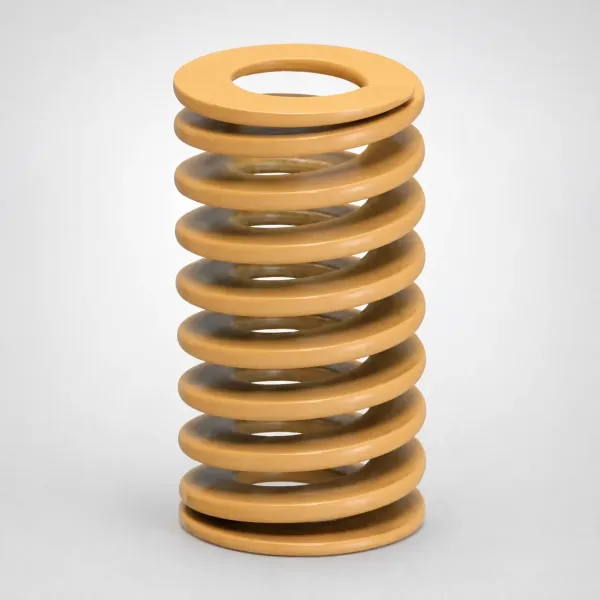
Coil Springs
Die springs (ISO 10243 color-coded) and round wire springs for standard stamping applications. Chrome silicon alloy.
View Products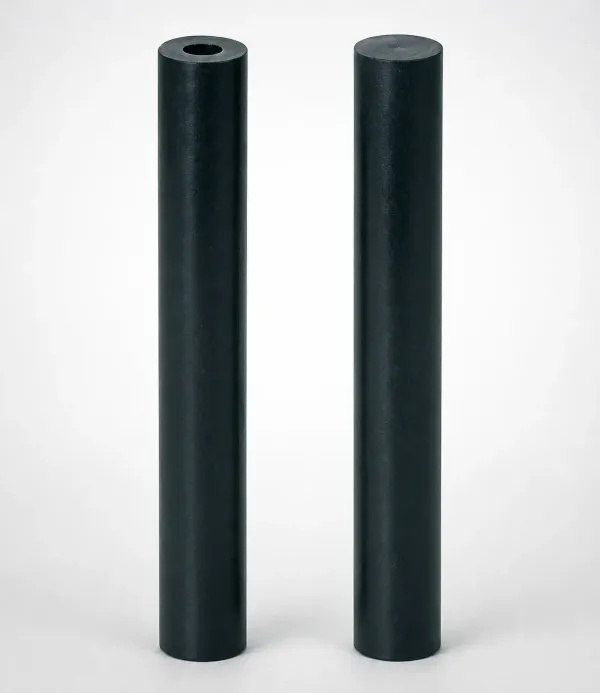
Urethane Springs
High load density polyurethane springs in round, square, and sheet forms. Shore A70–A90 hardness grades.
View Products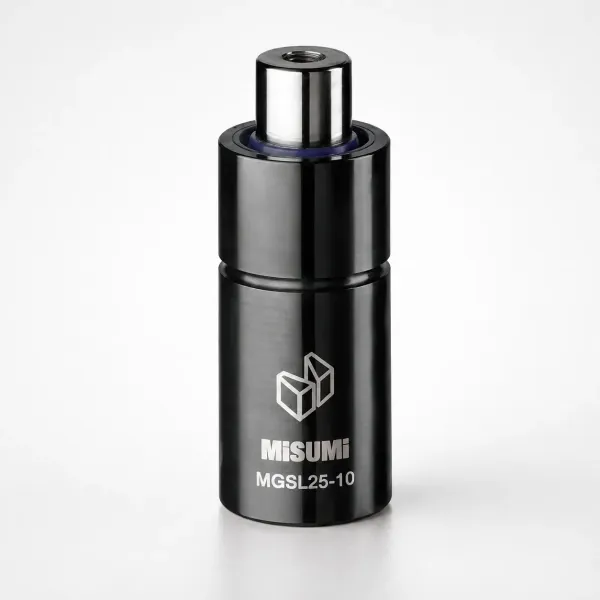
Gas Springs
Nitrogen gas springs with near-constant force output. ISO 11901 compliant. Includes mounting plates and brackets.
View ProductsWhich Spring Type Do You Need?
Select the spring type that matches your stamping application and operating conditions.
Standard Stamping — Stripping, Blanking & Pressure Pads
Your die requires predictable, repeatable spring force for standard stripping or blank-holding operations with cylindrical spring pockets.
High Load in Tight Spaces — Compact Dies & Corrosive Environments
You need maximum force in minimum space, or your stamping process involves oil, coolant, or chemicals that corrode metal springs.
Constant Force & Long Stroke — Deep Drawing & Precision Forming
Your operation demands near-constant force throughout the stroke with ≤8% variation, or requires force fine-tuning via nitrogen pressure adjustment.
Light Duty Cushioning — Buffers, Guides & General Elastic Return
You need general-purpose compression or extension springs for cushioning, guide return, or light stripping with high deflection tolerance (up to 75%).
Selection rule: Start with die springs for standard stamping — they cover 80%+ of applications with standardized ISO 10243 load classes. Upgrade to urethane when space or corrosion demands it; upgrade to gas springs when force consistency or adjustability is critical. For a detailed comparison, see our How to Choose the Right Spring Type for Your Stamping Die.
Three Spring Technologies Compared
Understanding the fundamental working principles helps you match the right spring technology to your stamping requirements.
Mechanical Energy Storage — Coil Springs
Coil springs store energy through elastic deformation of chrome silicon alloy wire (SWOSC-V, HRC 48-52). Force increases linearly with compression: F = k × x (Hooke's Law). Die springs use rectangular wire cross-sections to maximize load capacity within a given envelope, while round wire springs use circular cross-sections for higher deflection tolerance. ISO 10243 standardizes load classes via a color code system — green (lightest) through yellow (heaviest) — enabling interchangeable sourcing across brands.
Elastomer Compression — Urethane Springs
Urethane springs resist compression through bulk deformation of polyurethane elastomer (Shore A70–A90). The force-displacement relationship is nonlinear — initial stiffness is lower, then rises progressively. This gives urethane springs 3-5× higher load density per unit volume compared to metal springs. Key advantages: no fragmentation (eliminating die damage from broken spring debris), inherent corrosion resistance, and vibration damping. Maximum operating temperature is approximately 80°C.
Gas Compression — Nitrogen Gas Springs
Gas springs use compressed nitrogen in a sealed cylinder to generate force. The gas follows a near-isothermal compression process, producing a near-constant force curve with ≤8% variation across the full stroke. This is the critical differentiator: while coil springs see 30-50% force increase from free length to full compression, gas springs maintain virtually flat force output. Initial charging pressure is adjustable (in the GSU series), enabling force fine-tuning without changing the spring body. ISO 11901 standardizes dimensions and performance.
Engineering note: The force curve shape is the most important factor in spring type selection. Linear (coil), progressive (urethane), or constant (gas) — each curve optimizes different forming operations. For a deeper dive, see our How Nitrogen Gas Springs Work — Engineering Principles for Die Design.
Solve a Spring Problem
Experiencing spring failures or performance issues? Find the root cause and recommended solution:
| Problem | Likely Cause | Recommended Solution |
|---|---|---|
| Spring breaks before expected life | Exceeding maximum deflection rate; bore clearance too tight (<1mm) | Move up one load class (e.g., blue → red); verify bore-to-OD clearance ≥1mm |
| Force output decreases over time | Fatigue relaxation after 500K+ cycles; operating temperature exceeds rating | Switch to chrome silicon heat-resistant springs; shorten replacement intervals |
| Uneven strip or part ejection | Spring forces not balanced; free lengths inconsistent across stations | Replace with gas springs (constant force); verify all spring pre-loads match |
| Broken spring fragments jam die | Metal spring fractures produce loose debris inside the die | Add spring cages/guards; or switch to urethane springs (zero fragmentation) |
| Insufficient force in available space | Spring pocket too small for required metal spring size | Switch to urethane springs (3-5× load density) or compact gas springs |
| Spring corrodes in wet stamping | Coolant, oil, or moisture degrading metal spring surface | Replace with urethane springs (inherently chemical-resistant) |
Prevention rule: 80% of premature spring failures are caused by exceeding the maximum deflection rate. Always select one color class above the calculated minimum to maintain the 20% safety margin recommended by ISO 10243. For detailed failure analysis, see our Why Die Springs Break — Root Causes and Prevention Strategies.
About Our Press Die Springs
We supply the full spectrum of press die springs — from ISO 10243 color-coded die springs in chrome silicon alloy to precision-cast polyurethane elastomers and ISO 11901 nitrogen gas springs. Our range spans four major brands (MISUMI, DANLY IEM, Lamina, LEMPCO), covering both JIS metric and Inch standards. All springs are available from stock with MOQ 1 piece, enabling rapid prototyping and production tooling with the same supplier.
Spring Product Capabilities
| Coil Spring Load Classes | Extra Light → Extra Heavy Duty (ISO 10243 color-coded) |
| Coil Spring Material | Chrome Silicon (SWOSC-V), Music Wire |
| Urethane Hardness Range | Shore A70, A90, Porous Foam |
| Gas Spring Force Range | 150 N – 95,000 N (body Ø10 – Ø63) |
| Gas Spring Standards | ISO 11901, Global Standard, JIS |
| Available Brands | MISUMI, DANLY IEM, Lamina, LEMPCO |
| Minimum Order Quantity | 1 piece |
Springs Across Industries
Application scenarios by industry vertical
Automotive Stamping
High-volume progressive dies for body panels, brackets, and structural reinforcements require predictable spring force over millions of cycles.
Why it fits: ISO 10243 die springs provide standardized load classes with fatigue life exceeding 1M cycles; gas springs eliminate force variation across long blanking strokes.
Electrical & Connector Stamping
Precision progressive dies for terminals, contacts, and connectors demand consistent stripping force to prevent part deformation on delicate features.
Why it fits: Light-duty die springs and round wire springs provide gentle, repeatable stripping force; urethane springs add vibration damping for high-speed presses.
Heavy Plate & Deep Drawing
Thick-gauge stamping and deep drawing operations require extreme force with uniform distribution to prevent wrinkles and tears.
Why it fits: Gas springs deliver constant force over long strokes (≤8% variation), eliminating the progressive force increase that causes tearing in deep draws. Compact gas springs replace multiple die springs in space-constrained dies.
Frequently Asked Questions
Engineering Resources
How to Choose the Right Spring Type for Your Stamping Die
Systematic selection guide covering coil, urethane, and gas spring types for press die applications.
Why Die Springs Break — Root Causes and Prevention Strategies
Five root causes of premature spring failure and engineering strategies to extend service life.
How Nitrogen Gas Springs Work — Engineering Principles for Die Design
Force curve characteristics, charging pressure theory, and integration into stamping die designs.
Case Studies
How a Progressive Die Shop Cut Spring Costs 48% by Switching to Gas Springs
3-year TCO analysis comparing die springs vs nitrogen gas springs in high-volume production.
Why an Automotive Stamper Replaced Metal Springs with Urethane for Wet Stamping
Eliminating corrosion-related spring failures in coolant-rich stamping environments.
Frequently Asked Questions
What types of springs are used in press die tooling?+
How do I choose between coil springs, urethane springs, and gas springs for my stamping die?+
What causes die springs to break prematurely, and how can I prevent it?+
How does operating temperature affect spring type selection in press dies?+
What is the ISO 10243 color code system for die springs?+
Related Product Categories
Engineering Resources
How to Choose the Right Spring Type for Your Stamping Die
Systematic selection guide covering coil, urethane, and gas spring types for press die applications.
Why Die Springs Break — Root Causes and Prevention Strategies
Five root causes of premature spring failure and engineering strategies to extend service life.
How Nitrogen Gas Springs Work — Engineering Principles for Die Design
Force curve characteristics, charging pressure theory, and integration into stamping die designs.
Case Studies
How a Progressive Die Shop Cut Spring Costs 48% by Switching to Gas Springs
3-year TCO analysis comparing die springs vs nitrogen gas springs in high-volume production.
Why an Automotive Stamper Replaced Metal Springs with Urethane for Wet Stamping
Eliminating corrosion-related spring failures in coolant-rich stamping environments.
Need a Custom Quote?
Send your specifications — spring type, load class, dimensions, and quantity — and receive a quote. We carry die springs, urethane springs, and gas springs from MISUMI, DANLY, Lamina, and LEMPCO.