Nitrogen Gas Springs for Press Dies
Near-constant force output with ≤8% variation across the full stroke. ISO 11901 compliant nitrogen gas springs for blanking, deep drawing, and precision forming. Standard, mini, compact, and high-load series.
Gas Spring Categories

Gas Springs — Cylinders & Mounting Hardware
Complete range of nitrogen gas spring bodies and mounting plates/brackets. 13+ series from Ø10 mini to Ø63 standard.
View Products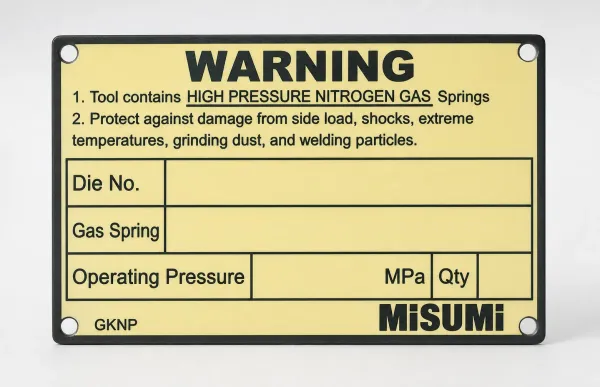
Gas Spring Accessories
Name plates and identification components for gas spring assemblies. Safety labeling and tracking.
View ProductsHow to Select Your Gas Spring Series
With 13+ gas spring series available, follow this decision tree to narrow down to the right model:
Standard die plates
→ Continue to Step 2
Selection rule: For new die designs without a specific standard requirement, start with the GSV (Global Standard) series — it offers the broadest size range and deepest stock availability. For a detailed series-by-series comparison, see our How to Select the Right Nitrogen Gas Spring Series for Press Dies.
Gas Spring Mounting Hardware Guide
Every gas spring needs mounting hardware. Select the installation method that matches your die plate design:
GSX, GSV, GSK, GST, GSSC, GSU
Vertical installation from below — easiest access for recharging and maintenance
All standard-diameter series
Quick-change mounting via groove engagement — ideal for dies requiring frequent spring removal
Horizontal force direction needed
Convert vertical gas spring to horizontal force application — for cam units and side-acting dies
Pairing rule: Bottom mount plates are the default choice for vertical installations. Switch to groove-mount brackets when you need tool-free spring removal for maintenance. For side-acting applications, horizontal plates are required. For detailed mounting selection, see our How to Select Mounting Hardware for Nitrogen Gas Springs.
Gas Springs vs Die Springs — Is the Upgrade Worth It?
Gas springs cost 5-10× more per unit than die springs. Here's when the investment pays off:
| Dimension | Die Springs (Baseline) | Gas Springs (Upgrade) |
|---|---|---|
| Unit cost | $5–30 per spring | $80–300 per cylinder |
| Force consistency across stroke | ±15–25% variation | ±5–8% variation (near-constant) |
| Part quality impact | Force variation → dimensional inconsistency | Constant force → consistent part dimensions |
| Maintenance interval | 50K–200K cycles (full replacement) | 1M–2M cycles (recharge only) |
| Annual cost (8-spring die, 1M cycles/yr) | ~$480/year (4 replacements) | ~$150/year (0.5 recharges) |
| 3-year TCO | $1,440 + scrap costs | $750 (including initial purchase) |
Cost rule: Gas springs are justified when annual stroke count exceeds 500K OR when force consistency directly affects part quality (deep drawing, precision forming). For a detailed ROI calculator framework, see our Gas Springs vs Die Springs — Cost Comparison and ROI Analysis.
About Nitrogen Gas Springs
Nitrogen gas springs use compressed nitrogen in sealed cylinders to deliver near-constant force output with ≤8% variation across the full stroke — a critical advantage over die springs for precision forming, deep drawing, and blanking operations. Our range includes 13+ MISUMI series spanning Ø10 mini to Ø63 standard diameters, plus a complete selection of mounting plates and brackets for vertical, horizontal, and groove-mount installations. All standard-size series comply with ISO 11901.
Application Scenarios
Deep Drawing & Precision Forming
Deep drawing operations require constant blank-holding force to prevent wrinkles without causing material tears or thinning.
Why gas springs fit: Near-constant force curve (≤8% variation) maintains uniform blank-holding pressure throughout the full draw depth. Die springs increase force 30-50% over the stroke, causing thinning at the bottom of deep draws.
Compact Dies with Space Constraints
Small dies where multiple die springs cannot fit in the available plate space, but significant holding force is still needed.
Why gas springs fit: A single GSP compact gas spring can replace 4-8 die springs while delivering equivalent or greater total force. This frees plate space for other tooling features.
Frequently Asked Questions
Engineering Resources
How to Select the Right Nitrogen Gas Spring Series for Press Dies
Step-by-step guide to choosing among 13+ gas spring series based on diameter, standard, and features.
Gas Springs vs Die Springs — Cost Comparison and ROI Analysis
3-year TCO comparison and ROI breakeven analysis for gas spring upgrade decisions.
Frequently Asked Questions
How do I select the right gas spring series for my press die application?+
Which mounting plates and brackets are compatible with my gas spring?+
Are gas springs worth the higher initial cost compared to die springs?+
How do I calculate the required gas spring force for my stamping operation?+
What maintenance does a nitrogen gas spring require?+
Engineering Resources
How to Select the Right Nitrogen Gas Spring Series for Press Dies
Step-by-step guide to choosing among 13+ gas spring series based on diameter, standard, and features.
Gas Springs vs Die Springs — Cost Comparison and ROI Analysis
3-year TCO comparison and ROI breakeven analysis for gas spring upgrade decisions.
Need a Custom Quote?
Specify your gas spring series, body diameter, stroke length, required force, and mounting method. Our engineers can help size gas springs for your specific die design.