Urethane Springs for Press Dies
High load density polyurethane springs for stamping, blanking, and stripping. Available in round, square, and sheet forms with Shore A70–A90 hardness grades. Zero fragmentation, inherent corrosion resistance.
Urethane Spring Categories
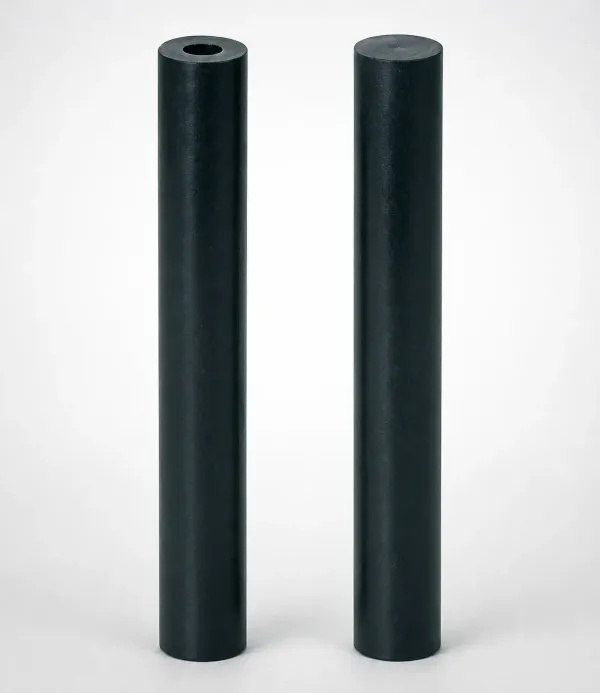
Urethane Springs — Round Type
Cylindrical urethane springs in heavy duty, economy, and low repulsion grades. Solid, through-hole, and counterbore options.
View Products
Urethane Springs — Square Type & Die Blocks
Square urethane blocks and pads for flat-surface cushioning. Metal top plates available for heavy load distribution.
View Products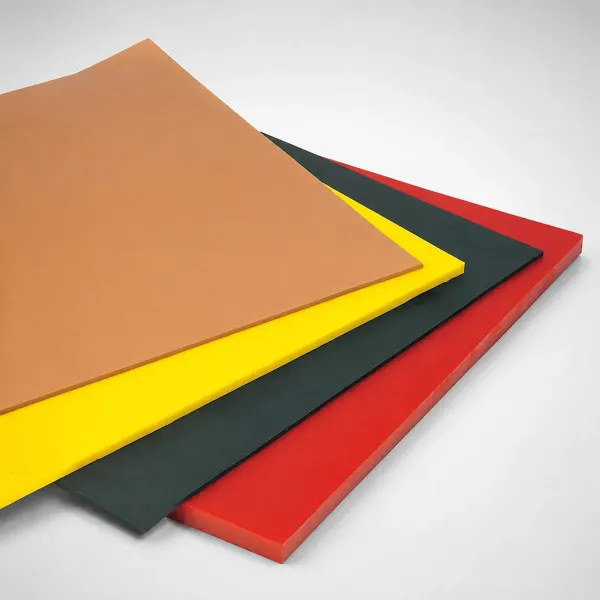
Urethane Sheets & Strip Stock
Flat urethane sheets for custom-cut cushion pads. Standard and low repulsion grades. Thickness selectable or configurable.
View ProductsRound vs Square vs Sheet — Which Shape?
Choose the urethane form factor that matches your die pocket geometry and application requirements.
| Criteria | Round | Square / Block | Sheet |
|---|---|---|---|
| Shape | Cylindrical (with/without through hole) | Rectangular block or pad | Flat plate (custom cut) |
| Installation | Standard spring bore (drop-in replacement for metal springs) | Flat surface under stripper plate | Cut to shape, adhered or placed |
| Sizing | OD × ID × Length (standard or configurable) | L × W × H (standard sizes) | T × L × W (selectable or configurable) |
| Best For | Replacing metal die springs in existing bores | Wide-area flat cushioning, non-circular pockets | Custom shapes, non-standard die layouts |
| Product Count | 26 products | 6 products | 5 products |
Selection rule: Round urethane springs are the most versatile — they fit standard cylindrical spring pockets and serve as direct drop-in replacements for metal die springs. Choose square blocks when your die has flat, non-circular pockets. Choose sheets when no standard shape fits your design. For hardness selection details, see our How to Select Urethane Spring Hardness — Shore A70 vs A90 for Die Applications.
Which Urethane Grade Do You Need?
Urethane springs come in multiple performance grades. Follow this decision tree to narrow down your selection:
Load > 50 kgf/cm², heavy blanking
→ Heavy Duty (Shore A90)
EX, A, E, AX, AZ, C/LA series
Standard die applications
→ Economy
AE, LAE, CEX series
Delicate parts, light stripping
→ Low Repulsion (Shore A70)
AN, ANX, AZN, AZNX series
Cushioning, shock absorption
→ Porous Foam
PA, PLA series
→ EX, AE, ANX series
→ A, E, AN series
→ AZ, AZN series
→ AX, EL, AEX, AZNX series
Decision rule: Heavy Duty Shore A90 covers 80% of stamping die applications. Choose Economy grade for cost-sensitive tooling with moderate force requirements. Low Repulsion is specifically designed for delicate electronics and cosmetic parts. For metal spring replacement guidance, see our When to Switch from Metal Die Springs to Urethane Springs.
Are Urethane Springs the Right Choice?
✅ You're in the right place if:
- You need higher load capacity than metal springs in the same space (3-5× load density)
- Spring fragmentation risk is unacceptable (zero break debris)
- Operating environment involves oil, coolant, or chemicals
- You want vibration damping combined with spring return force
- Operating temperature stays below 80°C
🔄 Consider switching to:
- Coil Springs (Die Springs) — if you need precise, standardized ISO 10243 load-deflection curves, or operating temperature exceeds 80°C
- Gas Springs — if you need constant force throughout the stroke (urethane force increases progressively), or if required force exceeds urethane capacity
About Urethane Springs
Polyurethane springs deliver 3-5× the load density of metal springs with zero fragmentation risk — making them ideal for compact dies, corrosive environments, and safety-critical applications. Our range includes MISUMI heavy duty, economy, and low repulsion series, plus DANLY Formathane and Lamina Marshmellow grades. Available in round, square/block, and sheet formats.
Application Scenarios
Wet Stamping & Chemical Environments
Stamping operations using oil, coolant, or chemical lubricants that corrode metal springs.
Why urethane fits: Polyurethane is inherently resistant to oils, greases, and most industrial chemicals. No surface treatment needed — the base material itself is corrosion-proof.
Precision Electronics Stamping
Stamping delicate connector terminals and thin-gauge metal parts where aggressive stripping force causes part deformation.
Why urethane fits: Low Repulsion grade (Shore A70) provides gentle, progressive force buildup without the sharp initial impact of metal springs. Built-in vibration damping reduces high-frequency bounce.
Frequently Asked Questions
Engineering Resources
How to Select Urethane Spring Hardness — Shore A70 vs A90 for Die Applications
Decision framework for choosing the right urethane hardness grade for your stamping application.
When to Switch from Metal Die Springs to Urethane Springs
Replacement criteria, temperature limits, and load density comparison for metal-to-urethane migration.
Frequently Asked Questions
What Shore hardness should I choose for urethane springs — A70, A90, or porous foam?+
What is the difference between round, square, and sheet urethane springs?+
Can urethane springs replace metal die springs in my existing tooling?+
How long do urethane springs last compared to metal coil springs?+
Engineering Resources
How to Select Urethane Spring Hardness — Shore A70 vs A90 for Die Applications
Decision framework for choosing the right urethane hardness grade for your stamping application.
When to Switch from Metal Die Springs to Urethane Springs
Replacement criteria, temperature limits, and load density comparison for metal-to-urethane migration.
Need a Custom Quote?
Specify your urethane spring shape (round/square/sheet), Shore hardness (A70/A90), dimensions, and configuration (solid/through-hole/counterbore). Custom lengths available on configurable series.