Ejector Pins
Ejector Pin Categories
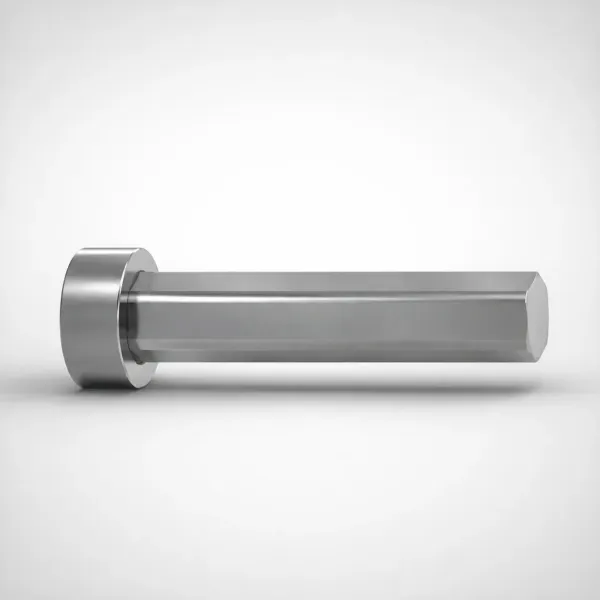
Straight Ejector Pins
The most widely used type. Uniform round cross-section. Available with tip processing, gas release venting, and character engraving. M2, H13, 440C steels.
View 50 Products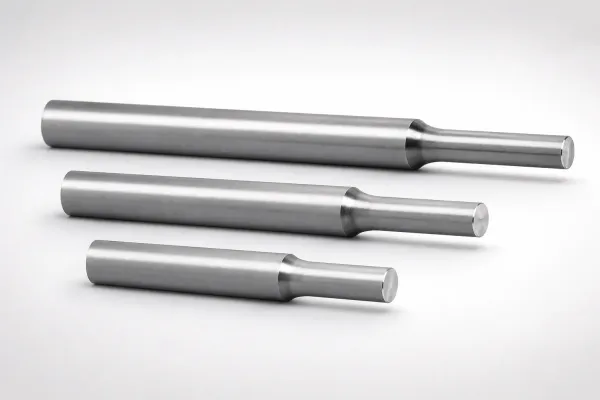
Stepped Ejector Pins
One-step and two-step diameter transitions. Including taperless versions with gas venting for fast maintenance and simplified plate machining.
View 32 Products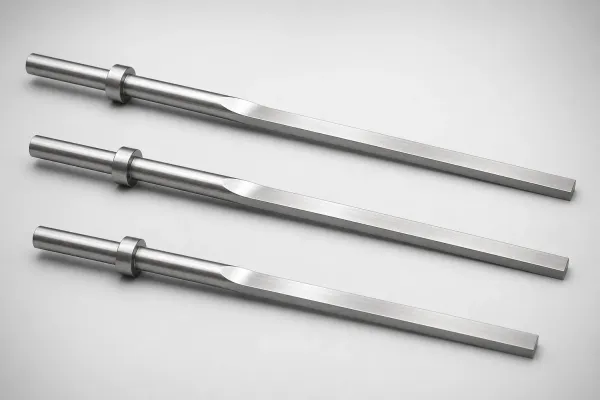
Free Flange-Position Ejector Pins
Adjustable head (flange) position for non-standard plate thicknesses. Available in straight, stepped, and blade cross-sections.
View 6 ProductsEjector Blades
Flat/rectangular cross-section for ejecting thin ribs, narrow slots, and features too narrow for round pins. D-type and rectangular shank variants.
View 39 Products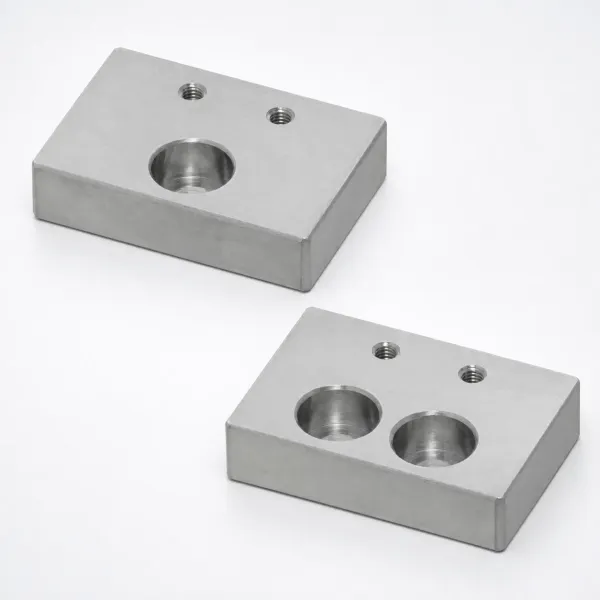
Air-Jet Valves
Pneumatic ejection for parts where mechanical contact is unacceptable — thin films, optical parts, and highly polished surfaces.
View 2 Products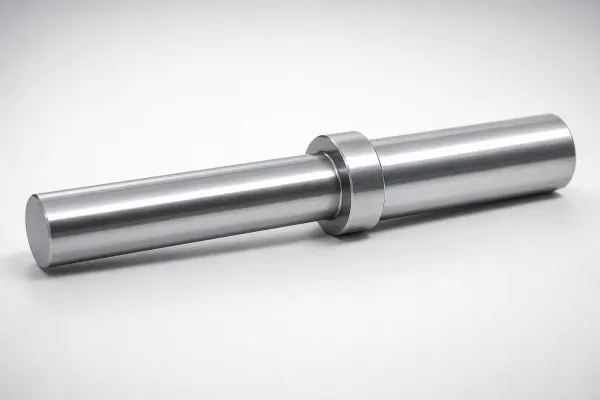
Pusher Pins
Spring-loaded pins for specialized ejector block applications requiring push-back return force.
View 1 Product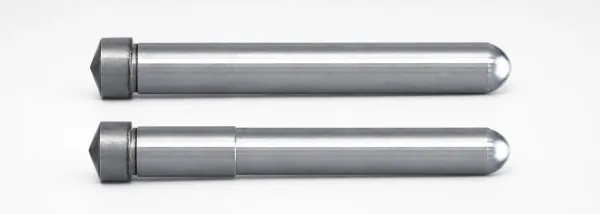
Pins for Ejector Block
Dedicated pins for ejector plate assembly and alignment in multi-plate mold systems.
View 1 ProductHow to Choose the Right Ejector Pin Type
Ejector pin selection starts with matching the cross-section shape and geometry to your part's ejection requirements, then choosing the right material and features.
Step 1: Select Cross-Section Type
| Selection Criteria | Straight (Round) | Stepped (Round) | Ejector Blade (Flat) | Air-Jet (Pneumatic) |
|---|---|---|---|---|
| Cross-Section | Uniform round | Multi-diameter round | Rectangular / D-shaped | No contact (air) |
| Best For | ~85% of standard parts | Multi-level features, counterbores | Thin ribs, narrow slots, long edges | Optical, thin film, no-mark surfaces |
| Ejection Area | πr² (circular) | πr² (larger head area) | W × L (rectangular, spread) | Distributed air pressure |
| Minimum Feature Width | ø1.0 mm | ø1.5 mm (head) | 1.2 × 3.0 mm | N/A |
| Pin Mark Visibility | Circular witness mark | Circular (larger area) | Rectangular mark (less visible on ribs) | No mark |
| Cost Level | $ | $$ | $$ | $$$ |
Rule of thumb: Start with Straight Ejector Pins — they cover the broadest range of standard injection molding. Switch to Ejector Blades when the ejection surface is too narrow for a round pin. Use Air-Jet Valves only when zero contact marks are mandatory. For a complete walkthrough, see our Ejector Pin Selection Guide.
Solve an Ejection Problem
Not sure which ejector pin you need? Find the solution based on the problem you're experiencing:
| Problem | Likely Cause | Recommended Solution |
|---|---|---|
| Visible ejector pin marks on part surface | Excessive ejection force concentrated on small pin tip area | Ejector Blades (distribute force) or add more pins |
| Burn marks / diesel marks on molded part | Trapped air has no escape path — compresses and ignites | Gas Release Ejector Pins |
| Ejector pin breakage before expected life | Material or geometry mismatch with stress conditions | Stepped Ejector Pins + H13 nitrided material |
| Excessive downtime during pin replacement | Taper fitting requires precision alignment each time | Taperless Ejector Pins (straight bore, drop-in) |
| Part sticking in cavity despite ejection force | Insufficient ejection area or vacuum lock | Air-Jet Valves (break vacuum) + additional pins |
| Missing date codes / cavity numbers on parts | No marking mechanism on the forming surface | Engraved Ejector Pins |
| Thin rib distortion during ejection | Round pin concentrates force on too-narrow feature | Ejector Blades (match rib width) |
Selection rule: Match the problem to the root cause, then click the recommended solution. For a deeper analysis of burn marks, pin marks, and breakage, see our Ejector Pin Marks: Causes, Prevention & Solutions.
Ejector Pin vs Other Ejection Methods
Ejector pins are one of several ejection methods. Confirm you're in the right product category:
✅ Ejector pins are the right choice if:
- The part has discrete push-point ejection surfaces (bosses, ribs, flat areas)
- Ejection force can be distributed across multiple pin locations
- Small circular or rectangular witness marks on the B-surface are acceptable
- The part does not require zero-contact ejection (optical/film parts)
🔄 Consider switching to:
- Ejecting a tubular feature (boss) with circumferential force? → Ejector Sleeves
- Need zero witness marks on thin-wall containers or caps? → Stripper Plates
- No mechanical contact allowed (optical lenses, thin films)? → Air-Jet Valves
- Part has undercuts or internal threads? → Hydraulic Lifters / Slide Mechanisms
Decision rule: If the part can tolerate small witness marks and has flat or ribbed B-surfaces, ejector pins are the most cost-effective solution. For a detailed comparison of all ejection methods, see our Understanding Mold Ejection Systems.
About Ejector Pins
Ejector pins are hardened steel rods installed in the mold's moving half (B-side) that push the cooled plastic part out of the mold cavity at the end of each molding cycle. They are actuated by the ejector plate system, which is driven by the molding machine's ejector stroke — typically hydraulic or mechanical.
Ejection Force Calculation: The required ejection force depends on the projected area of the part, the coefficient of friction between the resin and the mold surface, and the shrinkage-induced grip force. A general formula is: Fej = μ × Aproj × Pshrink, where μ is the friction coefficient (0.3–0.5 for unfilled resins, 0.5–0.8 for glass-filled), Aproj is the total contact area, and Pshrink is the shrinkage-induced pressure.
Pin Sizing Rule: Each ejector pin should withstand a compressive stress not exceeding 80% of its yield strength. For SKH51/M2 HSS (HRC 60-62), the allowable compressive stress is approximately 2,000 MPa. For nitrided SKD61/H13 (surface case 65–72 HRC / HV 950–1100, core 38–42 HRC for bending resilience), allowable compressive stress is ~1,400 MPa. This determines the minimum pin diameter for a given ejection force.
Applications by Industry
Automotive Interior Parts
Dashboard panels, door handles, and console components require ejection from deep-draw molds with tight surface finish requirements. Pin marks must be on non-visible B-surfaces only.
Why ejector pins fit: Straight pins handle 80% of automotive interior parts. Gas release pins solve trapped-air burns in deep ribs. Stepped pins address multi-level mounting boss features.
Recommended: H13 nitrided straight pins (heat resistance) + ejector blades for reinforcement ribs
Consumer Electronics Housings
Phone cases, laptop shells, and speaker enclosures with thin walls (0.8–1.5 mm), tight tolerances, and often textured surfaces. Ejection must not distort thin sections.
Why ejector pins fit: Ejector blades distribute force along thin walls. Free flange-position pins accommodate non-standard plate stacks in compact molds.
Recommended: M2 ejector blades (rigidity at small cross-sections) + TiCN coating for textured surfaces
Medical Device Components
Syringe barrels, IV connectors, and diagnostic housings require zero contamination, corrosion-resistant tooling, and full traceability (cavity marking).
Why ejector pins fit: 440C stainless steel pins resist corrosion from medical-grade resins. Engraved pins provide cavity-level traceability required by FDA 21 CFR Part 820.
Recommended: 440C stainless pins + engraved pins for cavity ID
Frequently Asked Questions
What is an ejector pin in injection molding?+
Ejector pin vs ejector sleeve vs stripper plate?+
What materials are ejector pins made of?+
How to prevent ejector pin marks?+
What is the standard ejector pin head thickness?+
Engineering Resources
How to Choose the Right Ejector Pin for Your Mold Design
Systematic selection from part geometry → cross-section type → material grade → features.
Ejector Pin Marks: Causes, Prevention, and Solutions
6 root causes of ejector pin marks and corresponding design + process solutions.
Understanding Mold Ejection Systems: Engineer's Guide
Ejection force calculation, system design, and component selection.
Need a Custom Quote?
Send your specifications — material, dimensions, quantity — and receive a quote. MOQ: 1 piece. Custom dimensions available.