Ejector Blades
Flat/rectangular cross-section ejector pins designed for thin ribs, narrow slots, and long edge features where round pins cannot fit. 39 product series across 6 variants including D-type, rectangular shank, gas release, and engraved options.
Ejector Blade Types
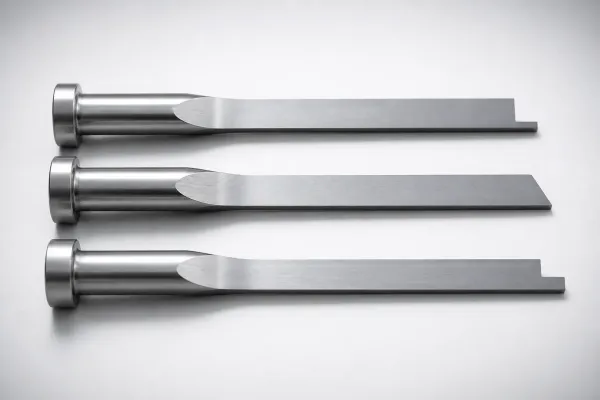
Without Tip Processing
Standard rectangular blades with as-ground tip. The base product in multiple sizes and materials. 27 series.
View Products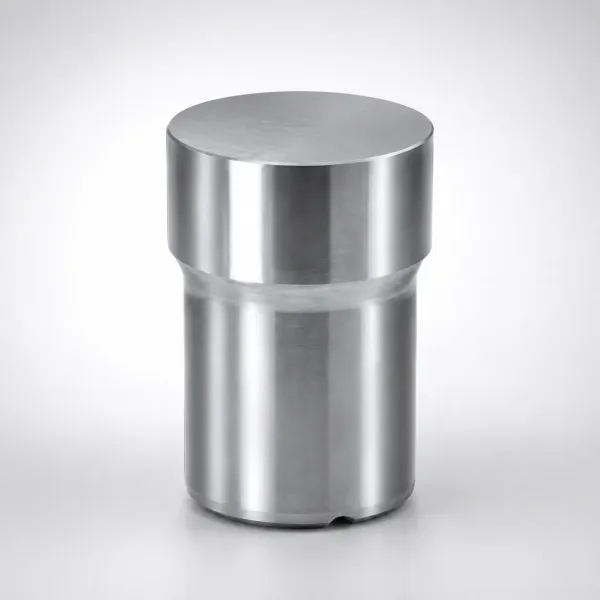
Gas Release Rectangular
Rectangular blades with built-in venting channels for trapped air escape during injection. 2 series.
View ProductsWith Tip Processing
Pre-machined tip profiles — angle cuts, chamfers, and compound surfaces. 3 series.
View Products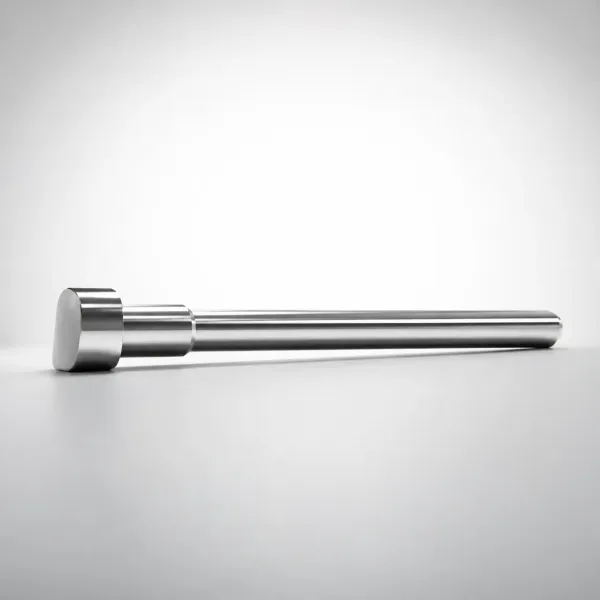
D-Type Blades
D-shaped cross-section that fits into a round bore with flat ground — no rectangular bore machining required. 1 series.
View Products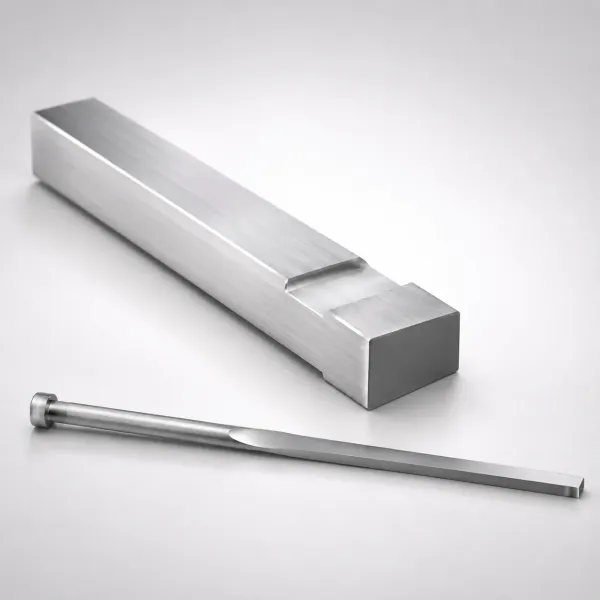
Rectangular Shank
Full rectangular shank (not round) that prevents blade rotation in the plate bore. 2 series.
View Products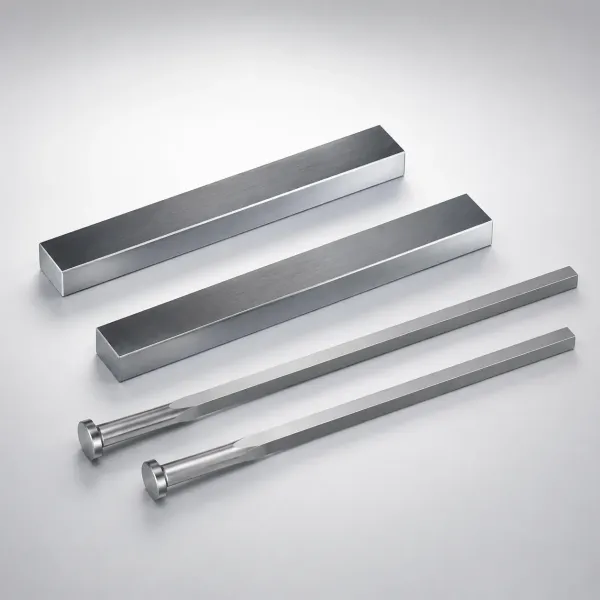
With Engraving
Date code and cavity number engraving on the blade ejection face. 4 series.
View ProductsBlade Cross-Section Selection
| Property | Standard Rectangular | D-Type | Rectangular Shank |
|---|---|---|---|
| Cross-Section | Full rectangular (W × T) | D-shaped (flat + curved) | Rectangular blade + rectangular shank |
| Plate Bore | Rectangular wire-EDM bore | Round bore + flat ground | Rectangular bore (full length) |
| Anti-Rotation | Rectangular bore prevents rotation | Flat on round bore prevents rotation | Rectangular shank prevents rotation |
| Machining Effort | Medium (wire-EDM) | Low (round bore + flat) | High (full rectangular bore) |
| Ejection Area | W × T (maximum) | ~70% of equivalent round bore | W × T (maximum) |
| Best For | Most rib/slot ejection | Quick installation, round bore molds | Maximum anti-rotation, high-force |
Selection rule: Standard rectangular blades cover most applications. Choose D-type when you want to use existing round bores without wire-EDM. Choose rectangular shank for high-force applications where absolute anti-rotation is critical. For a detailed comparison, see our D-Type vs Standard Rectangular Ejector Blades: Complete Guide.
Which Feature Do You Need?
Answer two questions to find the right blade feature for your application.
What is the primary functional requirement beyond basic blade ejection?
Selection tip: Start with standard Without Tip Processing blades. Upgrade to Gas Release only if burn marks appear in narrow rib cavities. For a detailed anti-rotation guide, see our Ejector Blade vs Round Ejector Pin: Selection Guide.
When Do You Need a Blade vs Round Pin?
Not every thin feature requires a blade. Use this boundary check:
✅ Use an ejector blade if:
- The ejection feature is a narrow rib, slot, or long edge less than 2.0mm wide
- You need to distribute ejection force along a thin wall to prevent deformation
- A line-shaped witness mark is preferred over a circular one (less visible on ribs)
- The rib width is ≥1.2mm (minimum for blade clearance)
🔄 Use a round ejector pin instead if:
- The ejection surface is circular, square, or wider than 2.0mm
- A round point-load witness mark is acceptable
- Rib width is <1.2mm → consider air ejection instead
Minimum rib width rule: The blade must be at least 0.2mm narrower than the rib. Practical minimum blade thickness is 1.0mm, so minimum rib width for blade ejection is 1.2mm. Below this, consider air ejection. For a detailed bending analysis, see our Bending Resistance of Ejector Blades: Engineering Analysis.
About Ejector Blades
Bending Resistance: The key advantage of rectangular cross-sections over round: for the same cross-sectional area, a rectangle oriented with its width along the rib provides higher section modulus (resistance to bending) in the direction of ejection force. The section modulus of a rectangle is W = bh²/6, compared to W = πd³/32 for a circle.
Example: A 3.0 × 1.5mm blade has W = 3.0 × 1.5²/6 = 1.125 mm³ in the weak axis. An equivalent-area round pin (ø2.39mm) has W = π × 2.39³/32 = 1.34 mm³. However, the blade's width aligns with the rib, providing support exactly where needed — the round pin's circular mark would extend beyond the rib edges.
Anti-Rotation: Blades must not rotate in the bore, or the rectangular ejection face will not align with the rib. Anti-rotation is achieved by: (1) rectangular bore (standard and rectangular shank), (2) flat ground on round bore (D-type), or (3) keyway slot. The D-type solution is the simplest to machine.
Application Scenarios
Thin-Wall Electronics Housings
Laptop shells, phone cases, and speaker grilles with walls 0.8–1.5mm and internal reinforcement ribs as narrow as 0.5mm.
Why blades fit: Distribute ejection force along the full rib length, preventing rib deformation. Line-shaped witness marks are less visible on narrow ribs than circular pin marks.
Recommended: M2 standard blades, h7 tolerance, TiCN coated for textured surfaces
Automotive Ventilation Grilles
HVAC outlet grilles with dozens of parallel fins, each 1.0–2.0mm wide and 15–25mm deep.
Why blades fit: Each fin needs individual ejection support that matches its rectangular cross-section. Round pins would either not fit or leave marks extending beyond fin edges.
Recommended: Standard rectangular blades matched to fin width, H13 for high-temp PP
Frequently Asked Questions
When should I use an ejector blade instead of a round pin?+
D-type vs standard rectangular blade?+
How to prevent blade bending?+
Minimum rib width for blade ejection?+
Engineering Resources
Ejector Blade vs Round Pin: Selection Guide
When to switch from round to flat, with minimum rib width calculations.
Bending Resistance of Ejector Blades
Section modulus analysis: rectangular vs D-type vs round.
D-Type vs Rectangular Ejector Blades
Installation, force, and machining comparison.
Need a Custom Quote?
Specify blade width, thickness, length, and cross-section type — we'll quote within 1 business day.