Free Flange-Position Ejector Pins
Adjustable-head ejector pins where the flange position is not fixed — set it to any location along the shaft to match non-standard plate thicknesses. Available in straight, stepped, and blade cross-sections. 6 product series.
Free Flange Variants
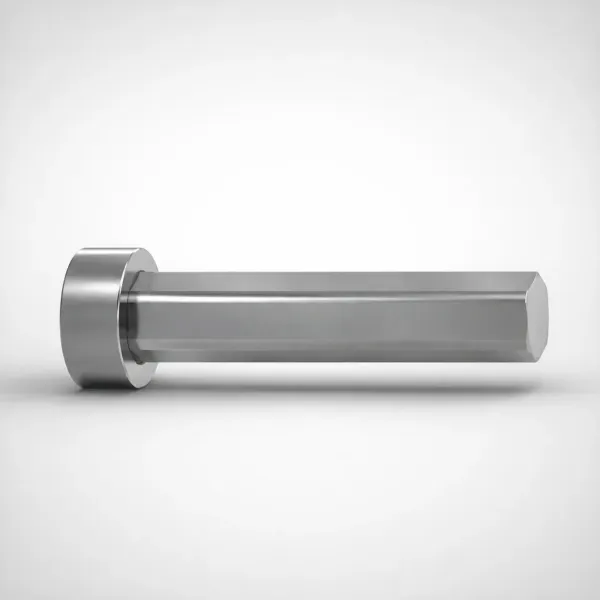
Straight Free Flange
Uniform round cross-section with adjustable head position. 3 series.
View Products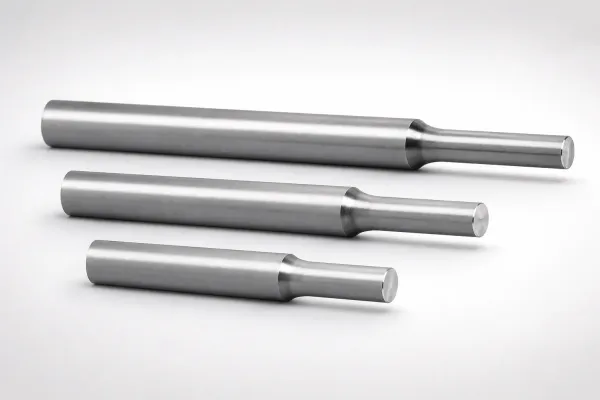
Stepped Free Flange
Stepped diameter with adjustable head. For multi-level cavities in non-standard molds. 2 series.
View Products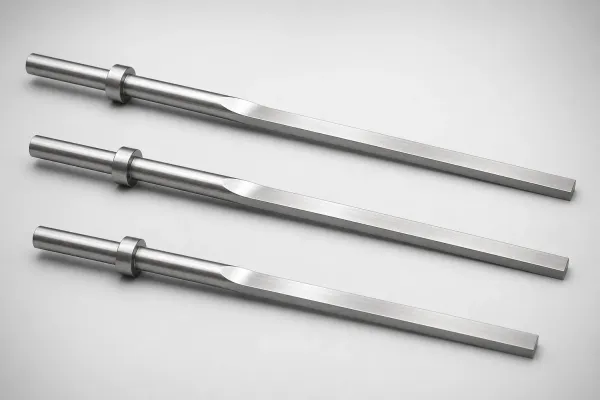
Blade Free Flange
Rectangular cross-section with adjustable head. For narrow ribs in non-standard molds. 1 series.
View ProductsVariant Selection
| Property | Straight | Stepped | Blade |
|---|---|---|---|
| Cross-Section | Round, uniform | Round, stepped | Rectangular |
| Ejection Feature | Round areas, general | Multi-level bores | Narrow ribs, slots |
| Availability | 3 series | 2 series | 1 series |
Selection rule: Choose the cross-section shape that matches your ejection feature (round for most, stepped for multi-level bores, blade for narrow ribs), then use the adjustable flange to match the non-standard plate. For more detail, see our Free Flange-Position Ejector Pins: When Standard Pins Won't Work.
Do You Need Free Flange-Position?
Free-flange is a specialty product. In most cases, standard fixed-head pins will work:
✅ Free-flange is the right choice if:
- The ejector retainer plate has non-standard thickness that doesn't match JIS or DIN head specifications
- You are repairing or retrofitting a mold where the original plate specifications are unknown or changed
- The mold is a prototype where plate dimensions may change during development
- Multiple pins need different head positions within the same ejector plate
🔄 Use standard fixed-head pins instead if:
- Plate thickness matches standard JIS (T=4mm) or DIN (T=3.2mm) specifications
- This is a new mold build where you can specify the plate to match the pin head
- Budget is tight and the $3-8 per-pin premium is not justified
Decision rule: If you're unsure whether you need free-flange, measure the actual plate stack-up. If it matches JIS or DIN, use standard pins. If not, free-flange saves you from re-machining. For a detailed analysis, see our Free Flange-Position: When Standard Pins Won't Work.
Cost-Benefit Analysis
| Option | Per-Pin Cost | Additional Labor | Risk |
|---|---|---|---|
| Re-machine plate + standard pins | $5–12 | $200–500 (toolroom) | Plate damage risk |
| Free flange pins (drop-in) | $8–20 | $0 | None |
Break-even rule: If you need more than 3–4 pins with non-standard head positions, free-flange is always cheaper than re-machining the plate. For a full ROI calculation, see our Cost-Benefit Analysis: Free-Flange vs Re-Machining Mold Plates.
Application Scenarios
Legacy Mold Repair
Repairing or upgrading molds with unknown or non-standard plate specifications, where original documentation is unavailable.
Why free-flange fits: Measure the actual plate stack-up and set the flange position to match. No need to reverse-engineer the original pin specifications.
Recommended: Straight free-flange, M2 steel
Rapid Prototyping Molds
Development molds where plate dimensions may change during design iterations.
Why free-flange fits: Adjust head position after plate modifications without ordering new pins each time.
Recommended: Straight or blade free-flange based on feature geometry
Frequently Asked Questions
What is a free flange-position ejector pin?+
When should I use free-flange vs standard?+
Cost difference?+
Engineering Resources
Need a Custom Quote?
Specify cross-section type, diameter, length, and target flange position — we'll quote within 1 business day.