Stepped Ejector Pins
Round cross-section ejector pins with one or two diameter transitions along the shaft. For ejecting parts with multi-level internal features, counterbores, and stepped cavities. 32 product series including taperless variants with gas venting.
Stepped Ejector Pin Types
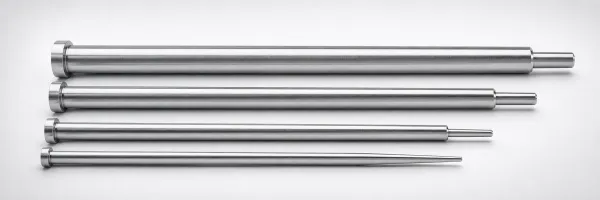
One Step Ejector Pins
Single diameter transition (head → shaft). The standard stepped pin — covers 90% of multi-diameter ejection needs. 17 series.
View Products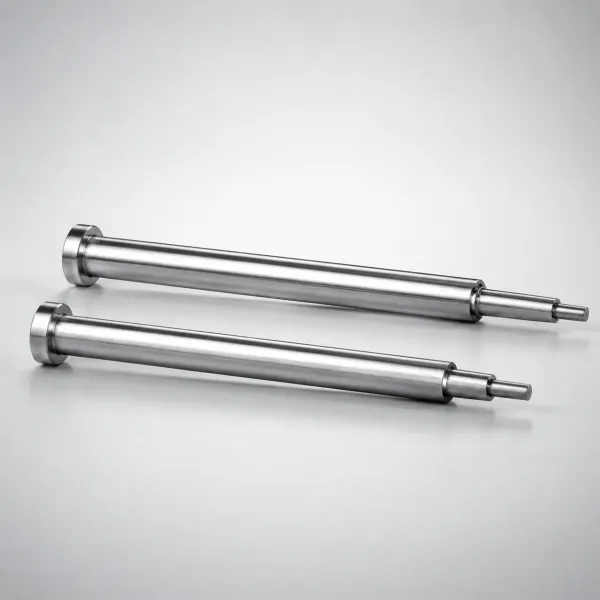
Two Step Ejector Pins
Dual diameter transitions (head → middle → shaft). For complex multi-level cavities with two stacked bore diameters. 1 series.
View Products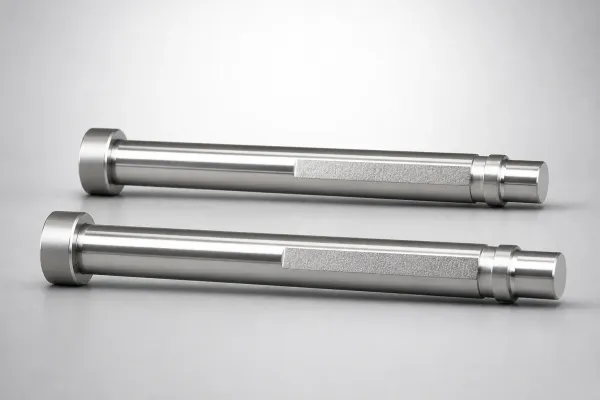
Taperless One-Step with Gas Vent
Precision cylindrical shank (no taper) + built-in gas venting. Simplified plate machining, drop-in replacement, fast maintenance. 12 series.
View Products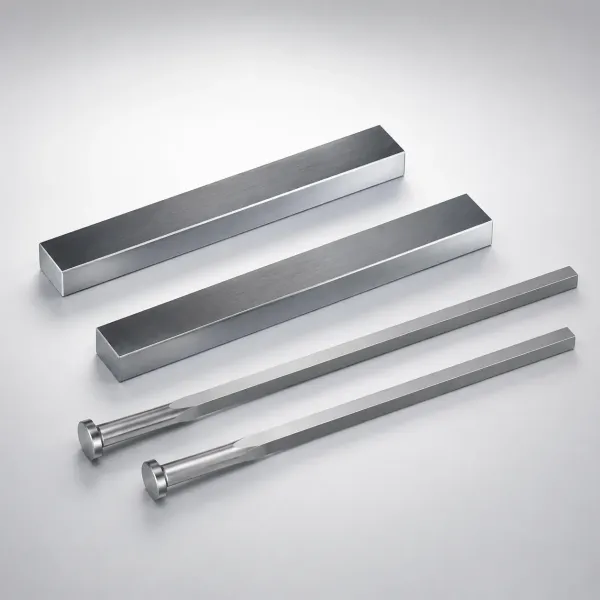
With Engraving
Stepped ejector pins with date code or cavity number marking on the ejection face. 2 series.
View ProductsWhich Stepped Pin Do You Need?
| Feature | One Step | Two Step | Taperless + Gas Vent |
|---|---|---|---|
| Diameter Sections | 2 (head + shaft) | 3 (head + middle + shaft) | 2 (head + shaft, cylindrical) |
| Plate Bore | Standard taper bore | Standard taper bore | Simple straight bore (no taper reaming) |
| Pin Replacement | Must match taper angle | Must match taper angle | Any same-diameter pin (universal) |
| Gas Venting | No (separate gas release optional) | No | Yes — built-in vent channels |
| Setup Time per Bore | ~30 min (taper reaming) | ~45 min (2 bores) | ~15 min (straight bore only) |
| Best For | Standard multi-level ejection | Complex 3-diameter cavities | High-cavity molds, fast maintenance |
| Product Count | 17 series | 1 series | 12 series |
Selection rule: Use one-step for standard multi-diameter cavities. Use taperless when maintenance speed is a priority (high-cavity molds). Two-step is a specialty product for 3-diameter internal features. For a detailed comparison, see our One-Step vs Two-Step Ejector Pins: When to Use Each.
Taperless ROI Analysis
Taperless pins cost 10-20% more per pin, but the labor savings in plate machining and maintenance often deliver ROI within 3 months:
| Cost Factor | Standard Stepped | Taperless | Savings |
|---|---|---|---|
| Pin unit cost | $8–15 | $10–18 | -$2–3 (higher) |
| Plate bore machining (per bore) | 30 min (taper reaming) | 15 min (straight bore) | +15 min saved |
| Pin replacement labor | 10 min (match taper) | 3 min (drop-in) | +7 min saved |
| 32-cavity mold setup total | ~16 hours | ~8 hours | +8 hours saved |
| Annual maintenance (4× per year) | ~8 hours | ~2 hours | +6 hours saved |
Break-even rule: For a 32-cavity mold, taperless setup saves ~8 hours ($400–800 in labor). The per-pin premium is ~$96 total ($3 × 32). ROI payback occurs at the first maintenance cycle. For a full ROI worksheet, see our Taperless vs Standard Stepped Ejector Pins: ROI Analysis.
How Stepped Ejector Pins Work
Mechanical Advantage: The stepped geometry allows the ejection face (larger diameter) to push on a larger area of the molded part, while the shaft (smaller diameter) passes through a smaller bore in the mold plate. This is essential when the part has a multi-diameter internal feature — the pin profile must match the cavity contour to avoid leaving marks on non-ejection surfaces.
Transition Radius: The step transition should have a fillet radius of R0.2–R0.5mm to avoid stress concentration. Sharp corners at the diameter change are the #1 root cause of stepped pin breakage. The fillet does not affect ejection function since it sits below the plate bore transition.
Concentricity: The head and shaft centerlines must be concentric within TIR 0.01mm. Off-center steps cause uneven loading, accelerated wear, and potential bore galling.
Application Scenarios
Multi-Level Connector Housings
Automotive and industrial connectors with stepped internal bores for pin contacts at different depths.
Why stepped pins fit: One-step pins match the connector's two-diameter bore profile, ejecting from the wider bore face while passing through the narrow bore section.
Recommended: One-step M2 pins, h6 tolerance on both diameters
High-Cavity Packaging Molds
64-128 cavity molds for caps, closures, and containers where maintenance speed directly impacts production uptime.
Why taperless fits: Drop-in replacement cuts per-pin change from 10 min to 3 min. On a 64-cavity mold, that's 7.5 hours saved per maintenance cycle.
Recommended: Taperless one-step with gas vent, H13 nitrided
Frequently Asked Questions
When do I need a stepped pin instead of straight?+
One-step vs two-step?+
What is taperless and when should I use it?+
Engineering Resources
Taperless vs Standard Stepped EP: ROI Analysis
Full cost-benefit with labor savings data by cavity count.
One-Step vs Two-Step Ejector Pins
Geometry, installation, and application selection guide.
How Stepped EP Solve Complex Ejection
Multi-diameter force analysis and design rules.
Need a Custom Quote?
Specify head diameter, shaft diameter, length, and material — we'll quote within 1 business day.