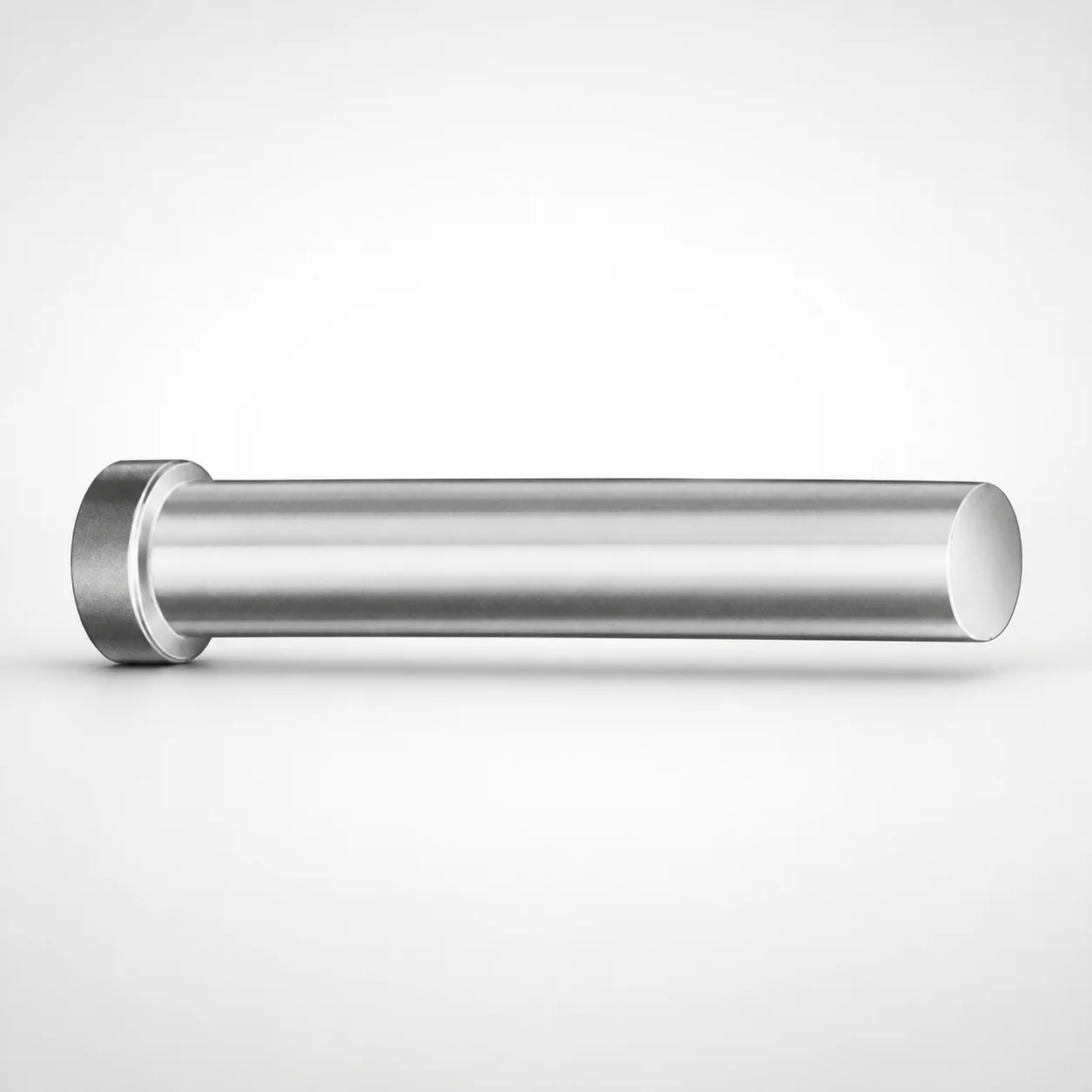
Straight Regular Punches Metric XCN Coating
Straight Regular Punches Metric (XCN coating) are designed for reliable punching in production tooling, helping minimize wear and maintain cutting performance over repeat cycles.
- Standard straight punch geometry supports stable alignment in the press
- XCN coating enhances surface durability for extended service life
- Length and P dimension options support different die set layouts
- Used in fabrication and stamping dies where consistent punch action is required
Specifications
1 configurations available
| L (Length) (mm) | P Dimension (mm) |
|---|---|
| 50 ~ 100 | 3 ~ 16 |
Product Guide
Application Scenarios+
These straight punches with XCN coating are used in injection mold tooling when stable, repeatable shearing or punching actions are needed in insert frames, tryout tooling, and production die sets. Their straight regular geometry helps maintain alignment through the press stroke, which supports consistent cutting engagement and reduces the risk of edge chipping during high-cycle runs.
- Fabrication and stamping/blanking dies: Ideal for punching sheet or strip features where a straight punch must deliver uniform penetration across repeated cycles.
- Multi-cavity die inserts: The available P dimension (3–16 mm) supports common die set layouts and helps engineers map punch location and clearance strategy to each cavity.
- Production tooling requiring longer service life: The XCN-coated surface improves wear resistance at the working interface, supporting more consistent cutting performance.
Select this variant when you need dimensional fit to the cavity/core layout (available L = 50–100 mm) and when coating-enhanced durability helps stabilize tool life under steady production loads.
Material & Process Details+
The provided data specifies this product as a straight regular metric punch with XCN coating, but it does not list a steel grade or post-heat-treatment condition. As a result, exact baseline hardness (HRC) and specific alloy equivalency (e.g., SKD61/H13) cannot be confirmed from the supplied specifications.
From an engineering standpoint, the key material-related differentiator here is the XCN coating, which is typically chosen to improve surface durability and wear resistance at the punch/work contact. That usually leads to a favorable tool-life/edge-stability trade-off under repeated punching, especially when abrasive wear and micro-surface damage become dominant.
- Coating effect: Enhances resistance to wear and helps maintain cutting performance over repeat cycles.
- Trade-off: Coatings can be more sensitive to edge damage from misalignment; therefore, geometry stability and correct fit are critical.
For precise hardness and heat-treatment targets, request the steel and coating spec sheet for series 250301354239.
Sizing & Selection Guide+
To select the correct punch size, match the punch length L (50–100 mm) and P dimension (3–16 mm) to your die set stack-up and punch guidance geometry. In practice, L must provide sufficient working engagement while allowing clearance for holder length, stop surfaces, and safe stroke depth.
- Match L to die height: Use the required protrusion and the press stroke rules to ensure the punch reaches the intended cutting depth without bottoming out.
- Set P dimension to layout: Choose the P value (3–16 mm) that fits the cavity/core and die block arrangement, supporting consistent punch positioning in the tooling.
- Consider fit and tolerance: Confirm functional clearances between punch and die opening in your drawings; misfit or misalignment can accelerate edge wear, especially for coated punches.
All listed dimensions here are fixed ranges by the series: you select specific values within L = 50–100 mm and P = 3–16 mm. If your layout requires a non-standard step, verify compatibility with your die insert design before finalizing.
Frequently Asked Questions
How do I choose the right L (50–100 mm) for my punch holder and press stroke depth?+
Use the required engagement depth and your die set stack-up to determine the minimum working length you need, then select a value within L = 50–100 mm. Ensure the punch has clearance to avoid bottoming at full stroke and that holder/protrusion requirements are met. If your tool uses a stop system, verify the length against the stop position in your press sequence.
What does the P dimension (3–16 mm) control, and how does it affect die layout?+
The series provides P dimension options from 3 to 16 mm, intended to support different die set layouts. In sizing, you select P to match your cavity/core geometry and punch location strategy so the punch enters the die opening with the intended alignment. Always cross-check P against your block spacing and any guiding features in the tool.
Why select the XCN-coated variant for punching applications—what wear behavior should improve?+
This product is specified as a straight regular punch with XCN coating, designed to enhance surface durability for consistent punching. The coating is intended to improve wear resistance at the punch/work interface, which helps maintain cutting performance over repeat cycles. For coated tools, alignment and fit are especially important to prevent edge damage that can reduce coating effectiveness.
Is there enough information here to confirm the steel grade and hardness (HRC) for the punch?+
No. The provided specifications list the coating (XCN) and the fixed dimension ranges (L = 50–100 mm, P = 3–16 mm), but they do not specify the steel grade or hardness. To confirm hardness in HRC and heat-treatment state, request the material/heat-treatment documentation for series 250301354239.
Can these straight regular punches be used across multiple die inserts, or are they layout-specific?+
They are layout-flexible within the available sizing ranges because the selection is based on L (50–100 mm) and P (3–16 mm). The standard straight geometry supports stable alignment in the press, which helps compatibility across multiple insert designs that share similar stack-up and guidance conditions. However, each die must still verify clearance and alignment to the specific die opening and cavity/core arrangement.
Related Products
Need Custom Specifications?
Our engineering team can help with custom configurations, material selection, and volume pricing.