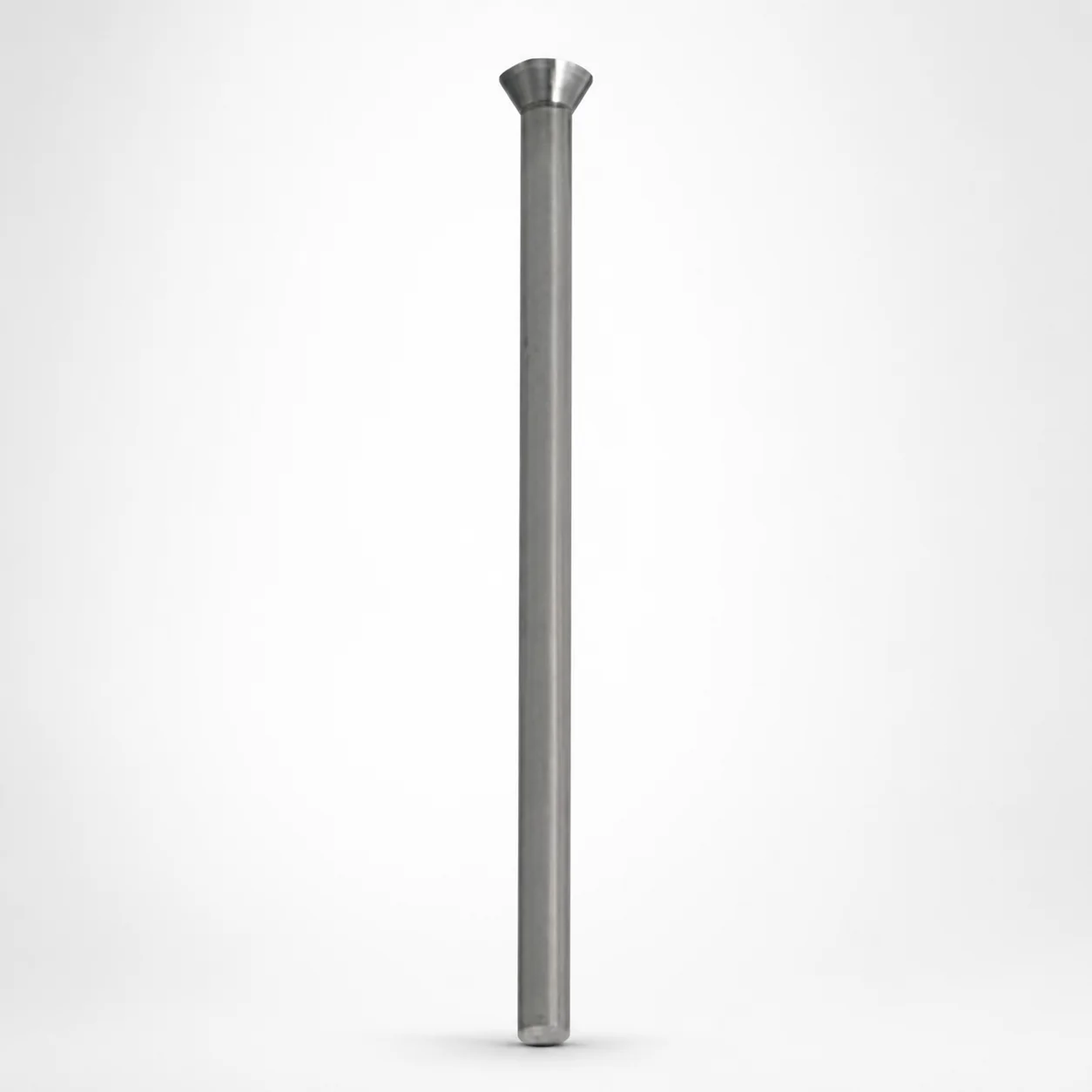
JIS Standard SKH51 Steel Straight Punches Flat Head
Straight Punches Flat Head (SKH51 steel) are made for accurate blanking and piercing, using a straight shank for stable guidance and repeatable positioning in die applications.
- Flat-head punch style with SH fixed type supports consistent forming in die sets.
- SKH51 (equivalent M2) hardened steel construction improves wear resistance for production runs.
- Precision manufacturing helps maintain repeatable engagement for reliable blanking quality.
- Designed for close-clearance tooling and typical punching operations in manufacturing dies.
Specifications
42 configurations available
| P (Tip dimension) (mm) | L (L dimension) (mm) | LC (Full length alteration) (mm) | type |
|---|---|---|---|
| 1.0 | 25 ~ 50 | - | - |
| 1.0 | - | 25 ~ 50 | - |
| 1.1 | 25 ~ 50 | - | - |
| 1.1 | - | 25 ~ 50 | - |
| 1.2 | 25 ~ 50 | - | - |
| 1.2 | - | 25 ~ 50 | - |
| 1.3 | 25 ~ 50 | - | - |
| 1.3 | - | 25 ~ 50 | - |
| 1.4 | 25 ~ 50 | - | - |
| 1.4 | - | 25 ~ 50 | - |
| 1.5 | 25 ~ 50 | - | - |
| 1.5 | - | 25 ~ 50 | - |
| 1.6 | 25 ~ 50 | - | - |
| 1.6 | - | 25 ~ 50 | - |
| 1.7 | 25 ~ 50 | - | - |
| 1.7 | - | 25 ~ 50 | - |
| 1.8 | 25 ~ 50 | - | - |
| 1.8 | - | 25 ~ 50 | - |
| 1.9 | 25 ~ 50 | - | - |
| 1.9 | - | 25 ~ 50 | - |
| 2.0 | 25 ~ 50 | - | - |
| 2.0 | - | 25 ~ 50 | - |
| 2.1 | 25 ~ 50 | - | - |
| 2.1 | - | 25 ~ 50 | - |
| 2.2 | 25 ~ 50 | - | - |
| 2.2 | - | 25 ~ 50 | - |
| 2.3 | 25 ~ 50 | - | - |
| 2.3 | - | 25 ~ 50 | - |
| 2.4 | 25 ~ 50 | - | - |
| 2.4 | - | 25 ~ 50 | - |
| 2.5 | 25 ~ 50 | - | - |
| 2.5 | - | 25 ~ 50 | - |
| 2.6 | 25 ~ 50 | - | - |
| 2.6 | - | 25 ~ 50 | - |
| 2.7 | 25 ~ 50 | - | - |
| 2.7 | - | 25 ~ 50 | - |
| 2.8 | 25 ~ 50 | - | - |
| 2.8 | - | 25 ~ 50 | - |
| 2.9 | 25 ~ 50 | - | - |
| 2.9 | - | 25 ~ 50 | - |
| 3.0 | 25 ~ 50 | - | - |
| 3.0 | - | 25 ~ 50 | - |
Product Guide
Application Scenarios+
Straight punches with flat head are used inside progressive or transfer die sets to drive consistent blanking and piercing. The flat-head tip geometry helps distribute forming load during each stroke, supporting stable penetration when the punch works with matching die openings.
- Automotive and appliance stamping: ideal for repeated steel or sheet-metal operations where straight shank guidance improves alignment and helps maintain consistent hole size across production cycles.
- Electronics and connector housings: suited for making precise locating features (tabs, mounting holes, and small openings) in thin gauge parts, where close clearance tooling benefits dimensional repeatability.
- General manufacturing dies: the fixed head type supports predictable engagement, reducing variation in piercing quality under cyclic loads.
This SKH51-based variant is well-suited for these applications because it is a hardened wear-resistant tool steel (JIS SKH51, described as equivalent to M2) that can better tolerate abrasive wear during high-frequency punching.
Material & Process Details+
JIS Standard SKH51 steel is specified for this punch. It is commonly regarded as an AISI M2 equivalent, targeting high hot-hardness for tooling and strong resistance to abrasive wear in metal forming operations.
- Hardness / wear vs. toughness: hardened tool steel like SKH51 is selected to maximize edge retention during blanking and piercing; this typically trades off some impact toughness compared with lower-alloy, softer steels.
- Heat treatment state: the tool is provided in a hardened steel construction suitable for production runs, which helps resist wear at the punch tip under repeated cycles.
- Manufacturing process: typically produced via precision machining of the straight shank and tip, followed by heat treatment to achieve the working hardness and stable dimensional performance.
If you compare alternatives, higher toughness steels may reduce chipping risk but often sacrifice wear life at the cutting edge—making SKH51 favorable where maintaining tip sharpness is critical.
Sizing & Selection Guide+
Select dimensions to ensure correct projection and engagement between the punch and mating die opening in the die set. This series provides a variable tip dimension P (1–3 mm) and fixed L (25–50 mm) plus LC (25–50 mm), which should be chosen to match your cavity/core layout and required working stroke geometry.
- Match the piercing/blanking feature size: set P according to the desired tip profile and the required hole/channel dimensions in the punched part.
- Confirm alignment and guidance length: use L (25–50 mm) to ensure sufficient straight-shank engagement within the guide components, improving repeatable positioning.
- Verify full length alteration (LC): choose LC (25–50 mm) to align with your die set spacing, holder stack-up, and clearance strategy.
Because the series includes fixed ranges for L and LC, keep tooling drawings consistent with the die’s cavity/core thickness and the required clearance. Follow your supplier’s standard tolerance for punch-to-die clearance to prevent edge chipping or burr formation.
Frequently Asked Questions
How should I choose the tip dimension P (1–3 mm) for piercing vs. blanking in a straight punch die set?+
Use P (1–3 mm) to match the required cutting profile for the punched feature in your part drawing. For piercing, select a P that achieves the target hole size with your die opening clearance strategy. For blanking, align P with the required blank contour and ensure the mating die opening geometry is compatible to minimize burrs and edge wear.
What do the fixed lengths L (25–50 mm) and LC (25–50 mm) mean for punch guidance and die stack-up?+
L (25–50 mm) provides the straight shank working length used for guidance inside the die/holder system. LC (25–50 mm) corresponds to the full length alteration dimension, which affects how the punch fits within the overall die stack-up and spacing. Confirm both dimensions against your holder height, die thickness, and clearance so the punch engages correctly without excessive protrusion.
Why is JIS SKH51 steel (M2-equivalent) used for straight punch flat-head tools?+
SKH51 is specified as a hardened tool steel and is described as M2-equivalent for improved wear resistance. This helps maintain cutting edge sharpness during production runs of punching and piercing operations. Compared with tougher, softer steels, the hardened SKH51 selection emphasizes wear life at the punch tip, which is critical for dimensional stability.
Is this flat-head straight punch more suitable for close-clearance tooling?+
Yes. The product description targets close-clearance tooling and typical punching operations in manufacturing dies. A straight shank supports stable guidance and repeatable positioning, which is especially valuable when die clearance is tight and dimensional repeatability is required.
What impact does the flat-head style (SH fixed type) have on forming consistency in die sets?+
The flat-head punch style with SH fixed type is intended to provide consistent forming load distribution during each press cycle. This helps reduce variation in piercing/blanking quality when used with corresponding die components. It also supports predictable engagement within the die set, improving repeatability across production cycles.
Related Products
Need Custom Specifications?
Our engineering team can help with custom configurations, material selection, and volume pricing.