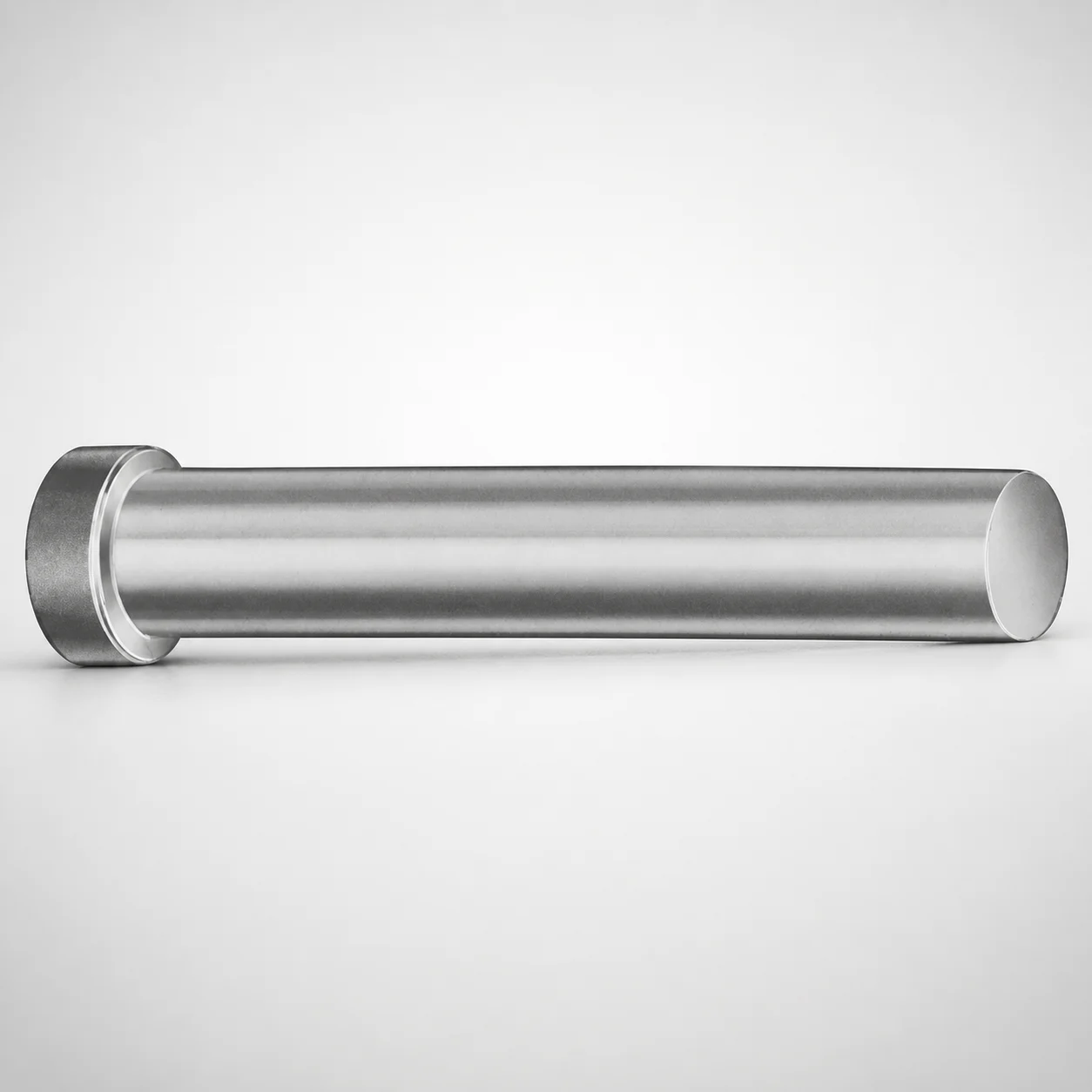
Straight Regular Punches Metric (CRN Coating)
Straight Regular Punches Metric (CRN Coating) are designed for consistent punching performance in die and press applications, combining robust punch geometry with a wear-focused surface treatment. They support reliable material forming cycles and long-term tool stability under production use.
- Straight punch profile for stable alignment in machining and die setups
- CRN coating enhances wear resistance for extended service life
- Optimized build for tight toolwork where repeatable punch stroke matters
- Used in metal forming, stamping, and general production punch operations
Specifications
1 configurations available
| L (Length) (mm) | P Dimension (mm) |
|---|---|
| 50 ~ 100 | 3 ~ 16 |
Product Guide
Application Scenarios+
These straight regular punches are used in injection mold tooling only when your project involves secondary metal forming or insert-making steps for mold components—most commonly for building die sets, strip tooling, and production fixtures. Their straight profile helps maintain stable alignment during repeated punching cycles, which reduces drift-related variations in punched features.
- Automotive and appliance production tooling: use them in press operations that prepare metal parts for downstream assembly. The CRN-coated working surface supports long production runs with improved wear resistance.
- General stamping and die-work inserts: suitable for tooling stations where repeatable punch stroke and consistent hole location are critical. The robust geometry supports stable performance in tighter toolwork setups.
- Precision die-making workshops: helpful when punches must stay dimensionally stable across many cycles; the wear-focused surface treatment reduces the frequency of rework.
With the fixed metric dimensions and CRN coating, this variant is best when you need reliable tool life and predictable alignment in repetitive punching applications.
Material & Process Details+
The provided data specifies this product variant as CRN (chromium nitride) coated, which is selected to enhance wear resistance at the punch’s working face. While the exact steel grade and heat-treatment parameters (such as hardness in HRC, quench & temper, or nitriding) are not included in the input, CRN coatings are typically used to improve sliding/abrasive wear performance during repeated forming cycles.
- Wear resistance vs. toughness trade-off: the coating prioritizes surface durability, helping maintain edge condition under production loads; however, overall impact toughness is still governed by the underlying tool steel and its heat treatment.
- Manufacturing process relevance: punches are generally produced by precision blanking/forging followed by machining to final dimensions, then receiving surface treatment; the CRN coating is applied to protect the contact surfaces.
If you require a specific steel grade (e.g., an equivalent to H13/AISI 420/CR series) or target hardness in HRC, confirm with Axiom Molds using the SKU/series code so we can match your press-load and lifetime requirements.
Sizing & Selection Guide+
Selection is driven by matching the punch’s fixed length (L) and the P dimension to your die and press layout. For this series, L is 50–100 mm and P is 3–16 mm, and these sizes are fixed ranges for ordering—choose values that provide sufficient working depth and clearance in your tool stack.
- Match working depth: use L to ensure the punch maintains engagement through the full stroke without bottoming on die components or violating separation settings.
- Match functional geometry: set P to the required punch-related feature size in your die tooling. Ensure that the corresponding die clearance and guiding conditions are compatible with your press-day tolerance requirements.
- Tool alignment considerations: a straight punch profile supports stable alignment, but you still need correct die support and guide alignment to prevent side loading.
Tolerance information is not provided in the input data. If you have tight fit requirements between punch and die openings, request the dimensional tolerance sheet for the specific ordered L and P values.
Frequently Asked Questions
What does the CRN coating contribute for punching cycles, and how does it affect wear resistance?+
How do I choose the correct punch length L from the available 50–100 mm range?+
What is the meaning of the P dimension (3–16 mm), and how do I match it to the die design?+
Is this punch suitable for metal stamping and die work, and what type of tolerance sensitivity is implied?+
Do I need to specify the underlying tool steel grade and hardness (HRC) for this CRN-coated punch?+
Related Products
Need Custom Specifications?
Our engineering team can help with custom configurations, material selection, and volume pricing.