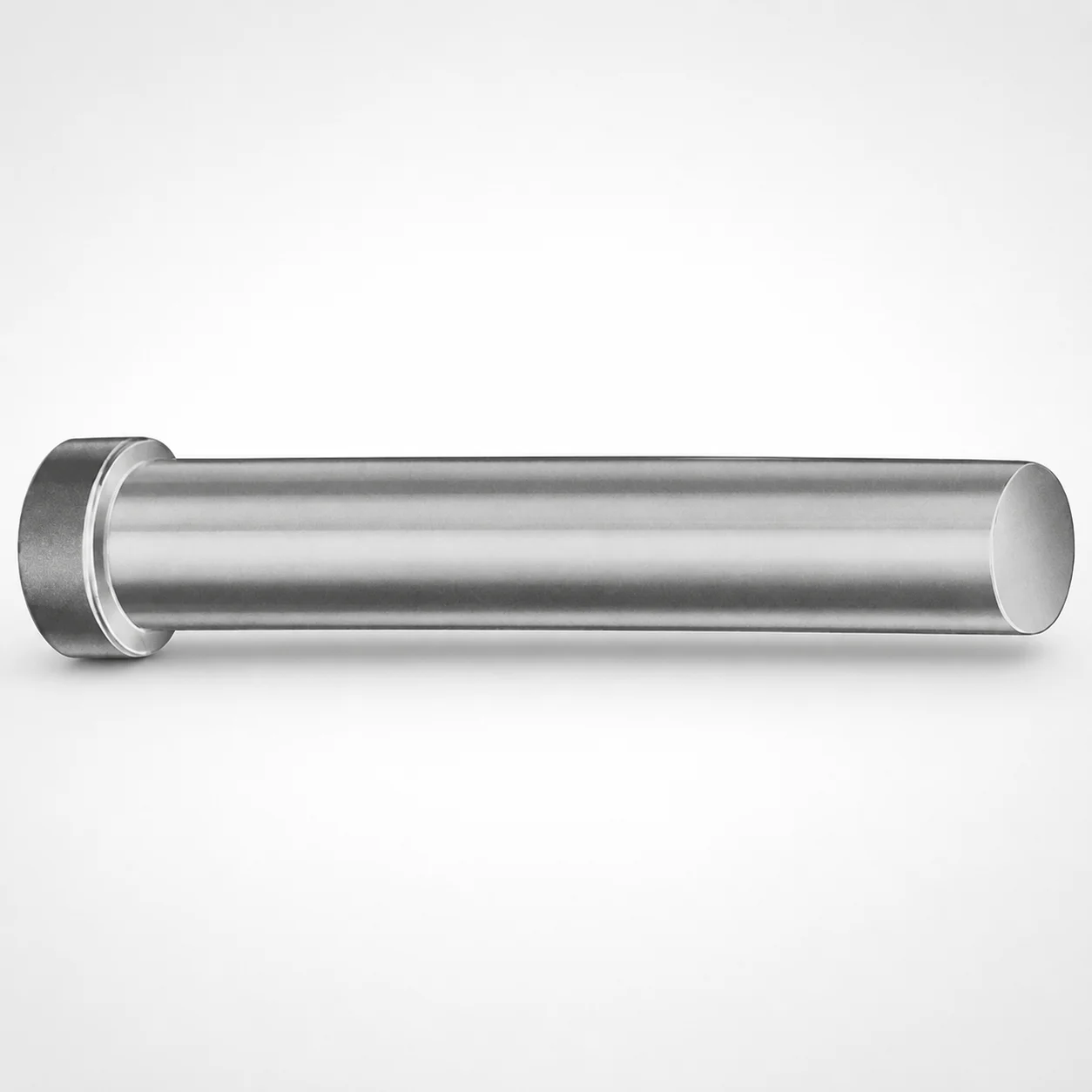
Inch Straight Regular Punches - XVP Coating
Straight regular punches (Inch) (XVP coating) are designed for stable, aligned punch action in progressive dies and tooling. The XVP surface coating supports consistent performance by improving wear and reducing friction during repeated stamping.
- Straight punch geometry for stable guidance and consistent ejection
- XVP coating helps control wear and friction in production
- Inch sizing range supports flexible tool building for varying die heights
- Dayton standardized part number format for faster procurement alignment
Specifications
1 configurations available
| L (Length) (in) | P Dimension (in) |
|---|---|
| 150 ~ 625 | 0.125 ~ 0.375 |
Product Guide
Application Scenarios+
Straight regular punches with an XVP-coated working surface are used in progressive and compound die sets where punch alignment and repeatable ejection are critical. Their straight geometry supports stable guidance through the die station, helping maintain dimensional consistency during high-cycle production.
- Automotive and appliance stamping: Ideal for punching operations that require controlled wear and friction over long runs, such as forming/blanking in layered parts. The XVP coating helps reduce surface scuffing and supports reliable part separation.
- Connector and terminal die sets: Suited for fine, repeatable ejection where punch-to-die motion must remain stable. Inch sizing flexibility supports matching die heights and tooling stack-up variations.
- General manufacturing die tooling: Works well when standardized punch part numbering and consistent performance reduce procurement and rework risk.
Choose this variant when you need dependable punch action in production conditions that demand wear resistance and smooth cycling.
Material & Process Details+
The provided specifications focus on geometry (inches) and the XVP coating rather than a specific steel grade. For these straight regular punches, the coating is the key material/process factor: XVP is applied to improve wear behavior and reduce friction at the punch working surface.
- Coating role: Supports consistent punching and ejection by controlling friction and limiting wear during repeated cycles.
- Heat treatment: Not specified in the available data; select the base steel and heat treatment that your tooling standard requires for the load, impact, and wear level.
- Property trade-off: In die work, higher wear resistance typically comes with reduced toughness if the base material is over-hardened—your heat treat should balance these based on forming forces and stripping requirements.
If you need a specific hardness (HRC) target or a known steel equivalency, confirm the punch body material/heat treatment with your quote request so it matches your die set expectations.
Sizing & Selection Guide+
Use the fixed dimensional parameters to match the punch to the corresponding die cavity/core and bolster clearance in your tooling. This series provides an L (length) of 150 to 625 in and a P dimension of 0.125 to 0.375 in.
- Select length (L): Ensure L covers the required working travel and fully engages the die station stack-up without bottoming, while maintaining alignment through the guide system.
- Select P dimension: Match P to the functional interface requirement for your punch/die layout (e.g., seating/feature dimension in your standard tooling drawing).
- Account for fit/tolerance: Even with correct nominal sizes, allow for manufacturing tolerances and desired clearance between punch and die parts to prevent binding and to support clean ejection.
- Configurable vs fixed: L and P are fixed as selectable ranges in this series; other dimensions are not provided, so rely on your die design standard for remaining features.
When building progressive dies, validate stack height and strip/die clearance so the punch maintains stable guidance throughout the cycle.
Frequently Asked Questions
Which punch dimensions in this series should I match to my die station stack-up?+
This series specifies L (Length) from 150 to 625 in and P from 0.125 to 0.375 in. Match L to the required tool height and engagement depth to avoid bottoming and maintain alignment. Match P to the functional interface dimension called out in your punch/die drawing standard.
How does the XVP coating affect wear and friction in progressive stamping?+
The XVP coating is intended to improve surface wear performance and reduce friction during repeated punch action. In progressive die sets, this supports more consistent cycling and can reduce surface-related issues that contribute to scuffing and unstable ejection. The base steel and heat treatment are not specified in the provided data, so coating benefits should be evaluated alongside your tooling material standard.
What are the selection limits for L and P when ordering these inch straight punches?+
The fixed spec ranges are L = 150–625 in and P = 0.125–0.375 in. Stay within these ranges to ensure compatibility with the series part configuration. If your drawing requires values outside the range, you may need a different series or a custom configuration.
Does this series include material/heat-treatment specs such as steel grade or HRC hardness?+
The available metadata provides coating information (XVP) and geometric ranges (L and P) but does not list a specific steel grade, heat-treatment state, or HRC hardness. To confirm hardness and toughness characteristics for your load case, request the punch material and heat-treatment details with your quote. This ensures the base material meets your die engineering requirements.
How do I avoid binding between punch and die when using XVP-coated straight punches?+
Even with correct nominal sizing, binding risk depends on clearance and tolerance stack-ups. Select the appropriate L so the punch travels/engages as intended, and choose P to match your interface requirement. Use your standard punch-to-die clearance strategy to account for machining tolerances and ensure smooth ejection during high-cycle operation.
Related Products
Need Custom Specifications?
Our engineering team can help with custom configurations, material selection, and volume pricing.