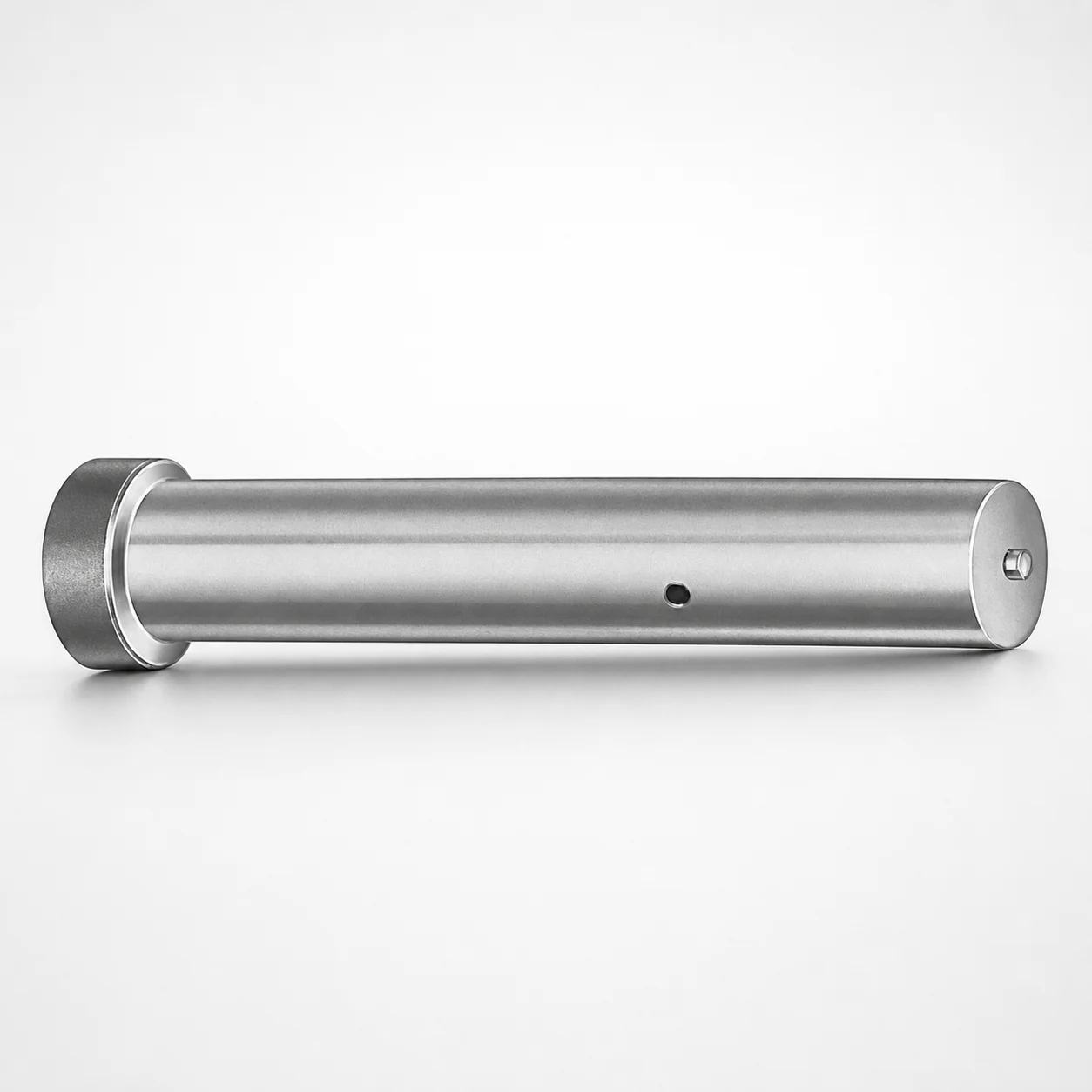
Metric Straight Ejector Punches (XNAD Coating)
Metric Straight Ejector Punches (XNAD Coating) by DAYTON are designed to eject formed parts with stable straight guidance in precision tooling. The XNAD surface coating helps reduce wear and support consistent cycle performance in production dies.
- Straight ejector punch geometry supports controlled part release in die sets
- XNAD coating for improved abrasion resistance during repeated cycles
- Built for metric tooling compatibility with standardized manufacturing dimensions
- Commonly used in punch and forming operations where reliable ejection matters
Specifications
1 configurations available
| L (Length) (mm) | P Dimension (mm) |
|---|---|
| 50 ~ 90 | 5 ~ 16 |
Product Guide
Application Scenarios+
These metric straight ejector punches are used in injection and forming tooling where stable, straight part release is critical. In production die sets, the straight-guided geometry helps maintain alignment during ejection, reducing the risk of scuffing, drag marks, or uneven release on thin or precision features.
- Precision die casting and punch applications: The XNAD surface coating is intended to improve wear resistance under repeated contact cycles, supporting consistent ejection force and longer service life.
- Punch-and-form tooling for formed components: Use when the part requires controlled removal from the die cavity with minimal lateral movement.
- Metric tooling compatibility: The fixed metric dimensions support easier fit into standard die bases and ejector systems designed around metric layouts.
With length options in the 50–90 mm range and P dimension coverage from 5–16 mm, this variant suits mold designs needing reliable straight guidance and abrasion-resistant surfaces during high-cycle operation.
Material & Process Details+
The provided specification focuses on the geometry and XNAD coating performance characteristics rather than a specific base steel grade. For engineers selecting ejector tooling, the key material-related advantage is that the DAYTON XNAD coating is used to improve wear resistance against abrasion from repeated ejection contact.
- Wear resistance: Enhanced surface durability helps resist polishing and edge rounding over high cycle counts.
- Toughness/strength trade-off: In ejector applications, base steel toughness typically controls resistance to bending and chipping, while the coating primarily targets surface wear; balance depends on the underlying punch steel.
- Heat treatment state: Not specified in the provided data; verify the underlying punch steel hardness and any surface treatment details (e.g., pre-hardened vs. quenched & tempered) when finalizing the tool build.
If alternative materials are required for higher shock loads, request the base steel grade and hardness (HRC) for direct comparison to coating-driven wear targets.
Sizing & Selection Guide+
Select the ejector punch dimensions to match both the ejector travel envelope and the die set geometry. This series provides fixed length L = 50–90 mm and fixed P dimension = 5–16 mm, so you can choose the version that fits your die thickness stack and ejection stroke requirements.
- Match length L: Ensure the selected L accommodates the die open/close position and ejector stroke without bottoming or excessive protrusion beyond guide limits.
- Match P dimension: Use the available P range (5–16 mm) to align with the mating pocket/shoulder features in your ejector layout, maintaining proper support for straight guidance.
- Tolerance and fit: Confirm clearance and alignment requirements between punch and guide components; because dimensions are fixed per variant, ensure your drawings use the same metric reference and allowable tolerances for assembly fit.
For multi-cavity tools, verify each station’s die thickness and ejector travel before standardizing on a single L and P option.
Frequently Asked Questions
Which XNAD-coated straight ejector punch should I choose for repeated-cycle die casting ejection?+
Choose a variant from L = 50–90 mm and P = 5–16 mm that matches your die stack thickness and mating ejector pocket geometry. The DAYTON XNAD coating is intended to improve wear performance under abrasion during repeated ejection cycles. If your tooling sees shock or high side load, request the base steel grade and hardness (HRC) to confirm toughness adequacy.
How do I verify the correct ejector punch length (L) for my die open/close stroke?+
Use the available fixed range of L = 50–90 mm to cover the required ejector travel without bottoming at full stroke. Compare your die thickness stack and expected protrusion to determine the minimum safe length, then ensure the selected L does not exceed guide limits. Because L is fixed by variant, select the closest L that satisfies clearance and stroke envelope.
What does the P dimension (5–16 mm) control in mold cavity/core ejection systems?+
In this series, P = 5–16 mm is a fixed dimensional parameter that must match the mating feature in your ejector layout (e.g., pocket/shoulder support geometry). Selecting the correct P helps ensure proper straight guidance and adequate support during ejection. Confirm your assembly drawings use the same metric reference and that tolerances allow proper fit and alignment.
Is the XNAD coating primarily for wear resistance or does it also change fit and alignment requirements?+
The provided description attributes improved performance to XNAD coating for enhanced abrasion resistance during repeated cycles. Coatings can affect surface contact behavior, but the core fit is governed by the selected variant’s fixed dimensions (L and P) and your guide/pocket tolerances. For tight alignment applications, verify clearances in your ejector guide system after accounting for coating thickness where applicable.
What base steel grade and hardness (HRC) is used for this ejector punch?+
The provided data does not specify a base steel grade or an HRC value for this series. The key material-related specification given is the DAYTON XNAD coating for wear performance. To finalize material selection for bending or chipping resistance, request the underlying steel grade, heat treatment state (e.g., quenched & tempered or nitrided), and target hardness.
Related Products
Need Custom Specifications?
Our engineering team can help with custom configurations, material selection, and volume pricing.