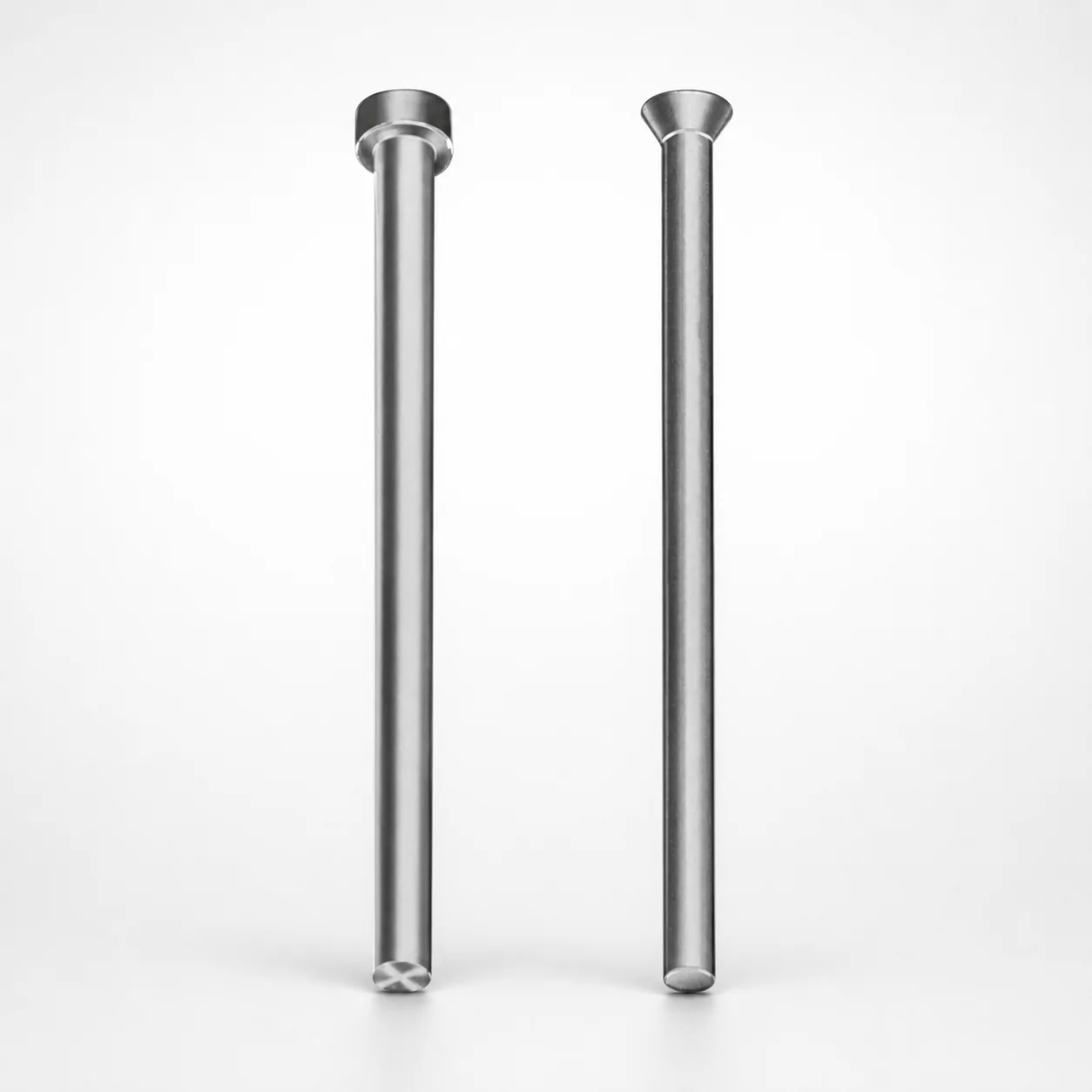
DAYTON XVP Coated Close Space Straight Punches - Inch
Close space straight punches - inch (DAYTON XVP coating) are designed for tight clearances, helping maintain punch stability during repetitive production cycles. The coated surface supports consistent performance while reducing friction-related wear.
- Tight-space straight punch geometry for stable guidance in close die sets
- DAYTON XVP coating helps limit wear and control friction
- Inch-series punch options support reliable fit across standard punch assemblies
- Used in press tooling for efficient blanking, forming, and multi-hit operations
Specifications
2 configurations available
| Type | L (Length) (in) | P Dimension (in) |
|---|---|---|
| Regular head - KCX | 150 ~ 400 | 0.04 ~ 0.25 |
| Angled head - KWX | 150 ~ 400 | 0.04 ~ 0.25 |
Product Guide
Application Scenarios+
These close-space straight punches are used in injection mold and press-type tooling where the punch must remain precisely guided within very limited clearance. The regular head (KCX) or angled head (KWX) style supports stable alignment in close die sets, which helps maintain repeatable punch stroke position over long production runs.
In automotive and appliance connector molds, tight guidance is critical to avoid side loading during blanking or forming operations. The tight-space geometry combined with the DAYTON XVP coating reduces friction at the punch/die interface, helping limit wear and maintain consistent cycle performance.
- Blanking & forming tools: suitable for efficient material removal with reduced wear-related variation.
- Multi-hit or repeated operations: stable guidance helps maintain punch alignment as contact forces cycle.
- Inch-series punch assemblies: available lengths (150–400 in) and close-space design support reliable fit within standard inch tooling layouts.
Material & Process Details+
The provided specifications identify the punch variant and coating system (DAYTON XVP), but they do not list the underlying steel grade or heat-treatment state. As a result, hardness (HRC), quench/temper, nitriding, and tempering temperature cannot be stated from the supplied data.
What can be confirmed is that the XVP coating is intended to improve tribology—supporting lower friction and reduced wear under repetitive punch motion. For mold makers, this is typically selected to balance wear resistance against coating durability in tight-clearance environments.
- Trade-off: coatings reduce friction and surface wear, but tooling life still depends on the base steel and guidance wear.
- Heat treatment: not specified in the provided parameters; verify with the supplier’s material certificate for exact treatment and target hardness.
Sizing & Selection Guide+
To select the correct close-space straight punch for inch applications, match the length L and the P dimension to the mold/tooling stack-up and guidance clearance.
- Length L (in): choose from 150–400 in to ensure the punch reaches the required forming/blanking depth without bottoming or interference with the die set.
- Head type: use KCX (regular head) or KWX (angled head) to align with your stripper, support, or tool geometry.
- Tolerance/fit: the supplied data does not provide tolerance values for L or P; use the vendor’s drawing for final fit checks against the punch pocket and die clearance.
P dimension (in): select 0.04–0.25 in based on your close-clearance guidance requirement. In tight die sets, P directly affects how closely the punch is supported during the stroke, which influences stability and wear behavior.
Frequently Asked Questions
Which head style should I choose—KCX (regular head) or KWX (angled head)—for close die-set guidance?+
Choose KCX for a standard straight guidance interface in close die sets, where axial alignment is the primary requirement. Select KWX when your tooling geometry benefits from an angled head configuration. The correct selection depends on your stripper/support layout and the available tool space.
How do I select the correct length L (150–400 in) for the punch stroke and forming depth?+
Select L within 150–400 in so the punch reaches the intended blanking/forming depth while avoiding contact with the backer or die-set components at bottom dead center. In close-clearance tooling, confirm the stack-up against the required working height and any motion allowance.
What does the P dimension (0.04–0.25 in) control in a close-space straight punch application?+
The P dimension range of 0.04–0.25 in is tied to the close-space guidance and clearance behavior of the punch within the die set. For stable punch operation in repetitive cycles, match P to your designed support/guidance clearance so the punch stays aligned under load.
Does the DAYTON XVP coating change the required fit or guidance clearance?+
The provided data confirms that the DAYTON XVP coating is intended to limit friction and reduce wear, which can help maintain stable operation in tight clearances. However, the specification does not state coating allowance or fit adjustments. Use your die-pocket and guidance clearances from the engineering drawing and verify coating impact with the punch drawing.
What base steel grade and target hardness (HRC) are used for this XVP coated punch?+
The supplied product parameters do not include the underlying steel grade, heat-treatment method, or hardness (HRC). To select compatible partner die materials and predict wear life, request the steel certificate/drawing data that lists the base material and heat treatment. Then validate hardness and toughness targets against your load and cycle conditions.
Related Products
Need Custom Specifications?
Our engineering team can help with custom configurations, material selection, and volume pricing.