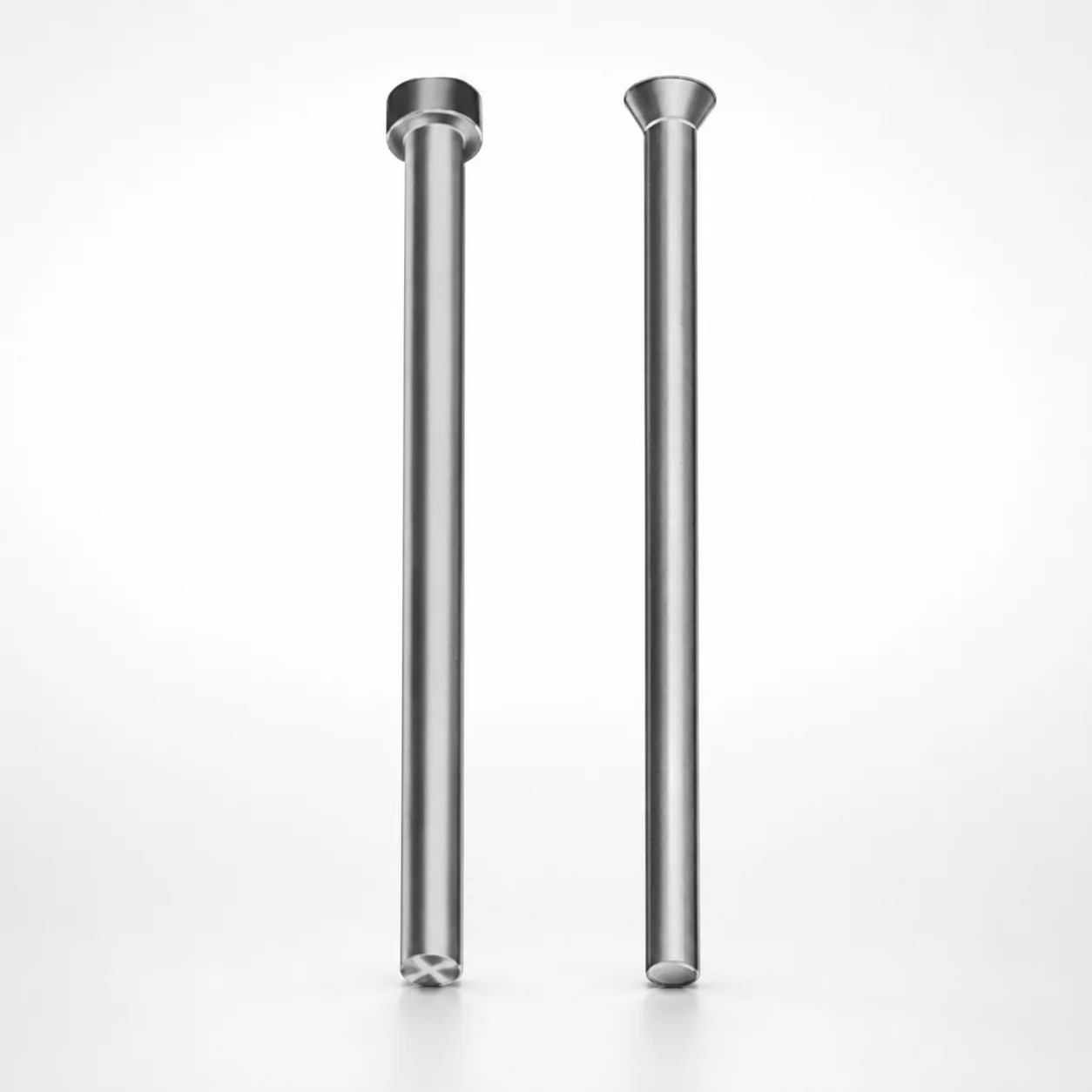
Close Space Straight Punches - Metric, XNAP Coating
Close Space Straight Punches - Metric (XNAP Coating) are designed for precise work in tight die spaces, supporting reliable punching alignment and repeatable production results. Suited to metric die builds requiring consistent punch performance.
- Close-space straight punch geometry for dependable positioning in compact tooling
- XNAP Coating selection for improved surface protection under punching cycles
- Supports both angled head and regular head configurations for process fit
- Metric format for integration with standardized die sets and production workflows
Specifications
2 configurations available
| Type | L (Length) (mm) | P Dimension (mm) |
|---|---|---|
| Angled head - AWX | 40 ~ 100 | 0.8 ~ 7 |
| Regular head - AXX | 40 ~ 100 | 0.8 ~ 7 |
Product Guide
Application Scenarios+
These close-space straight punches are used in precision die sets where punch-to-die alignment must be maintained inside limited working space. In automotive connector housings and terminal-component tooling, the compact straight-punch geometry helps keep positional accuracy during repeated piercing cycles, reducing the risk of uneven edge formation.
For electronics and household appliance parts, where fine features are produced from sheet or thin stock, the variant with XNAP coating supports improved surface protection under wear-inducing punching conditions. This is especially relevant when cycles are frequent and the die set relies on repeatable punch performance.
- Angled head (AWX) fits applications needing controlled entry or clearance in compact stations.
- Regular head (AXX) suits standard die layouts requiring straightforward punch travel.
The metric format and close-tolerance design make this variant suited for die builds that must integrate into standardized tooling practices.
Material & Process Details+
The provided specification data identifies this punch line by geometry and XNAP coating, but it does not include the underlying steel grade, measured hardness (HRC), or a specific heat-treatment state (e.g., quenched & tempered or nitrided). As a result, the material metallurgy cannot be stated from the supplied inputs without risking inaccuracy.
What can be confirmed from the data is that the XNAP coating is selected to improve surface protection under punching cycles, supporting wear resistance at the punch working surfaces. In practical tooling, higher wear resistance generally trades off against edge toughness depending on substrate and coating thickness; however, the exact trade-off depends on the missing substrate grade.
- Coated working surface: designed for enhanced protection during repeated punching.
- Material/heat treatment: not specified in the input—confirm with the supplier for hardness (HRC) and heat-treatment details.
Sizing & Selection Guide+
Select the punch length L and P dimension to match your die block engagement and clearance needs. This series provides L = 40–100 mm and P = 0.8–7 mm, so choose the shortest practical length that maintains stable guidance through your holder and die set.
In close-space tooling, correct sizing is critical because limited die-window clearance amplifies the effect of small dimensional mismatches on alignment and wear. Start by mapping the cavity/core geometry and the punch working height: set L so the punch reaches the required penetration depth while maintaining sufficient support in the punch plate.
- P dimension (0.8–7 mm): match the required positional/feature dimension for your piercing operation and clearance profile.
- Head type: choose AWX (angled head) or AXX (regular head) based on station clearance and entry path.
Tolerance and fit details are not provided in the input data; therefore, use the die set designer’s standard fit tolerances for your punch holder and guide bushings, and verify that the selected length/feature dimensions meet your assembly stack-up.
Frequently Asked Questions
What is the difference between the AWX (angled head) and AXX (regular head) versions for close-space straight punches?+
The series specifies Type: Angled head = AWX and Regular head = AXX. Choose AWX when your station requires an angled head configuration for clearance or controlled entry within a compact die layout. Choose AXX for standard straight travel where the tooling geometry doesn’t require an angled head.
How do I choose the punch length L within the 40–100 mm range for a tight die set?+
Use the provided range L = 40–100 mm to set the punch engagement through your punch plate and guidance elements. Select the shortest length that still ensures stable support and the required penetration depth for your cavity/core stack-up. Because tolerance/fit data isn’t listed in the input, verify your holder and die-window clearances against your assembly tolerances.
What does the XNAP coating contribute for punching cycles, and when should I prioritize it?+
This series explicitly uses XNAP coating to provide improved surface protection under punching cycles. Prioritize this variant in die sets with high cycle counts or where wear at the punch working surface can affect dimensional repeatability and edge quality. The input data confirms coating purpose, but it does not provide substrate hardness (HRC) or heat-treatment state—confirm those details for full tribology planning.
How should I match the P dimension (0.8–7 mm) to die feature requirements?+
Match P = 0.8–7 mm to the required die feature/clearance dimension for your piercing operation. In close-space die sets, the correct P dimension helps maintain the intended positional relationship and clearance profile, improving alignment and reducing uneven wear. If your design depends on specific tolerance classes, use your standard punch-to-die fit rules since tolerance data is not included in the provided specs.
Are there multiple material options or heat-treatment states for this punch series?+
The provided inputs do not include the underlying steel grade, hardness in HRC, or the heat-treatment state. The only explicitly stated technical element beyond geometry is the XNAP coating. To select based on wear vs. toughness, request the substrate material grade and heat-treatment details from the supplier.
Related Products
Need Custom Specifications?
Our engineering team can help with custom configurations, material selection, and volume pricing.