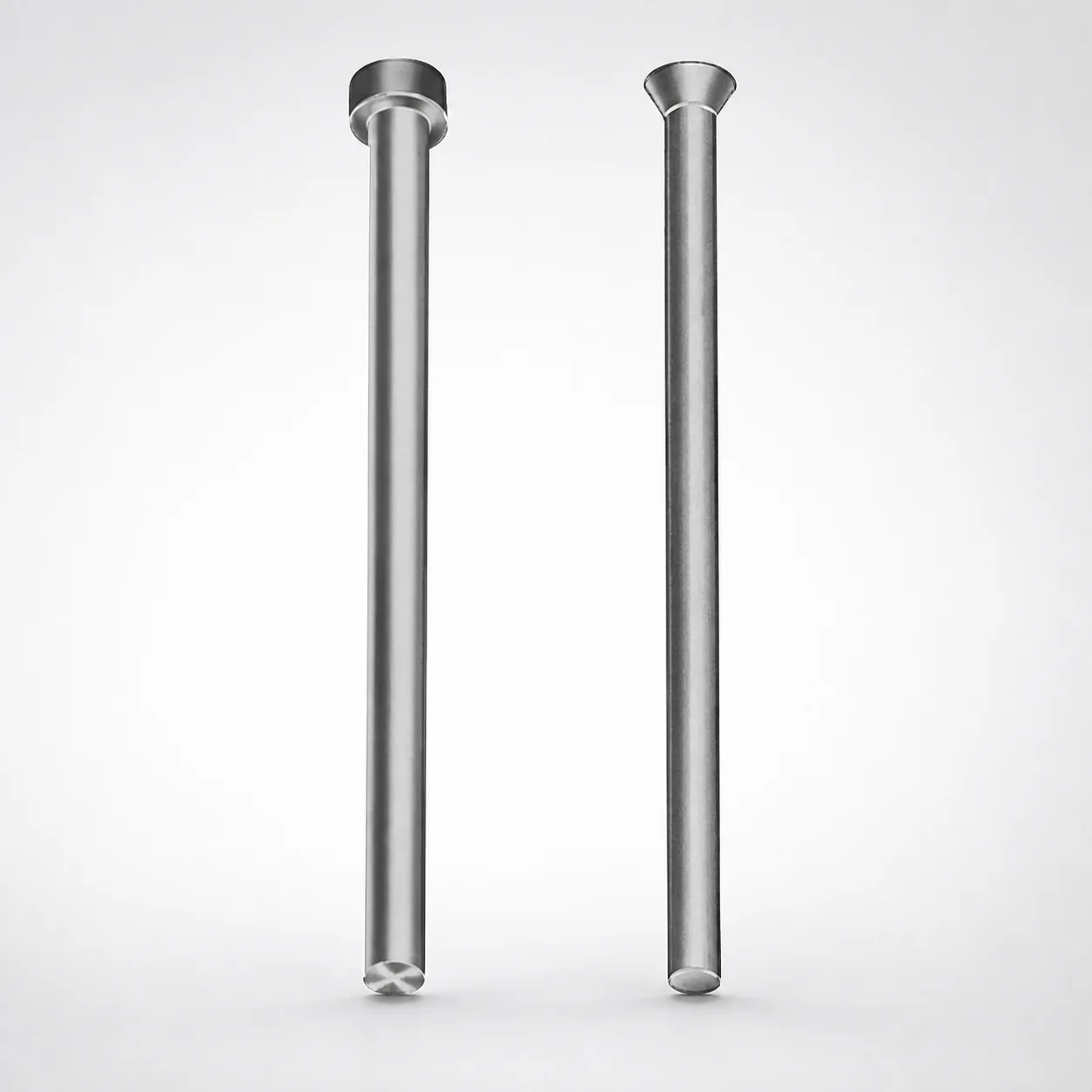
Close Space Straight Punches - Inch XNA Coating
Close Space Straight Punches - Inch XNA Coating are designed for precise punching in tight die layouts, helping maintain consistent punch performance through repetitive production cycles. The robust straight-punch geometry supports reliable feed and alignment.
- Straight punch design for accurate punching in close, limited tool space applications
- XNA coating system supports improved wear resistance and consistent cutting action
- Engineered for length configurations from 150–400 in to match varied die heights
- DAYTON punch tooling supports shop-tested process compatibility for die makers
Specifications
2 configurations available
| Type | L (Length) (in) | P Dimension (in) |
|---|---|---|
| Regular head - KCX | 150 ~ 400 | 0.04 ~ 0.25 |
| Angled head - KWX | 150 ~ 400 | 0.04 ~ 0.25 |
Product Guide
Application Scenarios+
Close-space straight punches are used in injection mold tooling and die sets where punching must be controlled inside a very limited vertical stack-up. They are especially suited for in-mold features such as thin-gauge shear operations, post-machining trimming, and localized hole formation that require stable alignment under repeated cycles.
Common scenarios include automotive connector and bracket molds, where tight die layouts demand consistent cutting action at the punch tip. The straight-punch geometry helps maintain feed and positional stability when tool access is restricted. In consumer appliance enclosures, these punches can support repeatable perforation of venting or attachment features during plate prep and secondary operations.
- Regular head (KCX) for straightforward punch/strip alignment in close spaces
- Angled head (KWX) when tooling layout benefits from an offset access path
The Inch variant and XNA coating are chosen to support controlled punching behavior in tight die spaces while helping maintain wear performance across production runs.
Material & Process Details+
The provided specifications for this punch series focus on form factor and coating performance; a specific steel grade and hardness (HRC) are not stated in the input data. However, the XNA coating system is intended to improve wear resistance and help preserve a more consistent cutting action during repetitive punching.
- XNA coating: optimized for controlled punching where surface wear and edge degradation directly affect dimensional stability.
- Trade-off: coating-focused solutions typically prioritize edge life and process consistency; they require correct alignment and proper lubrication/housekeeping to fully realize benefits.
Heat treatment state (for example, quenched & tempered or nitrided) and target hardness are not included in the supplied metadata, so they should be verified with the tooling datasheet before final material qualification.
If you can share the steel grade/HRC for the KCX/KWX options, Axiom Molds can map the hardness-to-application fit for your wear and toughness requirements.
Sizing & Selection Guide+
To select the correct punch dimensions, start with the required punching stroke depth based on your mold/die cavity or insert stack height. This series offers L (Length) from 150–400 in, which should be matched to die height so the punch projects correctly without bottoming or excessive stick-out.
Next, verify the P Dimension of 0.04–0.25 in. P influences the punch geometry relationship with the corresponding workpiece and die clearance/engagement zone; choose the value that best aligns with your die design and the required controlled cutting conditions.
- Regular head (KCX): use when straight access supports alignment in the close space.
- Angled head (KWX): consider when die layout requires an offset access path while keeping effective punching depth within your L selection.
- Tolerance/fit: confirm clearance between punch and mating die features in your CAD to prevent binding and maintain repeatable cutting edges.
L and P are fixed by the selected configuration, while Type (KCX vs KWX) determines head geometry for your tooling constraints.
Frequently Asked Questions
For close-space punching in a tight mold stack, how do I choose between KCX (regular head) and KWX (angled head)?+
What length range is available for this close space straight punch, and what die stack height should it cover?+
How does the P dimension (0.04–0.25 in) affect punch-to-die clearance and controlled cutting?+
Is XNA coating expected to improve wear resistance for repetitive punching in production?+
Which material grade and hardness are used for this punch series?+
Related Products
Need Custom Specifications?
Our engineering team can help with custom configurations, material selection, and volume pricing.