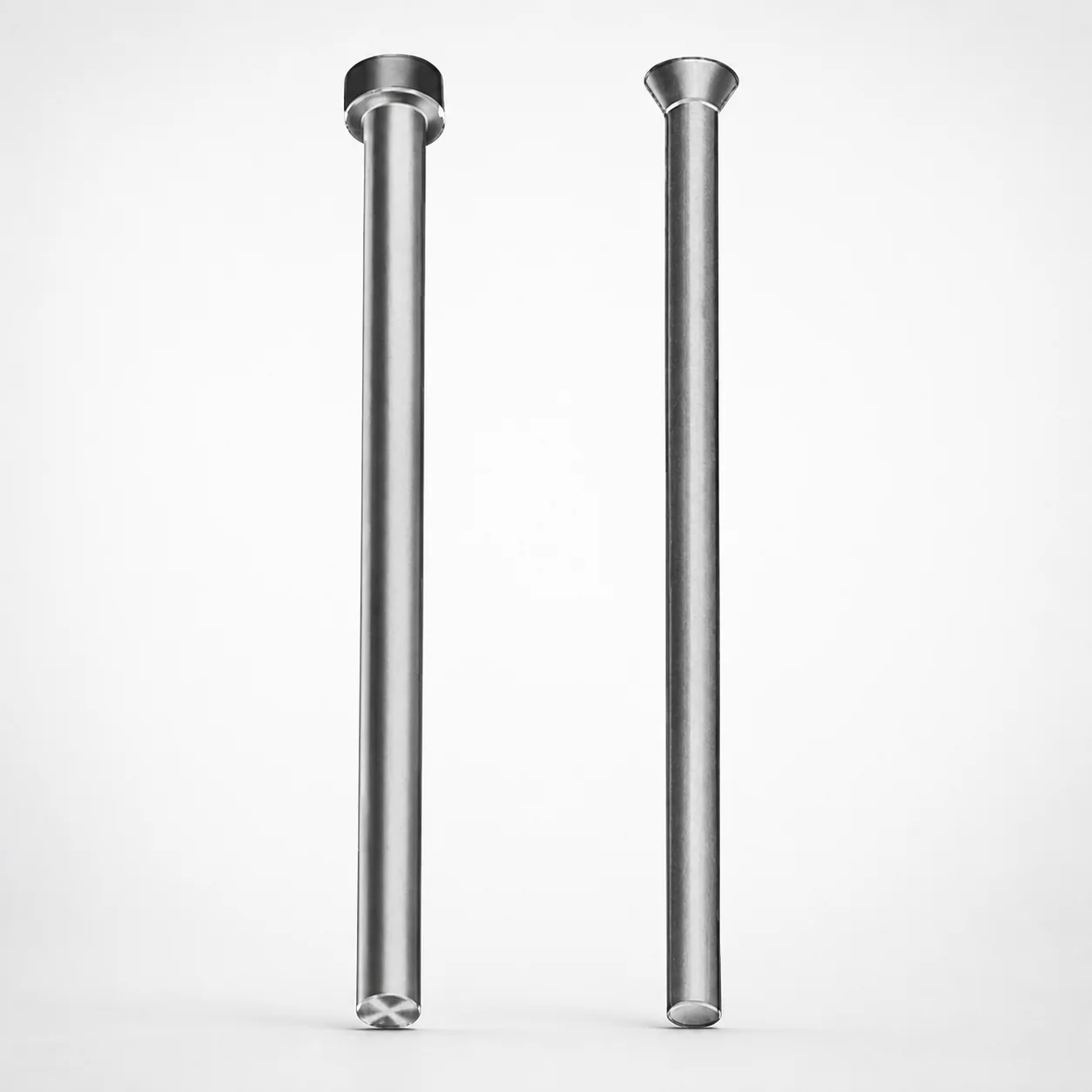
Metric M2 Steel Close Space Straight Punches
Close space straight punches (M2 steel) for metric tooling are designed for reliable piercing and ejection in tight clearances. Dayton parts support consistent positioning when access space is limited in the die set.
- Close-space straight punch geometry improves punch alignment in compact die cavities
- M2 steel construction with robust wear resistance for long production runs
- Available as angled head (AWX) or regular head (AXX) to match die layout
- Metric punch style used in stamping, forming, and fine blanking processes
Specifications
3 configurations available
| Material | Type | L (Length) (mm) | P Dimension (mm) |
|---|---|---|---|
| M2 | Angled head - AWX | 40 ~ 100 | 0.8 ~ 7 |
| M2 | Regular head - AXX | 40 ~ 100 | 0.8 ~ 7 |
| A2 | Regular head - AXX | 40 ~ 100 | 0.8 ~ 7 |
Product Guide
Application Scenarios+
Close-space straight punches are used in injection-mold tooling and metal-forming die sets when a piercing, trimming, or ejection feature must operate within limited access. The close-clearance geometry helps maintain punch alignment in compact cavity blocks, reducing the risk of side loading and uneven wear.
- Automotive connector and terminal housings: employed in in-die trimming or post-forming stations where the tooling envelope is tight and consistent positioning is required for repeatable part features.
- Medical device component forming: suitable for fine blanking-style operations where stable piercing is needed to maintain dimensional control across production lots.
- Appliance and consumer electronics brackets: effective for trimming and forming steps with higher cycle counts due to the variant’s abrasion resistance and stable guidance in close spaces.
With M2/A2 steel, the punches balance wear resistance for frequent cycles while the availability of angled (AWX) or regular (AXX) head types allows matching the punch approach to the die layout.
Material & Process Details+
This series is offered in M2 or A2 steel, selected for die-punch wear behavior under repeated piercing and ejection loads. M2 is a high-speed steel typically regarded as an AISI M2 equivalent class, providing strong wear resistance for long runs; A2 is an AISI A2 equivalent class that is commonly chosen when a balance of toughness and grindability is preferred.
- Hardness & trade-offs: high hardness for cutting life improves wear resistance, while higher hardness can reduce impact toughness. Select the steel that best matches your load profile and cycle frequency.
- Heat treatment state: punches are generally used in a quenched & tempered / hardened condition to achieve service hardness; exact heat-treat parameters should be verified to match your required HRC and coating compatibility.
Because the input data specifies steel grades (M2, A2) but not the exact HRC, final hardness should be confirmed before production to ensure the intended wear/toughness balance.
Sizing & Selection Guide+
To select the correct close-space punch, match the required envelope and engagement geometry to the provided fixed dimensions. For this series, the length L is fixed in the range 40–100 mm, and the P dimension is fixed in the range 0.8–7 mm.
- Determine the required installed length from your punch retention depth and required protrusion; choose L within 40–100 mm to avoid under-support or excessive stick-out.
- Select the P value to match the feature clearance and guidance needs in your die cavity/core stack-up; keep it consistent with the close-space design intent.
- Choose type based on your layout: AWX (angled head) for angled approach constraints or interference avoidance, and AXX (regular head) when alignment is directly in-line.
Because tolerance/fit values are not provided in the input data, confirm fit against your die block hole size and punch guide system; in close-space applications, small deviations can increase side loading.
Frequently Asked Questions
Which steel grade should I choose for long production runs: M2 or A2?+
This series supports M2 and A2 materials. M2 is typically selected when you need strong wear resistance for higher cycle piercing/blanking conditions, while A2 is chosen when you want a different toughness/performance balance.
Confirm the final hardened condition (e.g., quenched & tempered) and the target hardness for your application before locking the design.
When should I use the angled head (AWX) versus the regular head (AXX)?+
The series offers angled head (AWX) and regular head (AXX). Use AWX when your die layout or strip-path constraints require an angled approach to reduce interference while keeping punch alignment in close spaces.
Choose AXX for straightforward, in-line configurations where the punch axis matches the tooling stack geometry.
How do I select the correct length L for the punch in a die set?+
The fixed L (Length) range for this series is 40–100 mm. Determine your required installed depth based on the punch holder retention and the protrusion needed to engage the workpiece.
Select the smallest practical L that provides full guidance without excessive stick-out to minimize bending and side loading in close-clearance designs.
How should I choose the P dimension for close-space clearance?+
The series provides a fixed P dimension range of 0.8–7 mm. Choose P to match your close-space guidance and clearance requirements so the punch can enter/operate without binding.
Because tolerance/fit data isn’t included here, verify clearance against your die block hole sizes and guide system to prevent increased friction and wear.
Do I need a specific heat-treated hardness (HRC) before using these punches?+
The input specifies steel grades (M2, A2) but does not provide exact HRC. In practice, punches like these are used in a hardened state (typically quenched & tempered), and performance depends heavily on the final hardness.
Before production, confirm the delivered hardness and heat treatment condition so the punch wear life and toughness match your cycle load.
Related Products
Need Custom Specifications?
Our engineering team can help with custom configurations, material selection, and volume pricing.