Close Space Straight Punches - Inch XN DayTride Coating
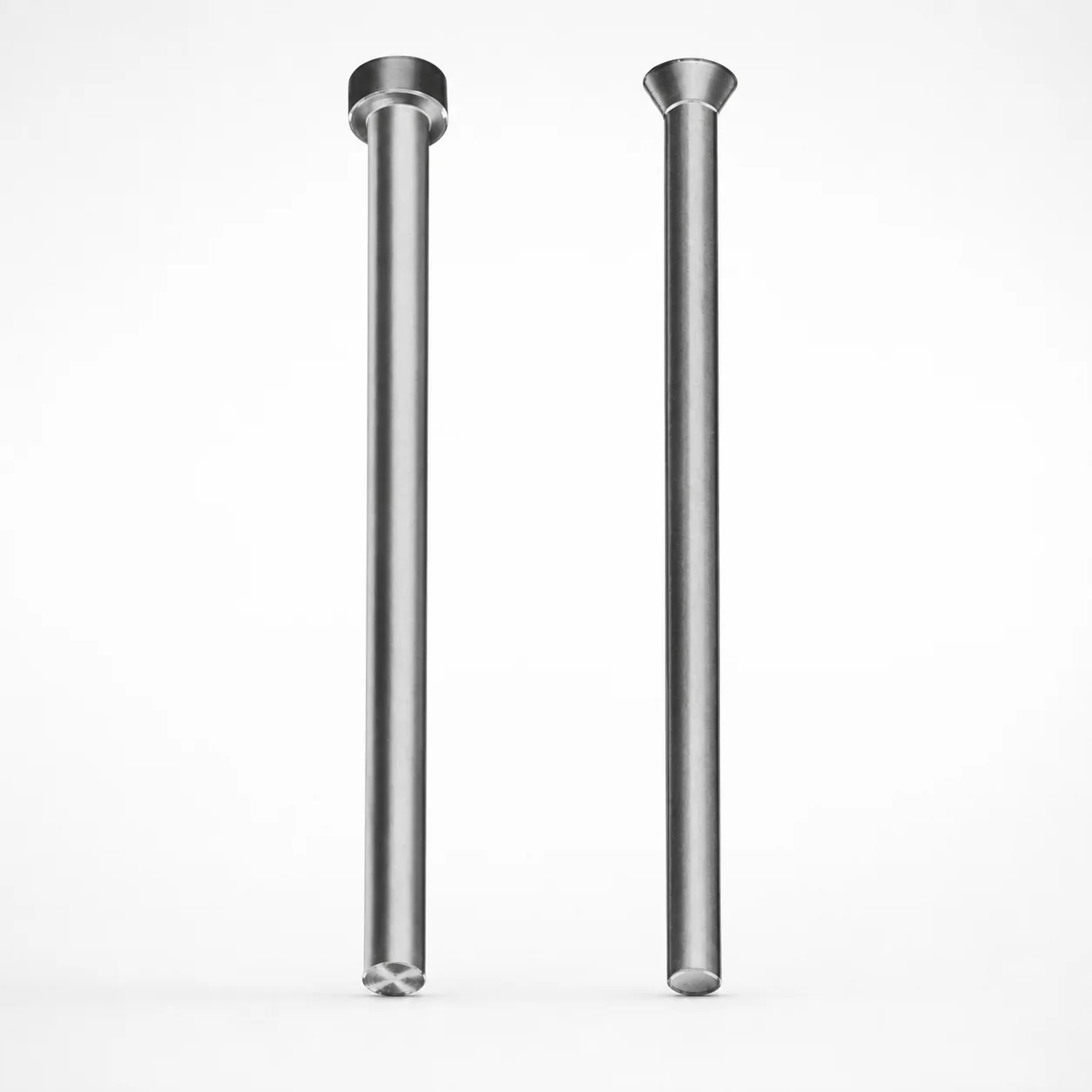
Close Space Straight Punches - Inch (XN DayTride® coating) from DAYTON are engineered for reliable straight punching in tight clearance die space. The coated punch surface helps improve wear resistance for consistent production.
- Close-space straight punch geometry supports stable alignment in die assemblies
- XN DayTride® coating enhances surface durability for demanding cycles
- Option for Angled head (KWX) or Regular head (KCX) to match tool layouts
- Designed for punch-and-die applications that benefit from straight guidance and repeatable output
Specifications
2 configurations available
| Type | L (Length) (in) | P Dimension (in) |
|---|---|---|
| Regular head - KCX | 150 ~ 400 | 0.04 ~ 0.25 |
| Angled head - KWX | 150 ~ 400 | 0.04 ~ 0.25 |
Product Guide
Application Scenarios+
Close clearance straight punches are used in die sets where tooling must maintain precise punch guidance within limited space between the punch and surrounding die components. This variant is suited for high-cycle die work because the surface is protected with XN DayTride®, helping reduce adhesive and sliding wear during repeated stamping.
- Automotive and appliance bracket blanking: stable straight guidance improves part-to-part dimensional repeatability when the die cavity has tight clearance and multiple stations.
- Electronics and connector housings (metal inserts): the punch style supports clean material shearing where alignment is critical to avoid burr growth.
- General fabrication with close-quarters tool layouts: the fixed length range and small P dimension support integration into compact die structures.
Choose the regular head (KCX) or angled head (KWX) based on your tool layout to maintain alignment with the die’s working direction.
Material & Process Details+
Product literature provided specifies the use of an XN DayTride® coating, but does not state the underlying punch steel grade or an explicit heat-treatment condition (e.g., quench-and-temper, nitriding) in the supplied data. For material selection, engineers should treat the coating as the primary differentiator for wear performance in close-clearance punching.
- XN DayTride® coating: designed to improve surface durability under sliding contact and repetitive punch-and-die cycles.
- Wear vs. toughness trade-off: coatings generally improve abrasion/adhesion resistance at the contact surface, while bulk toughness is governed by the underlying steel and heat treatment (not specified here).
If you require a specific steel grade (for example, for impact-heavy applications), confirm the base material and hardness through the product’s technical data sheet before finalizing your die design.
Sizing & Selection Guide+
Selection is driven by the fixed size ranges in your die drawing and the available clearance in the tool assembly. This close-space straight punch series provides L (Length) = 150 to 400 in and a P dimension = 0.04 to 0.25 in, so match these values to your stripper/support stack-up and die height requirements.
- Match L to die stack-up: ensure the punch working engagement and retention length accommodate guide length and holder design without bottoming.
- Match P to clearance/interface geometry: set P to maintain the intended close clearance in the die space so guidance remains stable during cycling.
- Head geometry selection: use KCX (Regular head) for standard alignment or KWX (Angled head) when your tool layout requires an offset head profile.
Because the tolerance values are not provided, validate dimensional tolerances against your press and die clearing requirements in the manufacturing drawing package.
Frequently Asked Questions
What are the available head styles (KCX vs KWX) for this close-space straight punch series, and when should I choose each?+
How do I select the correct punch length (L) within the specified range for my die stack-up?+
What does the P dimension (0.04 to 0.25 in) control in a close-clearance punch-and-die design?+
Does the XN DayTride® coating replace any need for base steel heat treatment?+
What dimensional constraints should I check first when integrating this punch into a tight die space?+
Related Products
Need Custom Specifications?
Our engineering team can help with custom configurations, material selection, and volume pricing.