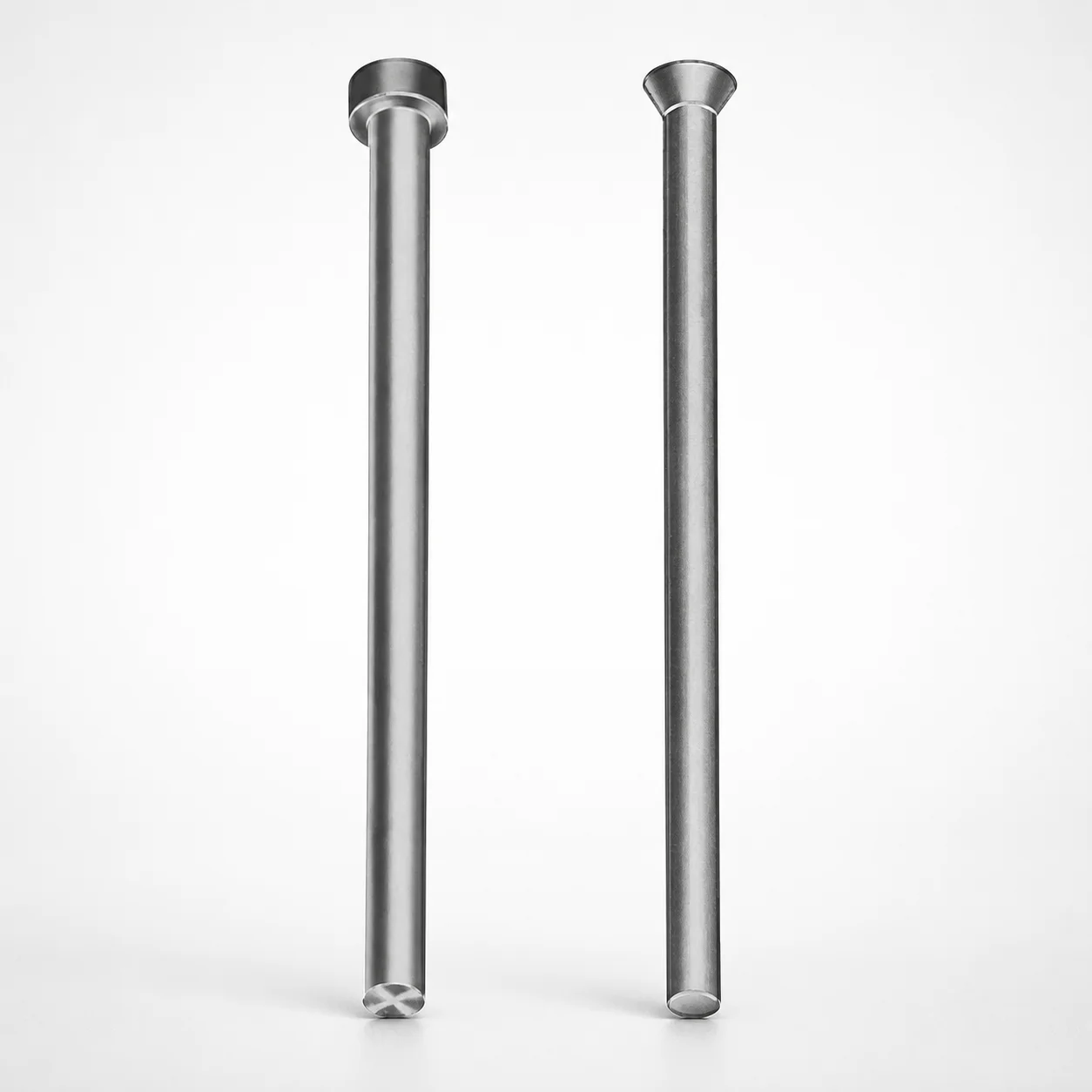
Inch Close Space Straight Punches (CRN Coating)
Inch close space straight punches (CRN coating) are precision punch components designed for compact tool space where guidance and surface durability matter. The CRN finish supports consistent performance through repeated forming cycles.
- Close space straight punch geometry for reliable alignment in limited die space
- CRN coating helps improve wear resistance for extended run time
- Suitable for regular or angled head styles to match tool layout
- Commonly used in progressive dies for trimming, piercing, and forming operations
Specifications
2 configurations available
| Type | L (Length) (in) | P Dimension (in) |
|---|---|---|
| Regular head - KCX | 150 ~ 400 | 0.04 ~ 0.25 |
| Angled head - KWX | 150 ~ 400 | 0.04 ~ 0.25 |
Product Guide
Application Scenarios+
Close space straight punches with CRN coating are designed for compact progressive die sets where alignment must remain stable despite limited die-to-punch clearance. Their close-space geometry supports reliable guidance, helping reduce punch wobble and maintain dimensional consistency during high-cycle trimming or piercing.
- Automotive and appliance progressive dies: Use these punches for piercing and trimming feedstock in tight tool space. The CRN surface supports long-wear cutting, which helps keep edge condition stable over repeated forming cycles.
- Electronics and thin-gauge metal forming: In applications requiring consistent hole quality, the stable punch guidance improves repeatability when operating with regular head (KCX) or angled head (KWX) layouts.
- Multi-station forming tools: When tool layouts demand a straight or angled working orientation, the regular/angled variants help match the station geometry while maintaining close-tolerance guidance.
Choose the CRN-coated variant when tool life and consistent cutting performance are key in close-space molds and dies.
Material & Process Details+
The provided specifications identify an Inch close space straight punch family with CRN coating, but no base steel grade, temper condition, or measured hardness (HRC) is listed in the input data. For this product page, the technical focus is on the coating’s role in wear control for repeated punching operations.
- CRN coating (wear-focused): Enhances surface durability to improve cutting tool life under frequent forming cycles.
- Trade-off considerations: Coatings are selected primarily to boost wear resistance; optimal toughness and impact performance depend on the underlying punch material and heat treatment, which are not specified here.
- Heat treatment state: Not specified for this series in the provided parameters, so the exact quenched-and-tempered or pre-hardened condition cannot be confirmed from the data.
If you need the exact steel grade and hardness for qualification, we recommend requesting the material test data for series 250301145473.
Sizing & Selection Guide+
To select the correct inch close space straight punch, match the length and the P dimension to the station’s tool layout and guidance requirements. The available ranges for this series are L (Length): 150–400 in and P (in): 0.04–0.25.
- Length (L): Choose the value that provides proper engagement depth and support within your die block and guide structure. Use the full tool stack-up (die shoe height, wear components, and clearance) to avoid under-support or excessive protrusion.
- P dimension: Select within 0.04–0.25 in to align with the designed close-space clearance and punch guidance geometry of the cavity/station.
- Head type: Confirm whether you require Regular head (KCX) or Angled head (KWX) to fit the station orientation.
Tolerance guidance is not provided in the input data; however, because close-space punches depend on clearance for stable guidance, you should coordinate with your die designer to confirm allowable clearance and fit for the selected L and P values.
Frequently Asked Questions
What do the KCX (regular head) vs KWX (angled head) variants enable in close-space progressive die layouts?+
This series is offered as Regular head (KCX) and Angled head (KWX). Use KCX when the station requires straight punch orientation for trimming/piercing. Use KWX when the tool layout or approach angle demands an angled working configuration while still benefiting from close-space punch guidance.
How does the CRN coating benefit punching operations in a tight die space?+
The CRN coating is specified for long-wear cutting in close-tolerance tools. In progressive dies, repeated forming cycles can wear punch faces and edges, leading to changes in cut quality. The coating targets improved surface durability to help maintain performance over extended runtime.
How should I choose L (length) between 150 and 400 inches for a punch station?+
Select L within the available range of 150–400 in based on your die block stack-up and required engagement depth. Ensure the chosen length provides stable support without excessive protrusion that could affect guidance. Because close-space guidance is central to this design, verify it against your tool’s clearance and guide geometry.
What P dimension range is available, and how does it relate to clearance in close-space tools?+
The available P dimension range is 0.04–0.25 in. In close-space designs, this dimension is selected to align the punch with the station’s guidance and clearance strategy. Confirm your die designer’s intended close clearance concept before locking the P value, since tolerance details are not provided in the input data.
Do you provide the base steel grade and hardness (HRC) for series 250301145473?+
The provided metadata confirms the CRN coating for series 250301145473, but it does not list the base steel grade, heat treatment condition, or hardness (HRC). For qualification, wear modeling, or supplier audits, request the material and hardness data specific to this series and head type.
Related Products
Need Custom Specifications?
Our engineering team can help with custom configurations, material selection, and volume pricing.