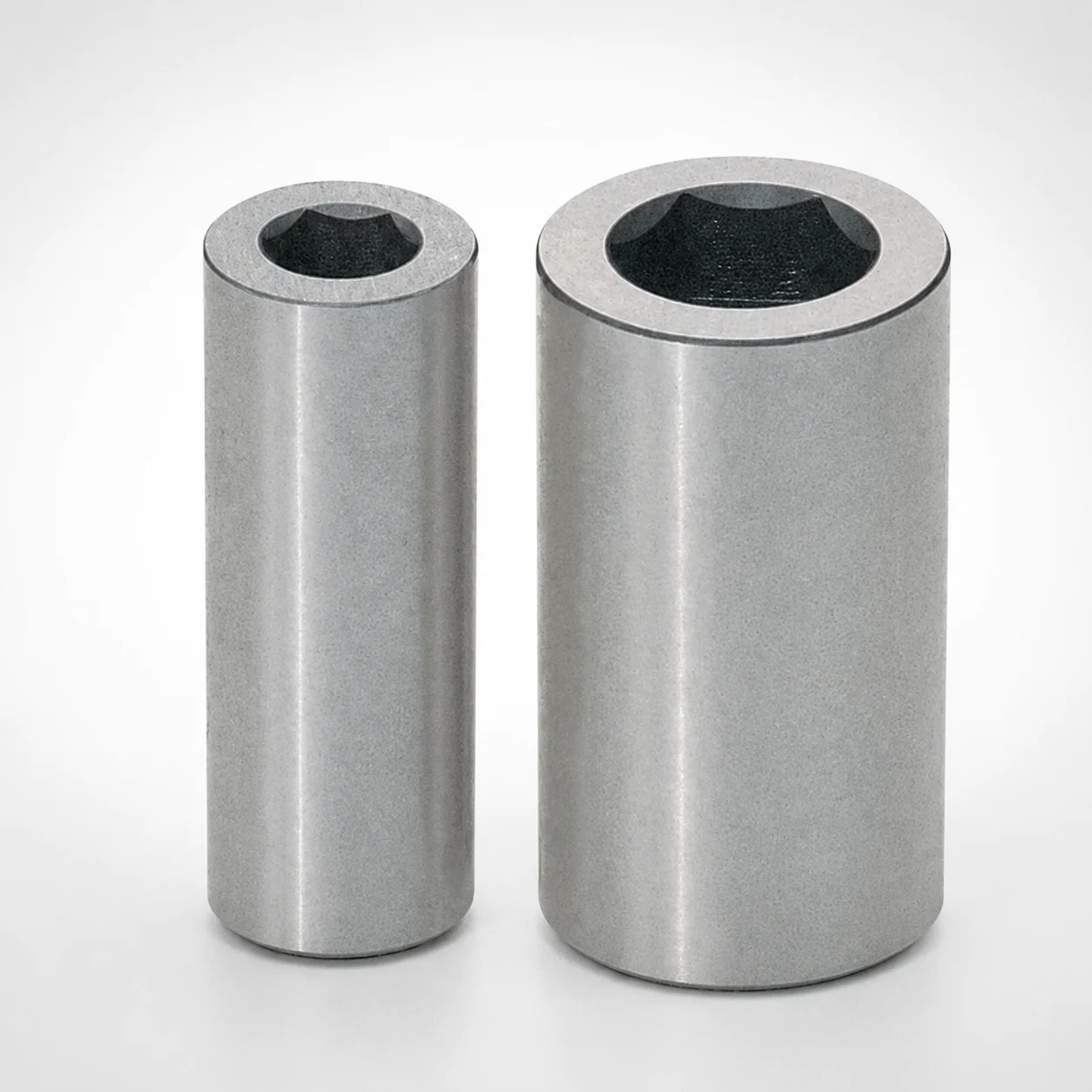
Fully Quenched Tapped Hexagon Socket Support Pillars
Fully Quenched Tapped Hexagon Socket Support Pillars (fully quenched steel) deliver high strength and rigidity to stabilize heavy-load assemblies. The tapped hexagon socket design provides secure mounting while reducing vibration and shock transfer.
- Fully quenched pillar body enhances rigidity for demanding fixture support
- Tapped hexagon socket mounting improves alignment and tightening control
- HSP/HSPL type options support consistent installation configurations
- Designed for industrial equipment builds where wear resistance matters
Specifications
16 configurations available
| D (Shaft diameter) (mm) | L (L dimension) (mm) | Type | type |
|---|---|---|---|
| 6 | - | L dimension selection type | - |
| 7.5 | - | L dimension selection type | - |
| 8 | - | L dimension selection type | - |
| 10 | - | L dimension selection type | - |
| 12 | - | L dimension selection type | - |
| 14 | - | L dimension selection type | - |
| 16 | - | L dimension selection type | - |
| 20 | - | L dimension selection type | - |
| 6 | 20 ~ 40 | L dimension designation type | - |
| 7.5 | 20 ~ 40 | L dimension designation type | - |
| 8 | 20 ~ 40 | L dimension designation type | - |
| 10 | 20 ~ 40 | L dimension designation type | - |
| 12 | 20 ~ 40 | L dimension designation type | - |
| 14 | 20 ~ 40 | L dimension designation type | - |
| 16 | 20 ~ 40 | L dimension designation type | - |
| 20 | 20 ~ 40 | L dimension designation type | - |
Product Guide
Application Scenarios+
Where it’s used: These fully quenched tapped support pillars are installed in leader/ejector and space tooling areas to stabilize heavy-load fixture components inside injection mold bases.
- Automotive and industrial assembly fixtures: Use the tapped hex socket interface to achieve repeatable alignment under vibration and handling loads, helping maintain clearances around moving mold elements.
- Machinery housings and brackets: The rigid pillar body supports secondary fixtures or part-holding arrangements, reducing shock transfer during clamping cycles and part ejection.
- High-wear support positions: The wear-resistant, fully quenched construction is suited for tooling stations that experience frequent tightening/loosening cycles and sustained contact stresses.
Why this variant fits: The tapped hexagon socket design enables secure mounting and tightening control, while the fully quenched steel body maintains stiffness for demanding industrial equipment support applications.
Material & Process Details+
Steel & heat treatment: This pillar is described as a fully quenched steel support component. Fully quenching maximizes hardness and improves resistance to indentation wear under repeated contact and clamping-related loads.
- Material state: Quenched (fully quenched) steel; no additional secondary treatment is specified in the provided data.
- Performance trade-off: Fully quenched steels typically provide high wear resistance and rigidity, with somewhat reduced impact toughness compared with softer or tempered-only states; designs should account for shock loads in mounting and fastener selection.
- Manufacturing process: The component includes a tapped hexagon socket, indicating controlled machining for internal thread accuracy and flatness to support consistent tightening and alignment.
Note on variants: The description references HSP/HSPL type options, but no alternate steel grades or hardness values are provided here; selection between types should be based on fit/configuration rather than material performance claims.
Sizing & Selection Guide+
Select the shaft diameter (D): Choose a pillar with D = 6 ~ 20 mm to match the mounting bore or guide/attachment requirement in the mold base or fixture plate. Ensure the chosen diameter is compatible with the drilled/reamed features and surrounding clearances.
Select the length (L): The length dimension is fixed in the given range: L = 20 ~ 40 mm. Since the data indicates L dimension selection type and L dimension designation type, confirm whether your ordering approach is by picking an available length value or by using a designated L code.
- Match to cavity/core needs: Use the required stack-up height (fixture plate thickness, spacing, and fastener engagement depth) to determine the correct L so the assembly remains rigid without bottoming out.
- Tolerance/fit considerations: Because this is a tapped hex socket pillar, thread fit and engagement depth dominate mechanical security; verify thread specification compatibility with your fasteners and check for sufficient thread length within the mold’s assembly stack.
Frequently Asked Questions
Which shaft diameter (D) range is supported for these fully quenched tapped hexagon support pillars?+
The pillar shaft diameter D is specified as 6 ~ 20 mm. Select the diameter that matches the mounting interface in your mold base or fixture plate to maintain proper alignment and support stiffness.
How do I choose the correct length (L) when selecting between “L dimension selection type” and “L dimension designation type”?+
The provided fixed length dimension range is L = 20 ~ 40 mm. Your ordering method may be either value-based selection (“L dimension selection type”) or code/designation based (“L dimension designation type”). Confirm which method your BOM/order interface uses, then set L to match your tooling stack-up height without interfering with adjacent components.
Why is the tapped hexagon socket feature important for mold base stability under vibration or shock?+
The tapped hexagon socket interface is designed to provide secure mounting with controlled tightening. This improves repeatable positioning and helps reduce vibration and shock transfer to surrounding fixture components, which is especially relevant in heavy-load industrial tooling areas.
Does “fully quenched” guarantee higher toughness, or should we expect a wear/rigidity versus toughness trade-off?+
The component is described as fully quenched steel, which is generally associated with higher hardness and improved wear resistance. However, fully quenched conditions can reduce toughness compared with tempered states; when your application includes frequent shock loads, validate mounting design, fastener choice, and support geometry.
Are HSP/HSPL type options different in material or only in configuration?+
The product description mentions HSP/HSPL type options, but no alternate steel grade, hardness, or heat-treatment variant is provided in the available specifications. In this context, treat HSP/HSPL as configuration/compatibility options and select based on the required installation arrangement and dimensions (not material performance).
Related Products
Need Custom Specifications?
Our engineering team can help with custom configurations, material selection, and volume pricing.