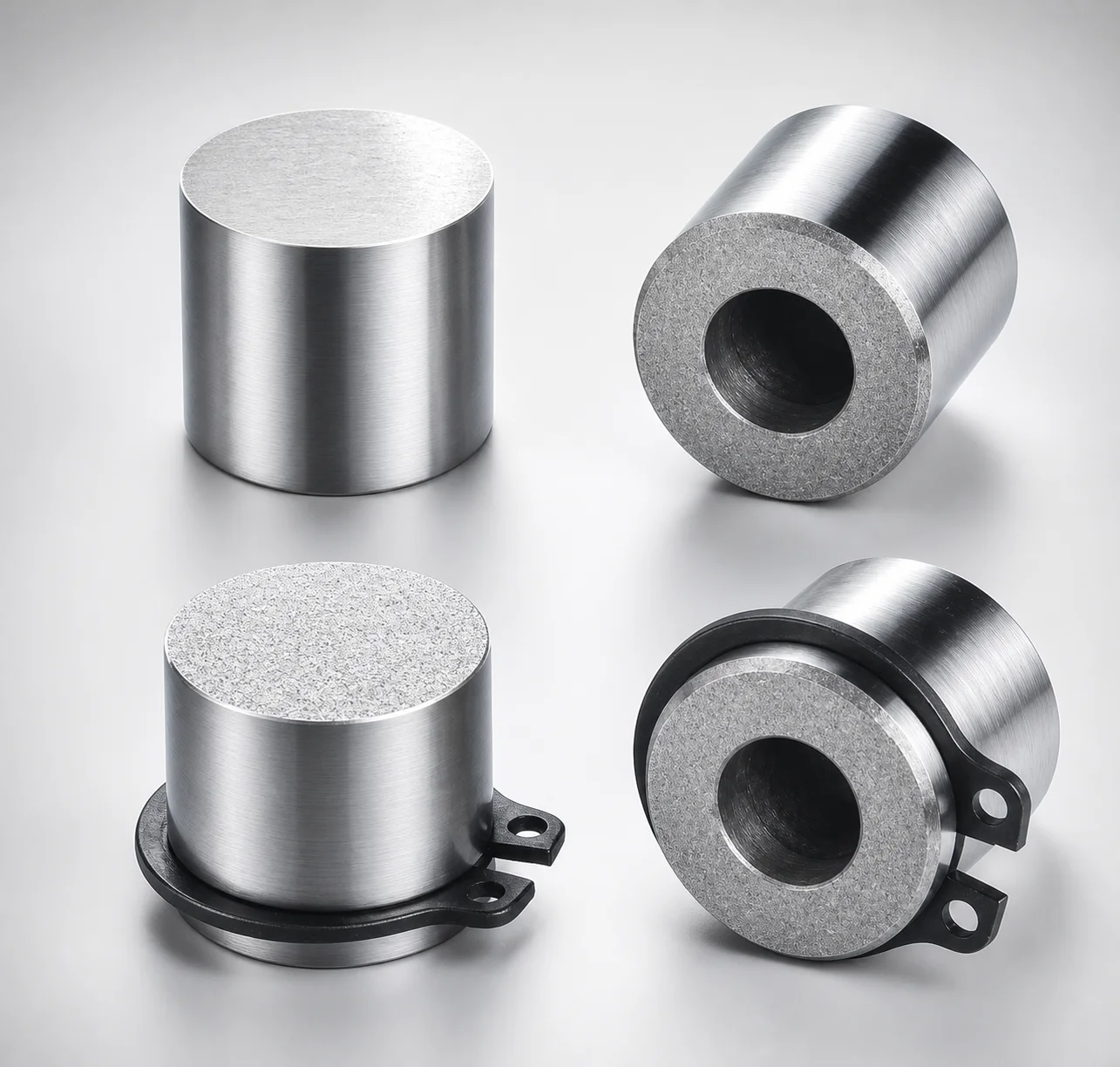
Porous Vent Rods for Mold Inserts
Porous Vent Rods for Mold Inserts use a sintered stainless porous structure to provide gas escape across the full vent surface, reducing welds, bubbles, and short shots. Machining or laser processing is supported after opening vent holes.
- Porous vent path design improves mold degassing and surface appearance
- Sintered stainless material (SUS430 equivalent) for stable vent performance
- Works with press-fit or C-ring options for practical installation layouts
- Supports laser/secondary machining to match molded part geometry
Specifications
28 configurations available
| D (Outer diameter) (mm) | L (L dimension) (mm) | type |
|---|---|---|
| 4 | 10 | - |
| 6 | 10 | - |
| 8 | 10 | - |
| 10 | 12 | - |
| 12 | 12 | - |
| 16 | 14 | - |
| 20 | 16 | - |
| 4 | 10 | - |
| 6 | 10 | - |
| 8 | 10 | - |
| 10 | 12 | - |
| 12 | 12 | - |
| 16 | 14 | - |
| 20 | 16 | - |
| 4 | 10 | - |
| 6 | 10 | - |
| 8 | 10 | - |
| 10 | 12 | - |
| 12 | 12 | - |
| 16 | 14 | - |
| 20 | 16 | - |
| 4 | 10 | - |
| 6 | 10 | - |
| 8 | 10 | - |
| 10 | 12 | - |
| 12 | 12 | - |
| 16 | 14 | - |
| 20 | 16 | - |
Product Guide
Application Scenarios+
Porous vent rods are used inside injection mold inserts to create a continuous venting path for trapped air and volatiles. The sintered porous structure allows gas escape across the full vent surface, which helps reduce weld lines, bubbles, and short shots, especially in fine-feature or deep-cavity parts.
- Automotive connector and housing molds: When high-flow plastics and tight parting zones increase air entrapment, a press-fit or C-ring installation layout keeps the vent rod stable while providing consistent degassing.
- Consumer electronics housings: For parts where surface appearance is critical, porous venting supports improved transferability by reducing discoloration and surface defects driven by incomplete gas evacuation.
- Medical device component molds: For thin walls and repeatable cycle-to-cycle filling, machining or laser processing after vent-hole opening enables vent geometry to be matched to localized flow/vent requirements.
Material & Process Details+
This porous vent rod uses a sintered stainless porous structure based on SUS430 equivalent to provide stable vent performance during repeated molding cycles. The sintered architecture maintains permeability across the full vent area, improving degassing uniformity compared with single-channel vent designs.
- Wear resistance vs. toughness: Stainless provides good corrosion resistance for venting gases and typical molding environments, while the porous structure prioritizes permeability over maximum mechanical hardness.
- Heat treatment state: The vent function is achieved through sintering of the stainless powder; post-processing can include machining or laser processing after opening vent holes to suit the insert cavity.
- Material comparison: For aggressive corrosive environments, stainless-based porous structures are generally preferred over plain steels; however, properties are optimized for venting performance rather than high hardness targets.
Sizing & Selection Guide+
Select the vent rod diameter and length to align with the insert vent pocket and the expected air evacuation zone. Available dimensions are outer diameter D = 4 ~ 20 mm and length L = 10, 12, 14, 16 mm, so choose the largest diameter that fits your insert geometry without reducing structural thickness.
- Match to cavity/core requirements: Size the rod so its porous section spans the region where gas collects (near gates, ribs, or thin-wall ends). Use a length (L) that covers the full vent pocket depth.
- Fit considerations: Since installation is described as compatible with press-fit or C-ring options, confirm your pocket diameter/retention method to prevent movement during clamping and injection pressures.
- Post-processing: If vent holes must be opened or vent geometry tailored, use secondary machining or laser processing so the vent openings correspond to the molded part flow path.
Frequently Asked Questions
What does the porous sintered stainless structure do for degassing compared with conventional grooves?+
The sintered porous structure provides a vent path across the full vent surface, enabling more uniform gas escape. This improves degassing and helps reduce weld lines, bubbles, and short shots that can result from trapped air.
Which outer diameter (D) range should I use for my insert vent pocket?+
Available outer diameter D is 4 ~ 20 mm. Select the largest diameter that still maintains sufficient insert/core thickness and aligns with your chosen retention method (press-fit or C-ring).
Can I machine or laser process the vent rod after installing it in the insert?+
Yes. The product description supports machining or laser processing after opening vent holes, which lets you tailor vent openings to specific molded geometry and local flow/vent needs.
How do I choose the length (L) for a deep vent pocket?+
The available lengths are L = 10, 12, 14, 16 mm. Choose the length that covers the full vent pocket depth so the porous vent section is positioned over the air entrapment region.
Is the stainless material based on SUS430, and what practical implications does that have?+
The vent rod is described as using stintered stainless (SUS430 equivalent). This supports stable vent performance and corrosion resistance for typical molding environments, with the design focus on permeability and degassing rather than high hardness.
Related Products
Need Custom Specifications?
Our engineering team can help with custom configurations, material selection, and volume pricing.