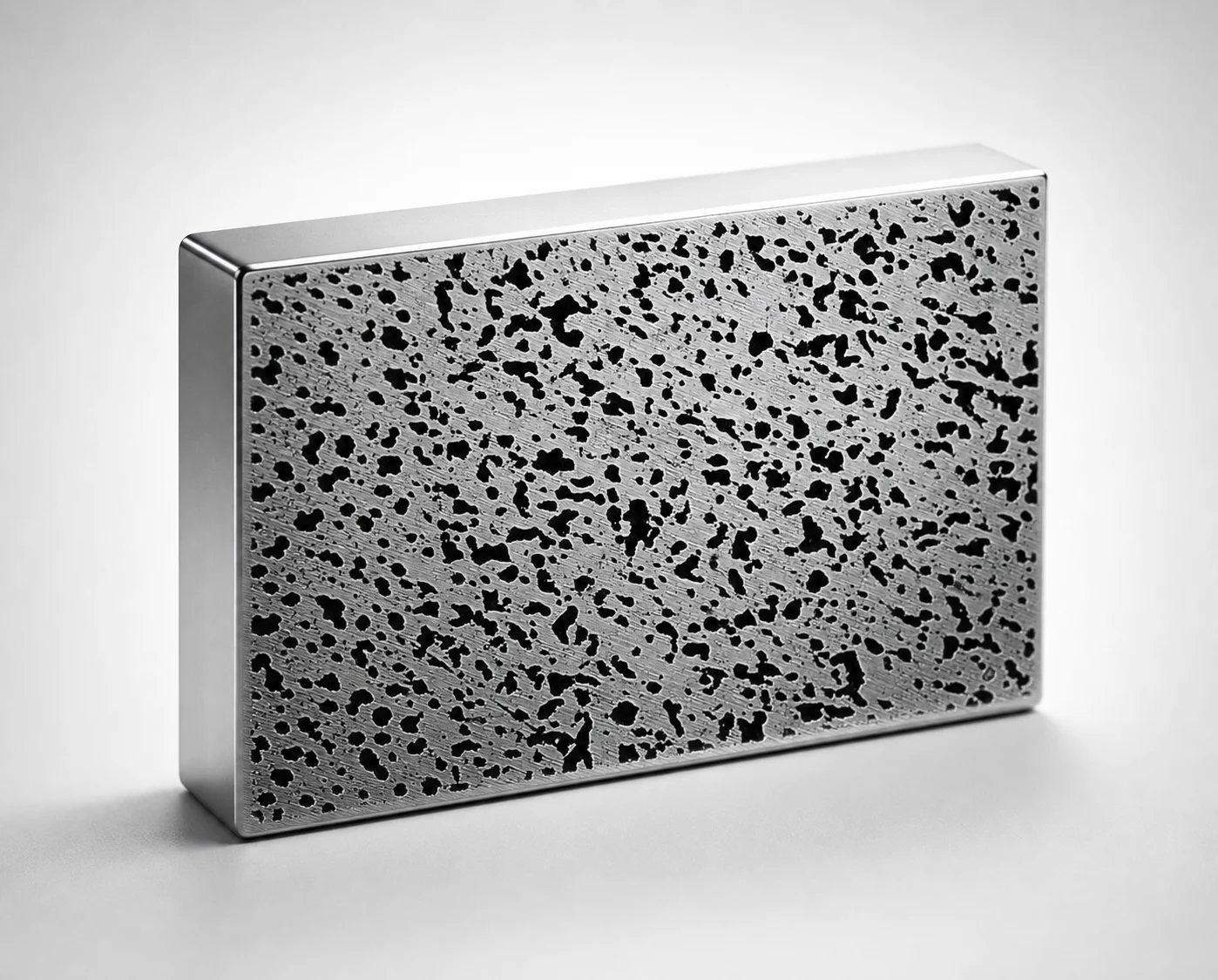
PRVT20 Type Porous Vent Blanks for Mold Inserts
Porous vent blanks for mold inserts (PRVT20 type) are engineered as breathable gas vent inserts to help manage mold exhaust efficiency. The porous metal body enables reliable performance when fabricated by common shop processes.
- Porous metal insert supports steady gas venting for mold airflow control
- PRVT20 type construction balances strength and breathability for durability
- Compatible with NC machining, EDM, and wire cutting for flexible forming
- Designed for insertion into mold blocks to improve venting during production
Specifications
11 configurations available
| A (Length) (mm) | B (Width) (mm) | T (Thickness) (mm) | type |
|---|---|---|---|
| 50 | 50 | 50 | - |
| 50 | 75 | 50 | - |
| 100 | 50 | 50 | - |
| 100 | 75 | 50 | - |
| 100 | 100 | 50 | - |
| 150 | 100 | 100 | - |
| 150 | 200 | 50 | - |
| 150 | 200 | 100 | - |
| 300 | 100 | 50 | - |
| 300 | 100 | 100 | - |
| 300 | 200 | 50 | - |
Product Guide
Application Scenarios+
Porous vent blanks (PRVT20 type) are used as insert-ready venting components in injection mold tooling where gas evacuation directly impacts weld line quality, void reduction, and surface finish. Because the insert is porous, it provides breathable exhaust paths that can be tuned by how the blank is machined and positioned in the cavity.
Common scenarios include:
- Automotive connector and housing molds: Use porous venting near parting lines or gate-adjacent areas to stabilize air release during high-volume molding and reduce risk of trapped gas defects.
- Consumer goods and thin-wall packaging components: Incorporate the vent blank in insert pockets to promote consistent cavity pressure venting and improve knit-line appearance on long flow lengths.
- General-purpose inserts for mold makers: The PRVT20 construction is suited for shops that need flexible fabrication since blanks can be machined by NC, EDM, or wire cutting to match cavity geometry.
These blanks are suited to insert tooling because they are designed to be fitted into mold blocks, enabling repeatable vent placement across production builds.
Material & Process Details+
The provided specifications focus on geometry for the PRVT20 porous vent blanks; no specific steel grade, hardness (HRC), or heat-treatment state is listed in the input data. Therefore, material selection details such as whether the blank is pre-hardened, quenched & tempered, nitrided, or otherwise treated cannot be stated reliably from the current dataset.
What can be confirmed is the porous metal structure, which is the key functional attribute for breathable gas venting. In practice, porous vent inserts require a balance between:
- Wear resistance to tolerate repeated thermal cycling and contact with molding environments.
- Toughness to withstand handling and machining stresses when using NC, EDM, or wire cutting.
If you can share the steel grade or supplied datasheet for PRVT20, we can update this section with exact equivalency (e.g., AISI/H13/M2) and measured hardness plus the relevant trade-offs between hardness and toughness.
Sizing & Selection Guide+
Select the PRVT20 porous vent blank size by matching its length (A), width (B), and thickness (T) to the vent pocket dimensions in your cavity or insert block. Available options are:
- A (Length): 50, 100, 150, 300 mm
- B (Width): 50, 75, 100, 200 mm
- T (Thickness): 50, 100 mm
To choose the correct variant, first determine the maximum usable footprint in the cavity/core: keep A and B within the machined pocket limits, and ensure T matches the insert stack-up thickness so the vent surface sits at the intended cavity level. For best fit, account for the machining process you’ll use (NC, EDM, or wire cutting): confirm clearance allowances for securing the insert and for any post-machining finishing steps.
If your design uses tight tolerances for flushness, treat the listed dimensions as selection ranges and verify final pocket dimensions against your shop’s tolerance standard before installation.
Frequently Asked Questions
Which PRVT20 porous vent blank dimensions (A, B, T) are available for mold insert pocket design?+
The PRVT20 vent blanks are offered in A (Length) values of 50, 100, 150, or 300 mm, B (Width) values of 50, 75, 100, or 200 mm, and T (Thickness) values of 50 or 100 mm.
Choose the variant that fits your pocket footprint while matching the insert stack-up so the vent surface can be positioned correctly relative to the cavity.
Can PRVT20 porous vent blanks be machined by NC, EDM, or wire cut to match cavity geometry?+
Yes. The product description states compatibility with NC machining, EDM, and wire cutting for flexible forming into your mold layout.
When using a specific process, plan for appropriate clearances in the pocket for fixing and post-machining results.
Where in an injection mold should a porous vent blank be positioned for exhaust efficiency?+
Porous vent blanks are intended for breathable gas venting when installed in mold blocks. Common placements include near the parting line and near gate-adjacent flow paths where trapped air can cause surface defects.
Sizing the vent pocket to the available A/B/T options helps maintain the intended vent surface location.
Do I need a specific steel grade or heat treatment for PRVT20 porous vent inserts?+
The provided input data does not specify a steel grade, hardness (HRC), or heat-treatment condition for PRVT20. As a result, the exact material equivalency and treatment state cannot be confirmed here.
If you share the datasheet or material certificate for this PRVT20 series, we can help align it to your thermal-cycle and wear requirements.
How should I match PRVT20 insert dimensions to my cavity/core vent pocket to avoid fit issues?+
Match A and B to the pocket’s allowable length and width, and match T to your mold’s insert stack thickness. The available PRVT20 options are A: 50/100/150/300 mm, B: 50/75/100/200 mm, T: 50/100 mm.
Because the blank is intended to be machined by NC/EDM/wire cut, include clearance for fixturing and validate pocket dimensions against your tolerance standard before final assembly.
Related Products
Need Custom Specifications?
Our engineering team can help with custom configurations, material selection, and volume pricing.