Slide Cores & Loose Cores
Engineered core blocks and slide units that simplify undercut ejection and mold design.
Product Categories
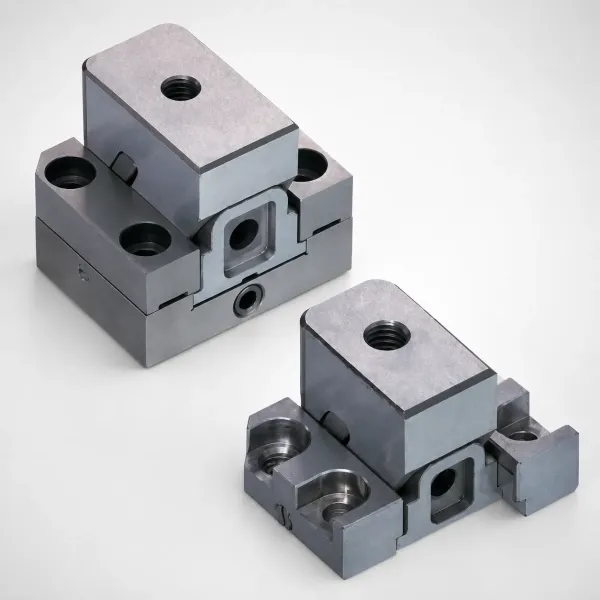
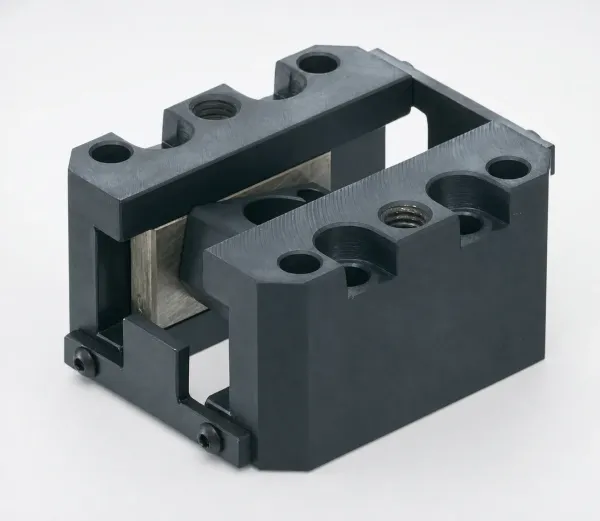
Slide Core vs Loose Core (Lifter) Comparison
Evaluating whether to use a slide core or a loose core (lifter) requires looking at undercut location, cooling requirements, stroke length, and space constraints.
| Dimension | Slide Cores | Loose Cores (Lifters) |
|---|---|---|
| Primary Application | External undercuts on the outside of the part. | Internal undercuts (snap fits, ribs, clips). |
| Direction of Motion | Horizontal/Lateral (during mold open). | Diagonal/Upward (during part ejection). |
| Actuation Source | Angled pins, cams, or hydraulic cylinders. | Ejector plate movement pushing the lifter rod. |
| Space Requirement | High. Requires wide footprint on mold base. | Low. Fits tightly inside the core block. |
| Max Stroke | Very long (up to 100mm+). | Short to Medium (limited by ejection stroke/angle). |
| Cooling Integration | Easier. Baffles/bubblers can be added to the block. | Difficult. Requires complex internal cooling rods. |
| Parting Line Impact | Leaves a visible witness line on the exterior. | Witness line is hidden on the inside of the part. |
| Maintenance | Accessible. Guided on rails. | Complex. Requires accessing the ejector box. |
Rule: External undercuts with large surface areas demand slide cores; internal undercuts with limited space dictate lifters. Do not attempt to use lifters for massive external features.
📖 In-Depth Technical Guide: Read our detailed engineering guide on Slide Core vs Loose Core Lifter Comparison →
Are You on the Right Page?
Before specifying a full-sized slide core, verify if a compact unit or an alternative mechanism is more appropriate for your mold design.
Stay here if you need:
- Heavy-duty sliding blocks for deep external undercuts.
- Standardized pre-machined slide bases to reduce lead time.
- Internal lifters for snap-fit features.
- Replacement slide retainers, stoppers, and springs.
Consider alternatives if:
- Space is extremely limited: Check out Mini Slide Core Units which integrate the pin and slide into one compact module.
- You need simple pin actuation: Consider standard Angled Undercut Pins instead of buying a whole slide assembly.
- You are only looking for guides: Visit the Guide Rails & Slide Plates category.
Rule: Specify mini slide core units when standard assemblies compromise cavity spacing in high-cavitation molds, but be aware of their lower extraction force limits.
📖 In-Depth Technical Guide: Read our detailed engineering guide on When to Switch to Mini Slide Core Units →
Slide Component Pairing Guide
Plungers, springs, and slide stoppers ensure that the slide core comes to a repeatable, precise stop at the end of its stroke, avoiding collision with the main core upon closing.
| Slide Core Type | Recommended Stopper | Position Retainer | Return Assist |
|---|---|---|---|
| Standard Horizontal Slide | Hardened Stopper Block (Bolt-on) | Ball Plunger (Medium Force) | Die Springs (Light/Medium Load) |
| Heavy Vertical/Angled Slide | Integrated Core Stopper | Spring Plunger (Heavy Force) | Gas Springs or Heavy Die Springs |
| Mini Slide Core Unit | Built-in to unit body | Internal friction/spring clip | Internal Coil Spring |
| Loose Core (Lifter) | Lifter Guide Base (Ejector plate) | N/A (Tied to ejector plate) | Ejector Return Pins |
Rule: The retention force of the stopper/plunger must exceed the gravitational and dynamic forces acting on the slide when the mold is open, especially in horizontal presses where the slide could fall closed.
📖 In-Depth Technical Guide: Read our detailed engineering guide on How to Select Slide Stoppers and Plungers →
Frequently Asked Questions
What is the advantage of a standard slide core unit?+
Standard slide core units come pre-machined with rails and pins, drastically reducing custom machining time during mold construction.
When should mini slide core units be used?+
Mini units are perfect for small, confined undercuts on precision parts where traditional slide assemblies cannot fit.
How does a loose core differ from a slide?+
A loose core (often functioning as a lifter) moves at an angle during ejection, freeing internal undercuts, while a slide typically moves horizontally before ejection.
Need a Custom Quote?
Send your specifications and receive a quote. MOQ: 1 piece. Custom dimensions available.
✓ MOQ 1 piece✓ Custom dimensions✓ Typically replies within 24 hours