Mold Cooling Baffles
Flat and spiral mold cooling baffles in brass, stainless steel, and nylon glass-fiber — with tapered screw plug integration, partition options, and blank stock for custom fabrication.
All Baffle Board Products (10)

Stainless Steel Flat Baffle Boards with Partition
Stainless Steel Flat Baffle Boards with Partition control airflow and improve flow stability in assemblies. Optional ...
View Details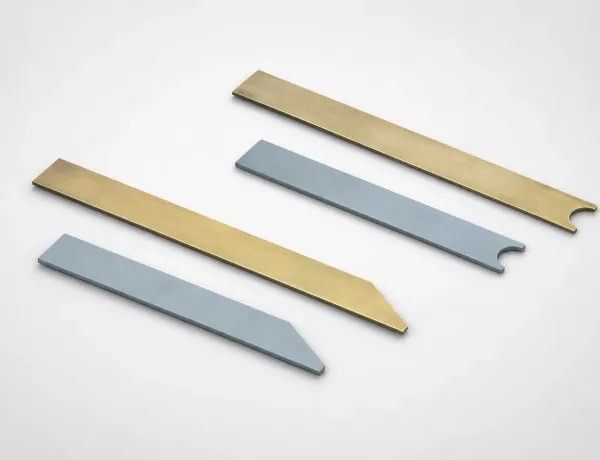
Baffle Boards R-Cut Flat Board
Baffle Boards R-Cut Flat Board for partitioning and flow control. Made in aluminum or brass for stable machining and ...
View Details
Baffle Boards Flat Board Blanks
Baffle Boards Flat Board Blanks for aluminum or brass stock. Flat blank design delivers dependable noise reduction by...
View Details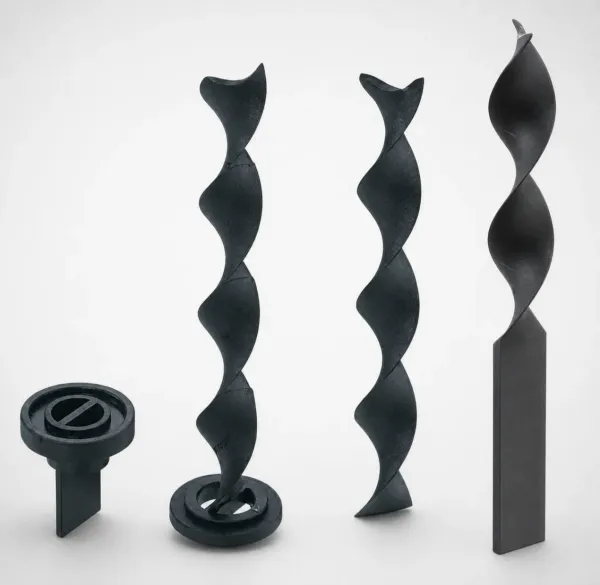
Spiral Baffle Boards (PA6 Nylon with 30% Glass Fiber)
Spiral baffle boards made from PA6 nylon with 30% glass fiber for separate plates options. Reduce turbulence and impr...
View Details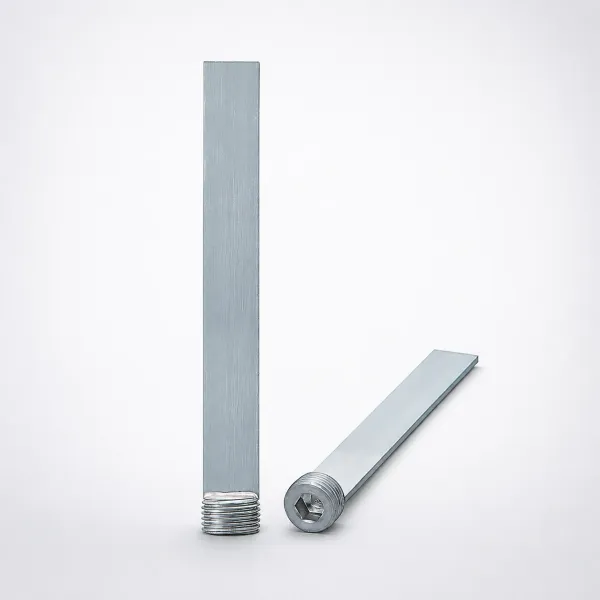
BFPT Brass Baffle Boards with Tapered Screw Plugs
BFPT brass baffle boards with tapered screw plugs for controlled flow. White zinc plated for corrosion resistance and...
View Details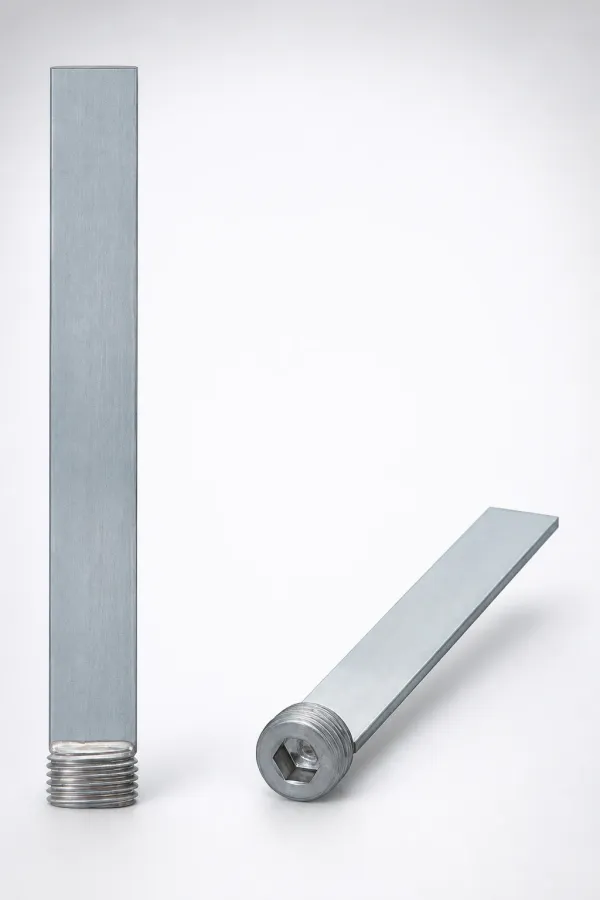
BFPTS Baffle Boards Flat Stainless Steel
BFPTS baffle boards flat in stainless steel for clean plate partitioning. Flat board design with tapered screw plug o...
View Details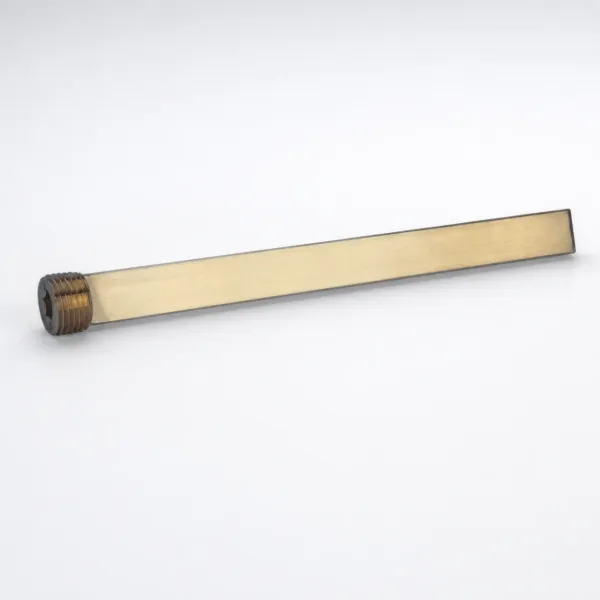
Inch Brass Baffles XT Technology Pipe Plug System
Inch Brass Baffles XT Technology pipe plug system that separates machined waterlines into multiple channels. Divert c...
View Details
Brass Blade Stock Baffle - Inch
Brass blade stock baffle in-inch stock separates machined waterlines into multiple channels for controlled coolant fl...
View Details
Brass Baffle Blade Stock (Inch)
Brass Baffle Blade Stock (Inch) separates machined waterlines into multiple channels for efficient coolant flow. Soli...
View Details
Spiral Brass Baffles - Inch XT Technology
Spiral Brass Baffles - Inch with patented XT Technology separate machined waterlines into multiple channels for more ...
View DetailsBaffle Type & Material Selection Guide
Choose your baffle design (flat vs spiral) and material based on your cooling performance requirements and operating conditions.
| Dimension | Flat Baffle (Brass C3604) | Flat Baffle (SUS304) | Spiral Baffle (PA66-GF30) | Spiral Baffle (Brass C3604) |
|---|---|---|---|---|
| Flow Pattern | Single-pass, laminar-prone U-turn | Single-pass, laminar-prone U-turn | Helical three-dimensional swirl | Helical three-dimensional swirl |
| Heat Transfer Efficiency | Baseline | Baseline | +20-40% vs flat at low flow rates | +25-45% vs flat (maximum turbulence) |
| Thermal Conductivity ($k$) | 109 W/m·K | 16 W/m·K | ~0.3 W/m·K (acts as insulator) | 109 W/m·K |
| Max Coolant Temp | 250°C+ | 400°C+ (best for hot oil) | ~120°C (restricted to water/glycol) | 250°C+ |
| Hardness & Chemical Resistance | 65-75 HRB; prone to scale buildup | 80-90 HRB; highly acid wash resistant | 70-80 HRR; completely corrosion-proof | 65-75 HRB; prone to scale buildup |
| Relative Cost | $ (lowest) | $$ (moderate) | $$ (moderate) | $$$ (highest) |
| Best For | Standard plates, pH-neutral water | High temp oil, treated corrosive water | Medical grade molds, lightweight setups | Heavy-duty thermal hot spots |
Selection rule: If your cycle time is acceptable with flat baffles, stay with flat — they're cheaper and simpler. Switch to spiral only when you need measurably better cooling at specific channel locations. For a detailed performance comparison, see our Flat vs Spiral Baffles Comparison.
How Mold Cooling Baffles Work
Understanding baffle fluid dynamics helps you optimize placement and get maximum cooling performance from your drilled channels.
Flat Baffle: Single-Pass U-Turn Flow Separation
A flat baffle blade divides a drilled waterline into two semicircular cross-sections. Coolant travels down the supply side, reverses direction by $180^\circ$ around the blade tip, and flows back up the return side. While cost-effective, this creates a major aerodynamic challenge: as flow reaches the blade tip, the cross-sectional flow area suddenly increases. This causes local fluid deceleration, creating a stagnant zone (dead zone) at the very tip with a low convective heat transfer coefficient ($h$). To mitigate this, a **Radius-Cut Tip** or a $180^\circ$ bevel should be chosen to smooth fluid turning and minimize boundary layer separation. Achieving fully developed turbulent flow ($Re > 10,000$) in flat channels requires a higher entry velocity, typically $\ge 2.0 \text{ m/s}$.
Spiral Baffle: Helical Swirl and Forced Mixing
A spiral baffle consists of a helical screw molded or machined onto a central core, forcing the coolant into a three-dimensional helical flow pattern against the channel wall. The continuous rotational acceleration generates secondary flow vortices (swirl flow) that continuously disrupt the thermal boundary layer. Consequently, the fluid transitions to turbulent heat transfer at much lower velocities ($Re > 4,000$ shows turbulent characteristics), boosting the overall heat transfer coefficient ($h$) by 20% to 40% compared to flat baffles at equivalent flow rates. However, the forced helical path increases flow friction, resulting in a 15% to 25% larger pressure drop ($\Delta P$). Spiral baffles are highly recommended for deep cavities where conventional flat baffles would allow flow stratification.
Critical Fluid Tolerances
Baffle effectiveness depends on three critical tolerances: (1) **Radial Clearance**: The gap between the baffle edge and the channel wall should be held to $0.3 \text{ to } 0.5\text{ mm}$. Exceeding this allows coolant bypass (short-circuiting), bypassing the hot tip. (2) **Tip Clearance**: The distance from the baffle tip to the bottom of the drilled hole must be set between $1.0\text{ to } 1.5 \times$ the channel hydraulic radius to balance flow restriction against stagnant volume. (3) **Flow Rate**: Monitor inlet pressure to ensure the minimum flow rate required for turbulence is maintained across all circuits.
Engineering note: The most common baffle installation mistake is leaving too large a gap between the blade tip and the channel bottom. Every millimeter of gap reduces effective cooling length. For installation best practices and flow path diagrams, see our How Baffles Work guide.
About cooling baffles for Mold Cooling
cooling baffles (also known as cooling baffles or blade baffles) are the most widely used internal cooling component in injection molds. They convert a single blind cooling hole into a functional cooling circuit by splitting the channel into supply and return paths. The baffle blade — a thin metal or polymer plate — sits in the center of the drilled hole, forcing coolant to travel down one side and up the other before exiting.
Our baffle range includes flat baffles (traditional design) and spiral baffles (enhanced turbulence) in three material families: brass (C3604/C3602, best thermal conductivity), stainless steel (SUS304/SUS303, best corrosion resistance), and nylon with glass fiber (PA66-GF30, lightweight and non-conductive). Both MISUMI (metric) and PCS (inch) brands are available, covering JIS and DME/Hasco mold base standards. Blank stock is available for custom fabrication.
Application Scenarios
Deep Core Cooling in Multi-Cavity Molds
High-cavity molds with deep core pins (80-150 mm depth) where each core needs independent cooling to prevent hot spots and ensure dimensional consistency across all cavities.
Baffles are the most space-efficient solution for core cooling — they require only a single drilled hole per core, unlike cooling pipes which need separate supply and return connections. Spiral baffles maximize heat extraction in the limited cross-section.
Recommended → Spiral Baffle (Brass or Nylon-GF) + Tapered Screw Plug
Mold Plate Base Cooling
Large cavity and core retainer plates that need uniform temperature across the entire surface — uneven plate temperature causes differential thermal expansion and parting line mismatch.
Multiple parallel baffled channels drilled across the plate create a grid cooling pattern. Flat brass baffles are sufficient for plate cooling where channel depth rarely exceeds 80 mm.
Recommended → Flat Baffle (Brass) + Partition option for long channels
Slide and Lifter Cooling
Moving mold components (slides, lifters, collapsible cores) that need cooling but have limited space for water connections — often only one drilling direction is possible.
A single baffled blind hole provides cooling without requiring two-sided water access. The baffle creates supply/return from a single port. For slides with high heat load, use stainless steel baffles for corrosion resistance in the potentially intermittent water flow.
Recommended → Flat Baffle (Stainless Steel) + O-Ring seal
Frequently Asked Questions
What is the advantage of spiral baffles over flat baffles for mold cooling?+
What material should I choose for mold cooling baffles — brass, stainless steel, or nylon?+
How do I install a baffle board in a mold cooling channel?+
What is the maximum operating temperature for nylon glass-fiber baffles?+
Can I order custom-length cooling baffles for non-standard mold depths?+
Engineering Resources
Flat vs Spiral Baffles: Material Selection & Performance Comparison
Detailed comparison of flat and spiral baffle designs across brass, stainless steel, and nylon-GF materials.
How Mold Cooling Baffles Work: Water Flow Path & Heat Transfer
Visual guide to baffle fluid dynamics — single-pass vs helical flow patterns and turbulence effects.
Need a Custom Quote?
Specify your cooling channel diameter, depth, material (brass/stainless steel/nylon-GF), and size standard (metric/inch). Custom lengths available. Blank stock also available for on-site fabrication.