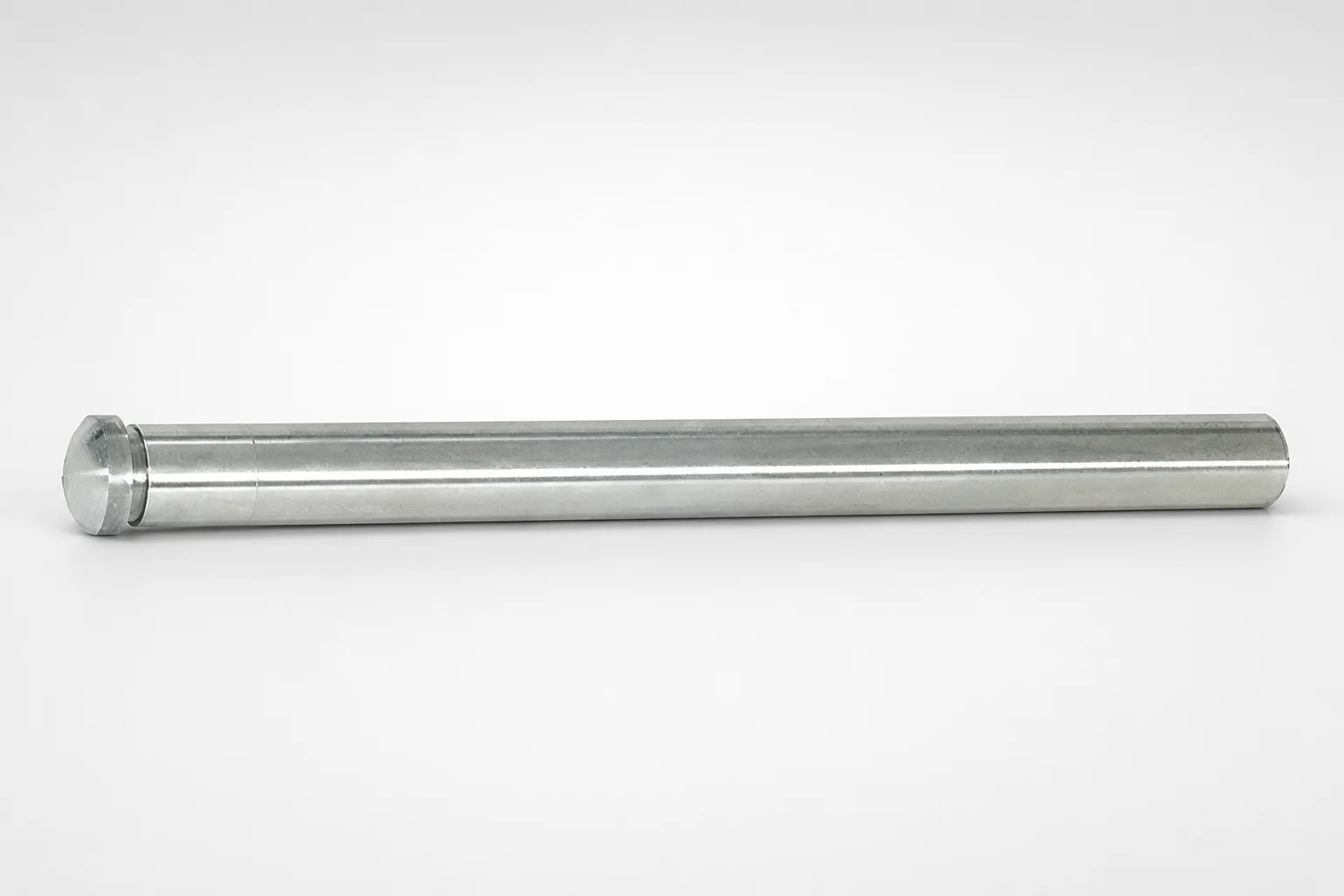
Hotwork Steel Radius Angle Pins - Nitrided
Radius angle pins (hotwork steel) are precision-ground components with a pre-machined spherical radius on the head for stable press-fit placement. They’re commonly used to locate and support slides with consistent engagement under production conditions.
- Pre-machined spherical radius on the head improves smooth slide movement
- Ground and nitrided hotwork steel construction delivers wear-resistant surfaces
- Surface hardness 65–74 Rc and core hardness 35–40 Rc balance durability and toughness
- Typical use with lifters and slides in die and mold assemblies
Specifications
15 configurations available
| Nominal Pin Diameter (in) | D (Actual Pin Diameter) (in) | L (Overall Length) (in) | H (Head Diameter (in) |
|---|---|---|---|
| 3/8" | 0.374" | 5" | 1/2" |
| 3/8" | 0.374" | 6" | 1/2" |
| 3/8" | 0.374" | 7" | 1/2" |
| 3/8" | 0.374" | 10" | 1/2" |
| 1/2" | 0.499" | 5" | 5/8" |
| 1/2" | 0.499" | 6" | 5/8" |
| 1/2" | 0.499" | 7" | 5/8" |
| 1/2" | 0.499" | 10" | 5/8" |
| 5/8" | 0.624" | 6" | 3/4" |
| 5/8" | 0.624" | 10" | 3/4" |
| 3/4" | 0.749" | 7" | 7/8" |
| 3/4" | 0.749" | 10" | 7/8" |
| 3/4" | 0.749" | 14" | 7/8" |
| 1" | 0.999" | 10" | 1-1/8" |
| 1" | 0.999" | 14" | 1-1/8" |
Product Guide
Application Scenarios+
Radius angle pins are used inside injection mold tooling to locate and support moving slide systems, especially where smooth engagement and repeatable positioning are critical. The pre-machined spherical radius on the head helps guide lifters and slides into consistent press-fit contact during cycling, reducing chatter and uneven wear.
- Automotive connector and housing molds: used with lifters/side action slides to maintain stable alignment under high cycle rates. The nitrided hotwork steel surface improves resistance to fretting and wear at the contact zone.
- Appliance and industrial enclosure molds: suited for slide supports that require reliable retention in press-fit pockets while still handling shock loads. The specified core hardness supports toughness during intermittent impact.
- Multi-cavity molds with frequent maintenance access: the ready-to-use nitrided surface helps shorten refurbishment time by maintaining a wear-resistant bearing area for slide movement.
These pins are suited to slide positioning because the spherical head radius promotes smooth travel while the nitrided surface provides durable contact performance in production conditions.
Material & Process Details+
This component is made from hotwork steel with a nitrided surface to increase wear resistance where sliding contact and press-fit stress occur. The specified surface hardness is 65–74 HRC with core hardness 35–40 HRC, providing a practical balance between a hard bearing surface and a tougher core.
- Nitriding state: nitrided case on a hotwork steel substrate for hardened surface performance without fully through-hardening.
- Wear resistance: nitriding supports resistance to surface abrasion and fretting in slide/lifter interfaces.
- Toughness trade-off: the lower core hardness (35–40 HRC) improves impact resistance compared with fully hardened equivalents, helping prevent chipping under shock loading.
If you compare to through-hardened steels, the nitrided approach typically offers better surface durability for contact areas while maintaining more resilient cores for longevity in high-cycle mold motion.
Sizing & Selection Guide+
To select the correct pin, match the pin diameter and overall length to the mating slide pocket and base plate geometry. The catalog options provide Nominal Pin Diameter of 3/8", 1/2", 5/8", 3/4", and 1", which correspond to actual diameters D of 0.374", 0.499", 0.624", 0.749", and 0.999".
- Diameter match: choose the D value that aligns with your press-fit hole size and intended interference. Use the “actual pin diameter” figures (not the nominal) when checking interference fit.
- Length match: set L to your required insertion depth: 5", 6", 7", 10", or 14".
- Head clearance/location: verify H (Head Diameter) against surrounding pocket/clearance constraints: 1/2", 5/8", 3/4", 7/8", or 1-1/8".
Recommended fit verification should consider your mold steel machining tolerances and any counterbore/shoulder features so the pin seats consistently without binding during slide motion. All listed dimensions are fixed options by size; select the closest configuration that meets cavity/core requirements.
Frequently Asked Questions
How do I choose the correct diameter for a press-fit pocket—should I use nominal or actual pin diameter?+
Use the provided actual pin diameter (D) values for fit checks: 0.374", 0.499", 0.624", 0.749", or 0.999". The nominal sizes (3/8", 1/2", etc.) are labels; the interference must be calculated using D. Confirm that your pocket diameter and tolerance stack provide the intended press-fit without overstressing the slide.
What hardness should I expect at the contact surface versus the core?+
This series specifies surface hardness of 65–74 HRC and core hardness of 35–40 HRC. The nitrided case produces the higher surface hardness for wear resistance where the pin contacts lifters/slides. The softer core supports toughness against cyclic impact during mold motion.
Which length option (L) should I select for slide support without bottoming out?+
Select L based on the required insertion depth in the slide support pocket: 5", 6", 7", 10", or 14". Ensure the pin does not bottom against the end of the cavity/core feature. If your pocket has a shoulder or counterbore, measure from the seating surface to the limit to choose the safest length.
How do head diameter (H) and the spherical radius affect slide engagement?+
The pin head includes a precision-ground spherical radius to promote smooth, stable press-fit positioning and consistent engagement. Verify H against the surrounding clearance/shoulder geometry to prevent interference during slide travel: 1/2", 5/8", 3/4", 7/8", or 1-1/8". Correct head clearance helps avoid binding and uneven wear in the slide motion path.
When would I prefer nitrided hotwork steel pins over fully through-hardened pins in a slide system?+
Prefer the nitrided hotwork steel variant when your application needs a hard bearing/contact surface with a tougher core. The specified combination of 65–74 HRC surface and 35–40 HRC core is intended to resist wear while improving resistance to chipping under cyclic shock. Through-hardened alternatives may be more brittle if fully hardened through the cross-section.
Related Products
Need Custom Specifications?
Our engineering team can help with custom configurations, material selection, and volume pricing.