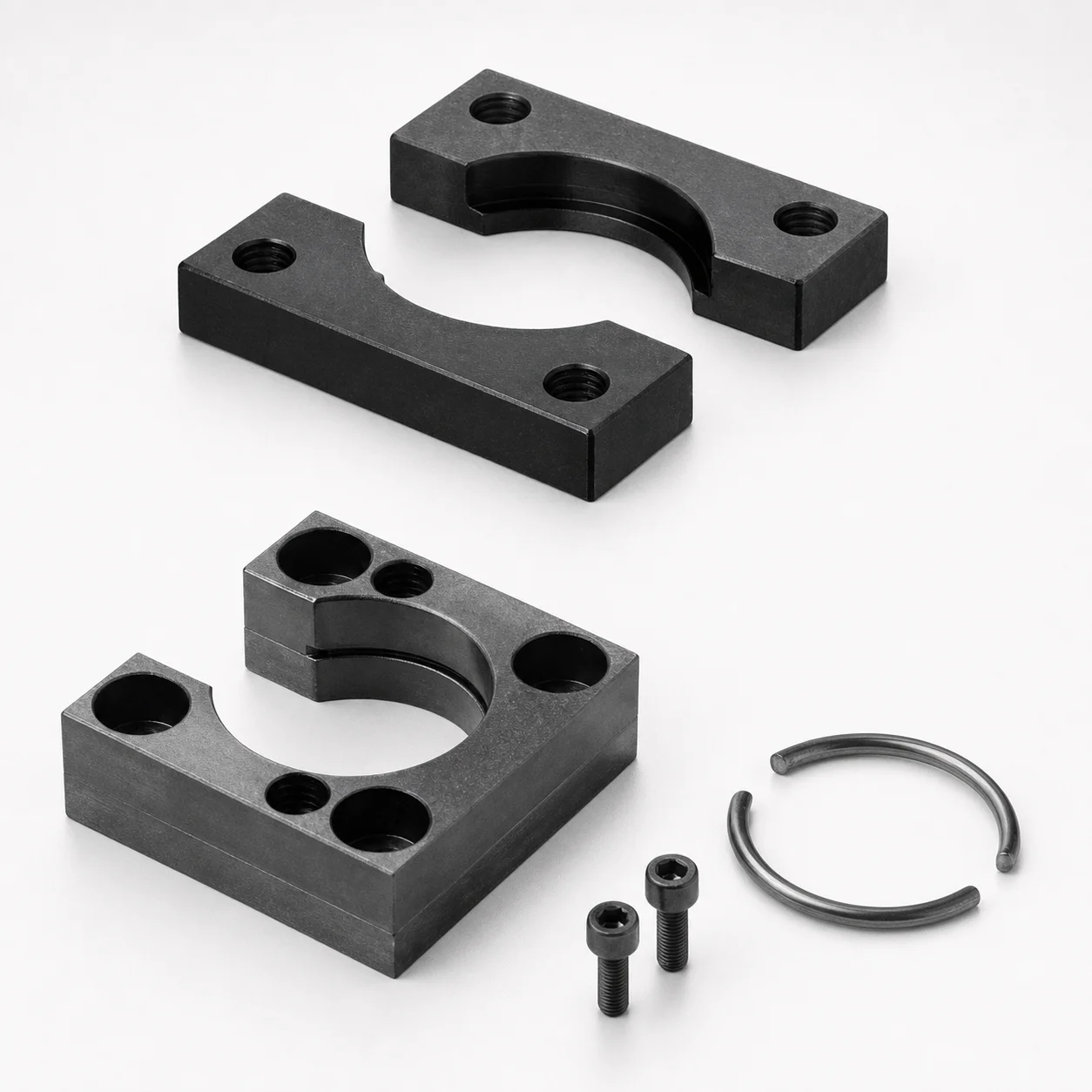
Gas Spring Lower Groove Mounting Plate
Gas Spring lower groove mounting plate is a plates-only component designed to support lower groove mounting on compatible gas springs. Use the catalog table to select the applicable gas spring configuration.
- Plates only for lower groove mount integration with the correct gas spring
- Multiple plate types available (FFC, FFCA, FFS, FCM, FFCB) to match mounting needs
- Accommodates a wide outer diameter (D) range for flexible system design
- Selection guided by the catalog table to ensure proper fit and mounting compatibility
Specifications
29 configurations available
| Outer diameter (D) (mm) | L Dimension (L) (mm) | Plate Type |
|---|---|---|
| 19 | 45 | FCM |
| 25 | 50 | FCM |
| 32 | 50 | FFC |
| 38 | 55 | FFC |
| 45 | 70 | FFC |
| 50 | 75 | FFC |
| 63 | 85 | FFC |
| 75 | 100 | FFC |
| 95 | 120 | FFC |
| 120 | 140 | FFC |
| 150 | 190 | FFC |
| 195 | 210 | FFC |
| 32 | 50 | FFCA |
| 38 | 55 | FFCA |
| 45 | 70 | FFCA |
| 50 | 75 | FFCA |
| 63 | 85 | FFCA |
| 75 | 100 | FFCA |
| 95 | 120 | FFCA |
| 120 | 140 | FFCA |
| 150 | 190 | FFCA |
| 195 | 210 | FFCA |
| 63 | 100 | FFCB |
| 50 | 75 | FFS |
| 63 | 100 | FFS |
| 75 | 100 | FFS |
| 95 | 125 | FFS |
| 120 | 140 | FFS |
| 150 | 175 | FFS |
Product Guide
Application Scenarios+
This lower groove mounting plate is used in injection mold tooling where a compatible gas spring must be integrated to provide consistent, controlled opening/return force. It is intended for plate-only support of the lower groove mounting configuration, making it suitable for mold base and machine-setup designs that rely on catalog-specified compatibility.
Common scenarios include:
- Automotive part molds: Mount the gas spring plate on the lower groove to help stabilize slide or shut height over repeated cycles, especially when repeated thermal cycles require predictable force.
- Consumer electronics housings: Use the correct plate type (FFC/FFCA/FFS/FCM/FFCB) to match the gas spring groove geometry and maintain consistent actuation for cover-opening mechanisms.
- Medical device molding fixtures: Select the appropriate outer diameter (D) and length (L) range so the plate seats correctly without interference, supporting repeatable movement under sustained production loads.
Because this is specifically built for lower groove integration and multiple plate types are available, it reduces fit risk versus using non-matching mounting styles.
Material & Process Details+
The provided specifications for this item focus on dimensional compatibility (outer diameter D, length L) and plate type (FCM, FFC, FFCA, FFCB, FFS). No steel grade, heat-treatment condition, or hardness (HRC) data is included in the input, so the exact material properties cannot be stated from the given information.
For engineering validation, treat this as a component mating part that must be selected by the gas spring catalog table to ensure correct mechanical fit and load transfer. When you confirm the compatible gas spring model, request the associated steel grade and heat treatment details (e.g., quenched & tempered or surface treatments such as nitriding if applicable) from your supplier documentation.
- Hardness & wear: Verify whether the plate requires higher wear resistance depending on how the groove interface cycles under load.
- Toughness trade-off: If the mating gas spring uses a hardened body, ensure the plate’s toughness is adequate to avoid cracking at groove edges.
Sizing & Selection Guide+
Selection is driven by matching your target gas spring lower groove geometry using the catalog table. This plate provides variable dimensions for the groove interface: outer diameter (D) = 19 ~ 195 mm and L dimension (L) = 45 ~ 210 mm.
How to size correctly:
- Step 1: Identify the compatible gas spring configuration (lower groove mounting) and then choose the matching Plate Type: FCM, FFC, FFCA, FFCB, or FFS.
- Step 2: Confirm the plate’s D falls within the required outer diameter envelope for your mounting interface.
- Step 3: Verify L (45 ~ 210 mm) provides the correct axial length for proper seating and prevents overhang or interference with adjacent components.
Tolerance & fit: The input does not specify tolerances. Use the compatible gas spring and plate type to ensure the designed fit, and reference the catalog table for the official fit/clearance values rather than relying on nominal dimensions alone.
Frequently Asked Questions
Which gas spring plate type should I use for lower groove mounting: FCM, FFC, FFCA, FFCB, or FFS?+
What outer diameter (D) and length (L) ranges are available for this lower groove mounting plate?+
Can I use this plate as an upper groove mounting component?+
Is the plate a complete gas spring or does it require a separate gas spring component?+
How do I verify dimensional fit for mold tooling after choosing D and L?+
Related Products
Need Custom Specifications?
Our engineering team can help with custom configurations, material selection, and volume pricing.