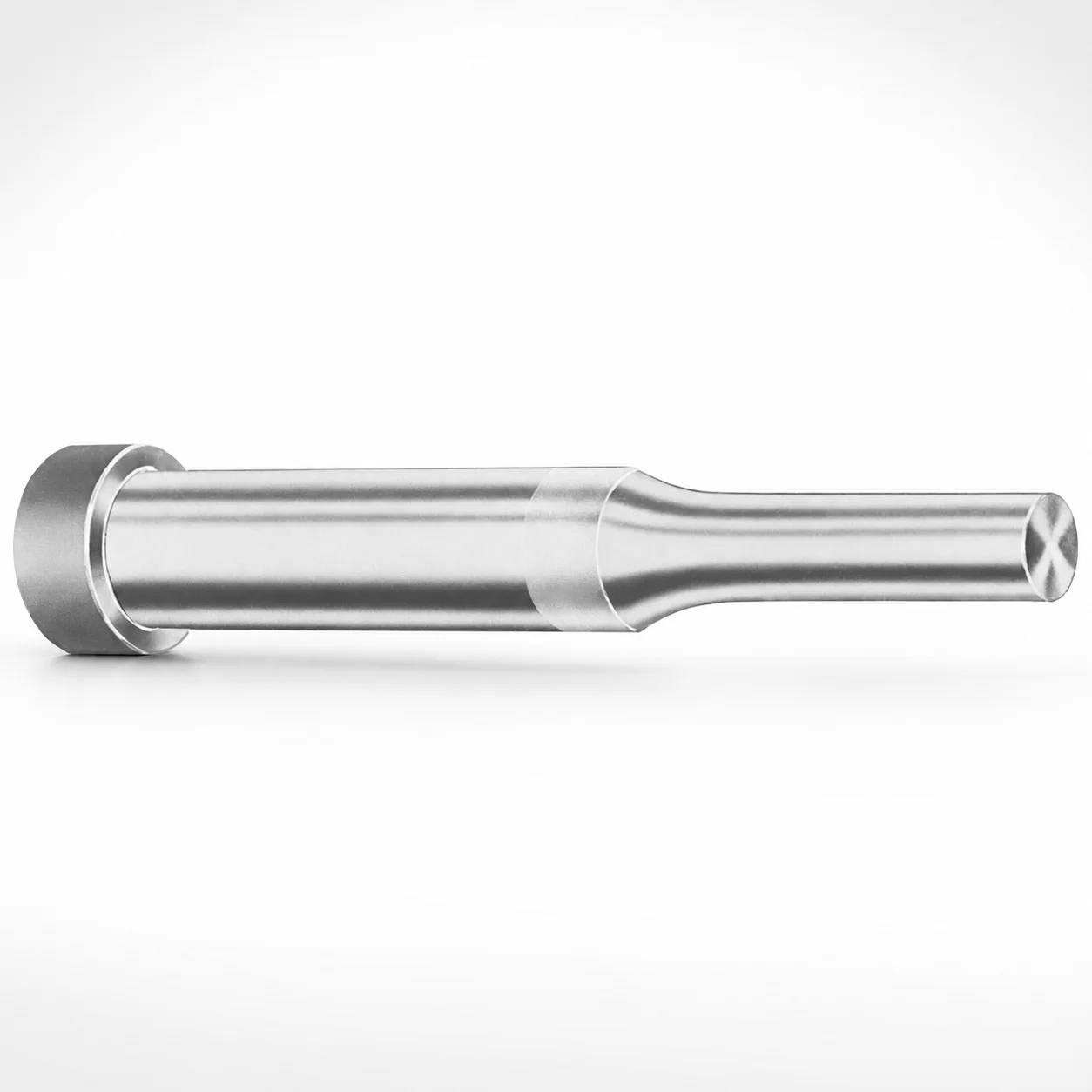
Metric XVP Coated Regular Punches
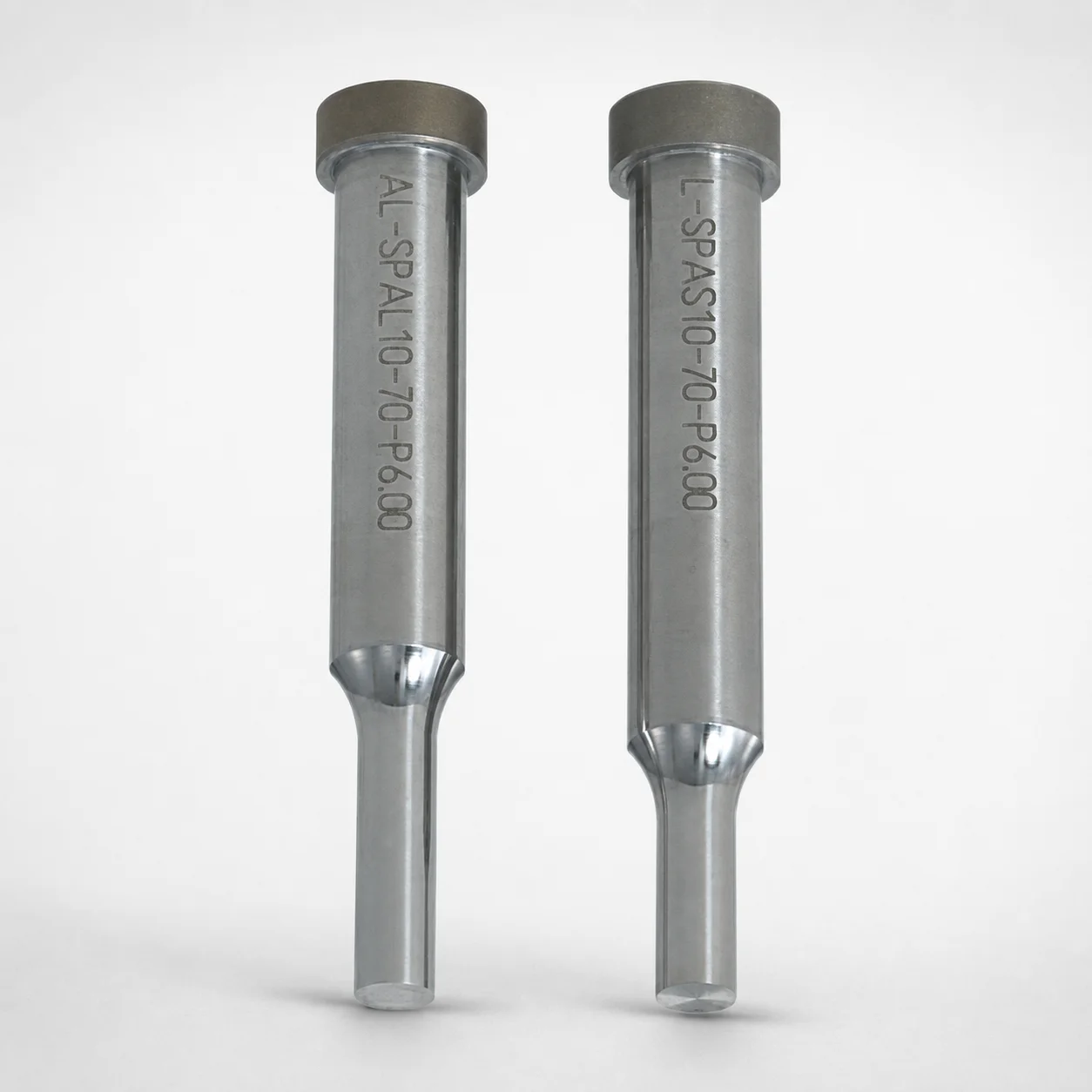
Metric XVP coated regular punches are designed for punching operations where consistent tool life and reliable performance matter. The XVP coating helps manage wear during repeated forming cycles while maintaining accurate punch engagement.
- XVP coating supports improved wear resistance for longer service life
- Coated punch tip options help match different press and part requirements
- Consistent metric standardization supports stable assembly and repeatability
- Suitable for precision punching in production dies and progressive tooling
Specifications
318 configurations available
| Tip shape | Material | D (Shank dia.) (mm) | L1 (Point Length) (mm) | L (Length) (mm) | P Dimension (mm) | W Dimension (mm) | R Dimension (mm) |
|---|---|---|---|---|---|---|---|
| H | M2 | 04 | 8 ~ 13 | 40 ~ 100 | 1.3 ~ 3.95 | 1.3 ~ 1.59 | - |
| H | M2 | 04 | 8 ~ 13 | 40 ~ 100 | 1.3 ~ 3.95 | 1.6 ~ 3.95 | - |
| H | PS | 04 | 8 ~ 13 | 40 ~ 100 | 1.3 ~ 3.95 | 1.3 ~ 1.59 | - |
| H | PS | 04 | 8 ~ 13 | 40 ~ 100 | 1.3 ~ 3.95 | 1.6 ~ 3.95 | - |
| H | M2 | 05 | 13 ~ 19 | 40 ~ 100 | 1.6 ~ 4.95 | 1.6 ~ 4.95 | - |
| H | PS | 05 | 13 ~ 19 | 40 ~ 100 | 1.6 ~ 4.95 | 1.6 ~ 4.95 | - |
| H | M2 | 06 | 13 ~ 19 | 40 ~ 100 | 1.6 ~ 5.95 | 1.6 ~ 5.95 | - |
| H | PS | 06 | 13 ~ 19 | 40 ~ 100 | 1.6 ~ 5.95 | 1.6 ~ 5.95 | - |
| H | M2 | 08 | 19 ~ 25 | 50 ~ 100 | 2.5 ~ 7.95 | 2.5 ~ 7.95 | - |
| H | PS | 08 | 19 ~ 25 | 50 ~ 100 | 2.5 ~ 7.95 | 2.5 ~ 7.95 | - |
| H | M2 | 10 | 19 ~ 25 | 50 ~ 100 | 3.2 ~ 9.95 | 3.2 ~ 9.95 | - |
| H | PS | 10 | 19 ~ 25 | 50 ~ 100 | 3.2 ~ 9.95 | 3.2 ~ 9.95 | - |
| H | M2 | 13 | 19 ~ 25 | 50 ~ 100 | 4 ~ 12.95 | 4 ~ 4.49 | - |
| H | M2 | 13 | 19 ~ 25 | 50 ~ 100 | 4 ~ 12.95 | 4.5 ~ 12.95 | - |
| H | PS | 13 | 19 ~ 25 | 50 ~ 100 | 4 ~ 12.95 | 4 ~ 4.49 | - |
| H | PS | 13 | 19 ~ 25 | 50 ~ 100 | 4 ~ 12.95 | 4.5 ~ 12.95 | - |
| H | M2 | 16 | 19 ~ 25 | 50 ~ 100 | 6 ~ 15.95 | 6 ~ 15.95 | - |
| H | PS | 16 | 19 ~ 25 | 50 ~ 100 | 6 ~ 15.95 | 6 ~ 15.95 | - |
| H | M2 | 20 | 19 ~ 25 | 56 ~ 100 | 6 ~ 19.95 | 6 ~ 7.99 | - |
| H | M2 | 20 | 19 ~ 25 | 56 ~ 100 | 6 ~ 19.95 | 8 ~ 19.95 | - |
| H | PS | 20 | 19 ~ 25 | 56 ~ 100 | 6 ~ 19.95 | 6 ~ 7.99 | - |
| H | PS | 20 | 19 ~ 25 | 56 ~ 100 | 6 ~ 19.95 | 8 ~ 19.95 | - |
| H | M2 | 25 | 19 ~ 25 | 56 ~ 100 | 6 ~ 24.95 | 6 ~ 8.99 | - |
| H | M2 | 25 | 19 ~ 25 | 56 ~ 100 | 6 ~ 24.95 | 9 ~ 24.95 | - |
| H | PS | 25 | 19 ~ 25 | 56 ~ 100 | 6 ~ 24.95 | 6 ~ 8.99 | - |
| H | PS | 25 | 19 ~ 25 | 56 ~ 100 | 6 ~ 24.95 | 9 ~ 24.95 | - |
| H | M2 | 32 | 25 ~ 30 | 63 ~ 100 | 7.2 ~ 31.95 | 7.2 ~ 9.99 | - |
| H | M2 | 32 | 25 ~ 30 | 63 ~ 100 | 7.2 ~ 31.95 | 10 ~ 31.95 | - |
| H | PS | 32 | 25 ~ 30 | 63 ~ 100 | 7.2 ~ 31.95 | 7.2 ~ 9.99 | - |
| H | PS | 32 | 25 ~ 30 | 63 ~ 100 | 7.2 ~ 31.95 | 10 ~ 31.95 | - |
| J | M2 | 04 | 8 ~ 13 | 40 ~ 100 | 1.3 ~ 3.95 | 1.3 ~ 1.59 | - |
| J | M2 | 04 | 8 ~ 13 | 40 ~ 100 | 1.3 ~ 3.95 | 1.6 ~ 3.95 | - |
| J | PS | 04 | 8 ~ 13 | 40 ~ 100 | 1.3 ~ 3.95 | 1.3 ~ 1.59 | - |
| J | PS | 04 | 8 ~ 13 | 40 ~ 100 | 1.3 ~ 3.95 | 1.6 ~ 3.95 | - |
| J | M2 | 05 | 13 ~ 19 | 40 ~ 100 | 1.6 ~ 4.95 | 1.6 ~ 4.95 | - |
| J | PS | 05 | 13 ~ 19 | 40 ~ 100 | 1.6 ~ 4.95 | 1.6 ~ 4.95 | - |
| J | M2 | 06 | 13 ~ 19 | 40 ~ 100 | 1.6 ~ 5.95 | 1.6 ~ 5.95 | - |
| J | PS | 06 | 13 ~ 19 | 40 ~ 100 | 1.6 ~ 5.95 | 1.6 ~ 5.95 | - |
| J | M2 | 08 | 19 ~ 25 | 50 ~ 100 | 2.5 ~ 7.95 | 2.5 ~ 7.95 | - |
| J | PS | 08 | 19 ~ 25 | 50 ~ 100 | 2.5 ~ 7.95 | 2.5 ~ 7.95 | - |
| J | M2 | 10 | 19 ~ 25 | 50 ~ 100 | 3.2 ~ 9.95 | 3.2 ~ 9.95 | - |
| J | PS | 10 | 19 ~ 25 | 50 ~ 100 | 3.2 ~ 9.95 | 3.2 ~ 9.95 | - |
| J | M2 | 13 | 19 ~ 25 | 50 ~ 100 | 4 ~ 12.95 | 4 ~ 4.49 | - |
| J | M2 | 13 | 19 ~ 25 | 50 ~ 100 | 4 ~ 12.95 | 4.5 ~ 12.95 | - |
| J | PS | 13 | 19 ~ 25 | 50 ~ 100 | 4 ~ 12.95 | 4 ~ 4.49 | - |
| J | PS | 13 | 19 ~ 25 | 50 ~ 100 | 4 ~ 12.95 | 4.5 ~ 12.95 | - |
| J | M2 | 16 | 19 ~ 25 | 50 ~ 100 | 6 ~ 15.95 | 6 ~ 15.95 | - |
| J | PS | 16 | 19 ~ 25 | 50 ~ 100 | 6 ~ 15.95 | 6 ~ 15.95 | - |
| J | M2 | 20 | 19 ~ 25 | 56 ~ 100 | 6 ~ 19.95 | 6 ~ 7.99 | - |
| J | M2 | 20 | 19 ~ 25 | 56 ~ 100 | 6 ~ 19.95 | 8 ~ 19.95 | - |
Product Guide
Application Scenarios+
Metric XVP coated regular punches are used in injection mold tooling and stamping-style operations where a punch must pierce, form, or size features with repeatable engagement across many cycles. The XVP coating variant is especially suitable when you expect abrasive wear at the punch tip and need stable performance in high-throughput production dies.
- Automotive connector and terminal dies: Use the correct tip shape (H, J, K, L, N, O, R, V, X, Y, Z) to match the required hole or feature geometry, while the XVP coating helps reduce tip wear during repeated piercing.
- Consumer electronics housings and brackets: Pair the metric shank diameter range (D = 4–32 mm) and point length selections (L1 = 8–13 to 25–30 mm ranges) with progressive tooling stations to maintain consistent punch penetration and dimensional stability.
- Medical device component fixtures: Select the material grade (M2 or PS) that aligns with your process wear vs. toughness needs; the coated tip supports dependable piercing when cycle life is a priority.
Material & Process Details+
This punch series is offered in M2 and PS tool steel options, enabling selection based on wear resistance and toughness trade-offs. M2 is a high-speed steel grade commonly chosen for tougher cutting/piercing demands and improved wear resistance at the punch tip.
- M2 option: Typically heat-treated to a hardened, service-ready condition (commonly quenched and tempered) to balance hardness with toughness for repeated piercing.
- PS option: Selected when you require a different performance balance in your forming environment, while still using the XVP coating to manage tip wear during production cycles.
Coating role: The XVP coating functions as a wear-control layer at the working area, improving resistance to abrasion and helping maintain consistent punch engagement. Exact hardness (HRC) and specific heat-treatment cycle details are determined by the supplied material condition for the selected grade.
Sizing & Selection Guide+
To select the correct metric regular punch dimensions, start by matching the shank diameter (D) to the tooling guide/bushing ID and alignment feature in your press or die set. Then confirm the working geometry using point length (L1) and overall length (L) so the punch provides sufficient penetration without bottoming against the die plate.
- Shank diameter (D): choose from 4–32 mm to fit your metric tooling interfaces.
- Point length (L1): select the appropriate range: 8–13, 13–19, 19–25, or 25–30 mm, based on required piercing depth.
- Overall length (L): available ranges include 40–100, 50–100, 56–100, or 63–100 mm; match to your stack height and punch stroke setup.
- Tip geometry: select the tip shape (H/J/K/L/N/O/R/V/X/Y/Z) and verify related profile dimensions P (0.8–10 mm), W (1.3–10 mm), and R (0.2 mm) for feature size control.
For best fit and repeatability, maintain consistent metric standards across punch and corresponding die components; if your press uses guides/bushings, ensure the D dimension meets the intended clearance/fit requirements for stable alignment.
Frequently Asked Questions
Which tip shape options (H, J, K, L, N, O, R, V, X, Y, Z) are typically selected for precision hole or feature piercing with metric regular punches?+
Choose the tip shape based on the required feature geometry in your die design. This series supports multiple tip shapes (H, J, K, L, N, O, R, V, X, Y, Z) so you can match the piercing profile to your part requirement while keeping the metric shank interface consistent for assembly stability.
How do I select point length (L1) to achieve the correct piercing depth without damaging the die stack?+
Select L1 from the available ranges (8–13, 13–19, 19–25, 25–30 mm) based on required penetration into the die. Then verify the overall punch length (L) range (40–100, 50–100, 56–100, 63–100 mm) to prevent bottoming against die plates during the punch stroke.
What material grade should I choose—M2 or PS—when XVP coating is used for production piercing?+
The series is available in M2 and PS. Use M2 when you need higher wear capability for repeated piercing, and select PS when your process benefits from that grade’s performance balance. In both cases, the XVP coating is intended to manage tip wear and support dependable piercing over long runs.
How do D (shank diameter) and the tooling interface affect punch stability and repeatability in die sets?+
Choose D from 4–32 mm to match your metric guide/bushing and alignment features. Correct D selection helps maintain punch straightness and consistent engagement during cycles, supporting assembly repeatability in progressive or multi-station tooling.
Are the profile dimensions P (0.8–10 mm), W (1.3–10 mm), and R (0.2 mm) critical for final feature size control?+
Yes—these profile dimensions define the punch tip geometry used for the pierced feature. This series provides P = 0.8–10 mm, W = 1.3–10 mm, and a fixed R = 0.2 mm, so your die drawing should be matched to the corresponding punch geometry to achieve the intended clearance and feature definition.
Related Products
Need Custom Specifications?
Our engineering team can help with custom configurations, material selection, and volume pricing.