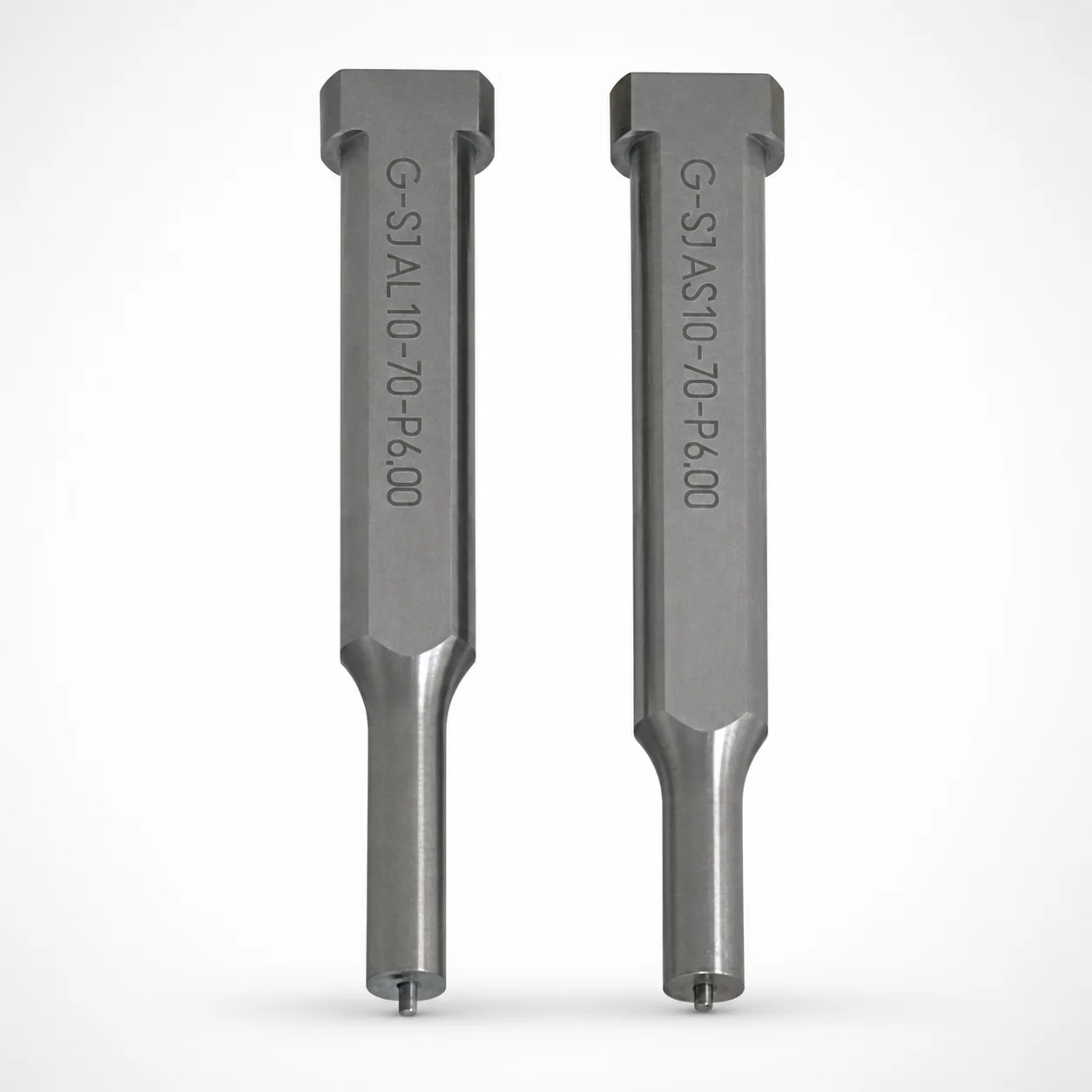
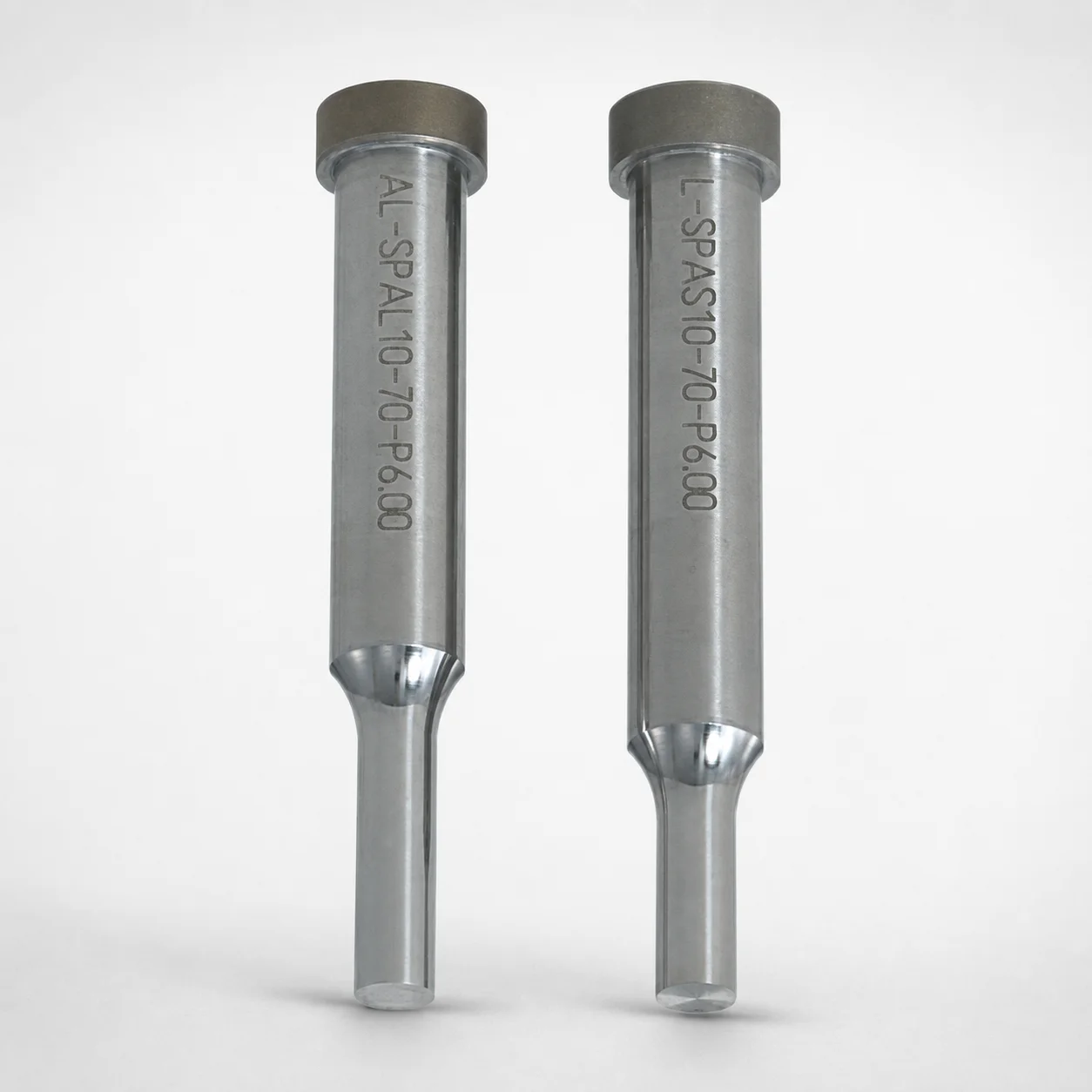
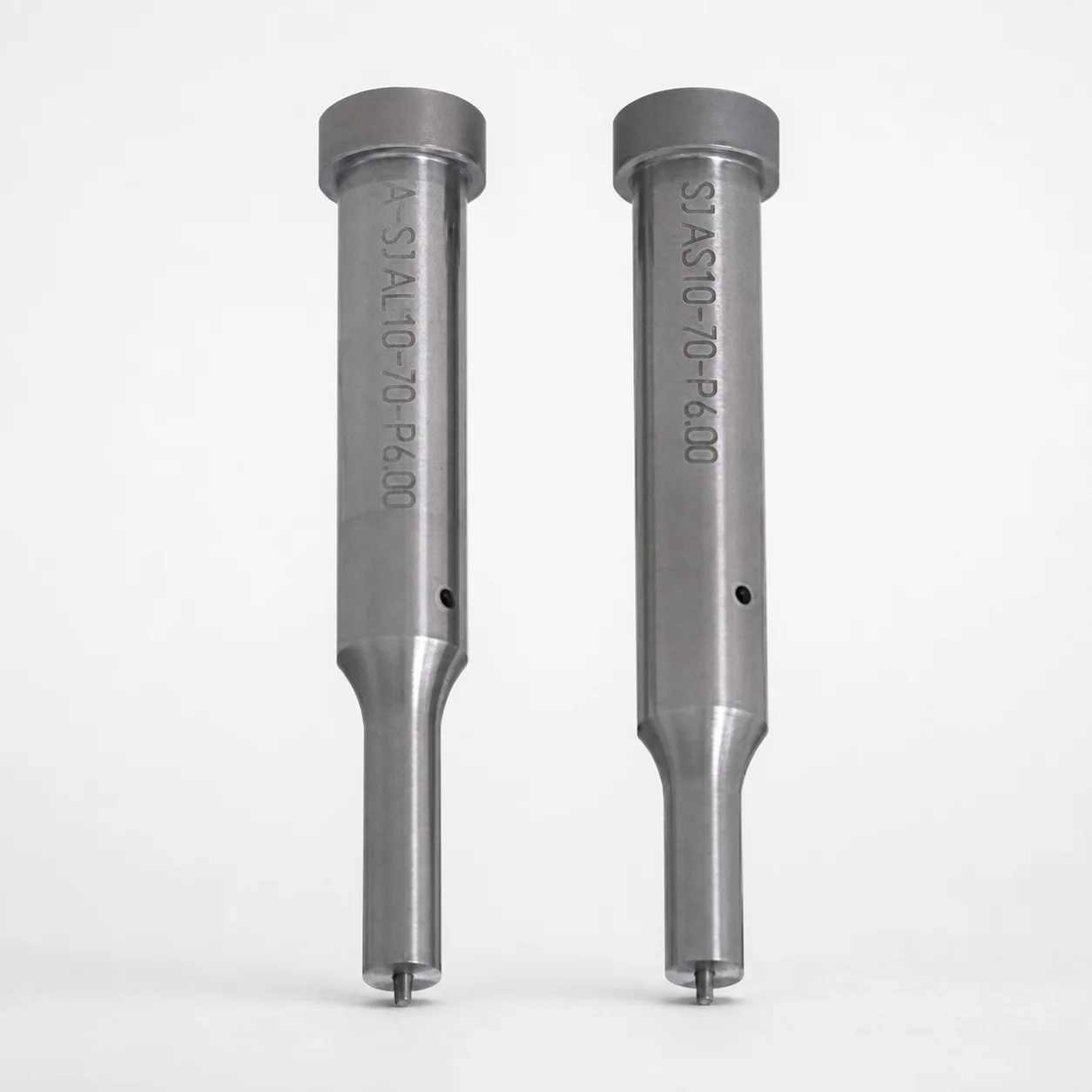
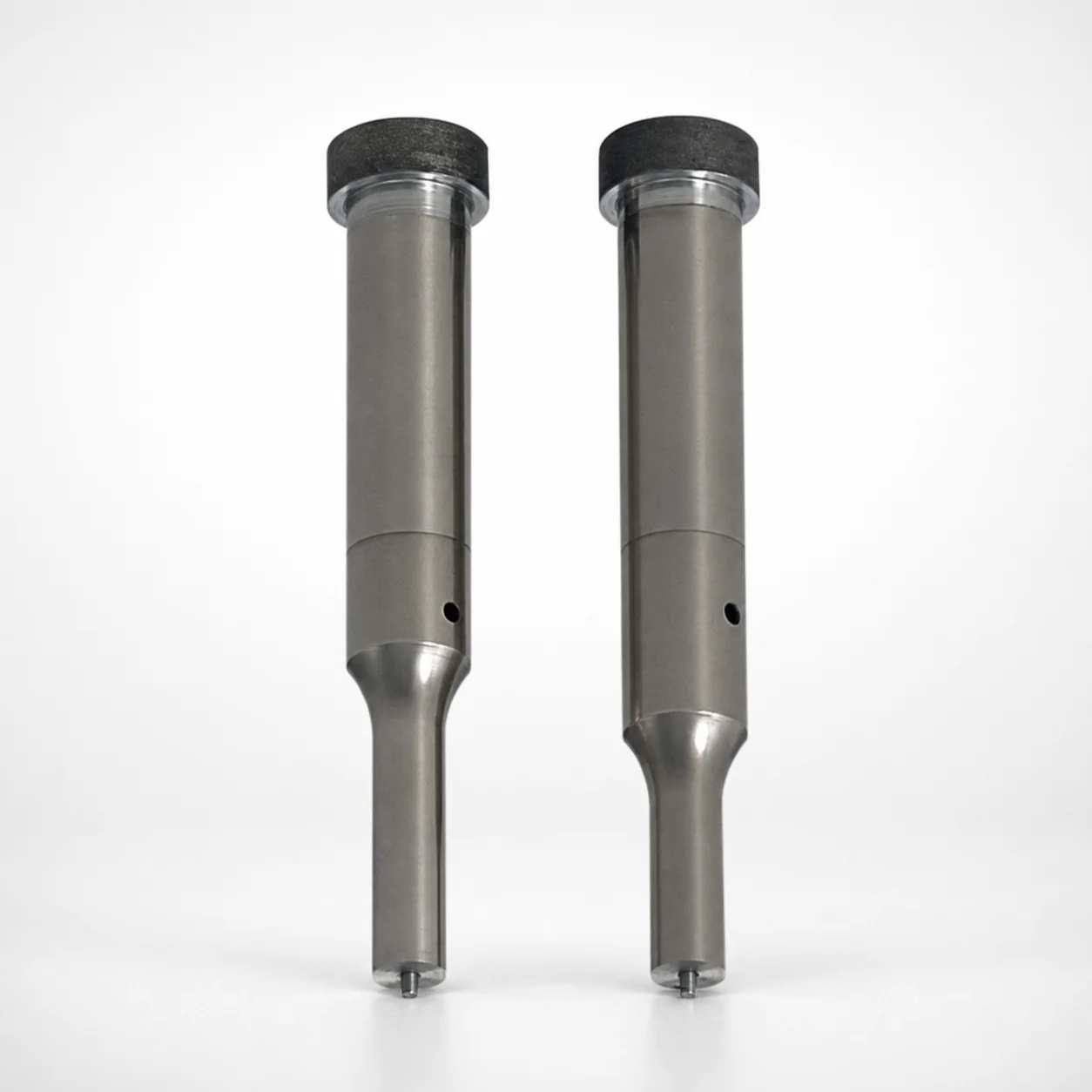
JIS Standard Hardened Steel Key Flat Shank Ejector Punches (TiCN Coating)
Key Flat Shank ejector punches (TiCN coating) are designed for stable locating during press ejection, using a single-stepped shank and spring-reinforced pin mechanism for efficient operation. The TiCN surface treatment supports reliable wear performance in production.
- Single-stepped key flat shank improves alignment for consistent ejection in tool cavities
- TiCN (XCN) coating enhances surface wear resistance and helps maintain smooth punch action
- Precision ground manufacturing supports controlled fit with spring-reinforced jector pin setup
- Built to JIS-standard toolroom needs for die and mold assembly work
Specifications
18090 configurations available
| Jector | Tip shape | Material | Surface treatment | B (Tip length) | D (Shank diameter) (mm) | P (Tip dimension) (mm) | L (L dimension) (mm) | LC (Full length alteration) (mm) | LCT (Head thickness tolerance change + Total length alteration) (mm) | LMT (Head thickness tolerance change + Total length alteration) (mm) | PC (Tip dimension alteration) (mm) | R (Tip corner R) (mm) | W (Tip dimension) (mm) | WC (Tip dimension alteration) (mm) | type |
|---|---|---|---|---|---|---|---|---|---|---|---|---|---|---|---|
| Standard | Round | SKH40 Equivalent (Powdered High-Speed Steel) | None | L | 4 | 1 ~ 2.8 | 50 ~ 80 | - | - | - | - | - | - | - | - |
| Standard | Round | SKH40 Equivalent (Powdered High-Speed Steel) | None | L | 4 | - | 50 ~ 80 | - | - | - | 0.9 ~ 0.99 | - | - | - | - |
| Standard | Round | SKH40 Equivalent (Powdered High-Speed Steel) | None | L | 4 | 1 ~ 2.8 | - | 39 ~ 49.9 | - | - | - | - | - | - | - |
| Standard | Round | SKH40 Equivalent (Powdered High-Speed Steel) | None | L | 4 | - | - | 39 ~ 49.9 | - | - | 0.9 ~ 0.99 | - | - | - | - |
| Standard | Round | SKH40 Equivalent (Powdered High-Speed Steel) | None | L | 4 | 1 ~ 2.8 | - | 50.1 ~ 59.9 | - | - | - | - | - | - | - |
| Standard | Round | SKH40 Equivalent (Powdered High-Speed Steel) | None | L | 4 | - | - | 50.1 ~ 59.9 | - | - | 0.9 ~ 0.99 | - | - | - | - |
| Standard | Round | SKH40 Equivalent (Powdered High-Speed Steel) | None | L | 4 | 1 ~ 2.8 | - | 60.1 ~ 69.9 | - | - | - | - | - | - | - |
| Standard | Round | SKH40 Equivalent (Powdered High-Speed Steel) | None | L | 4 | - | - | 60.1 ~ 69.9 | - | - | 0.9 ~ 0.99 | - | - | - | - |
| Standard | Round | SKH40 Equivalent (Powdered High-Speed Steel) | None | L | 4 | 1 ~ 2.8 | - | 70.1 ~ 79.9 | - | - | - | - | - | - | - |
| Standard | Round | SKH40 Equivalent (Powdered High-Speed Steel) | None | L | 4 | - | - | 70.1 ~ 79.9 | - | - | 0.9 ~ 0.99 | - | - | - | - |
| Standard | Round | SKH40 Equivalent (Powdered High-Speed Steel) | None | L | 4 | 1 ~ 2.8 | - | - | 39 ~ 49.9 | - | - | - | - | - | - |
| Standard | Round | SKH40 Equivalent (Powdered High-Speed Steel) | None | L | 4 | - | - | - | 39 ~ 49.9 | - | 0.9 ~ 0.99 | - | - | - | - |
| Standard | Round | SKH40 Equivalent (Powdered High-Speed Steel) | None | L | 4 | 1 ~ 2.8 | - | - | 50.1 ~ 59.9 | - | - | - | - | - | - |
| Standard | Round | SKH40 Equivalent (Powdered High-Speed Steel) | None | L | 4 | - | - | - | 50.1 ~ 59.9 | - | 0.9 ~ 0.99 | - | - | - | - |
| Standard | Round | SKH40 Equivalent (Powdered High-Speed Steel) | None | L | 4 | 1 ~ 2.8 | - | - | 60.1 ~ 69.9 | - | - | - | - | - | - |
| Standard | Round | SKH40 Equivalent (Powdered High-Speed Steel) | None | L | 4 | - | - | - | 60.1 ~ 69.9 | - | 0.9 ~ 0.99 | - | - | - | - |
| Standard | Round | SKH40 Equivalent (Powdered High-Speed Steel) | None | L | 4 | 1 ~ 2.8 | - | - | 70.1 ~ 79.9 | - | - | - | - | - | - |
| Standard | Round | SKH40 Equivalent (Powdered High-Speed Steel) | None | L | 4 | - | - | - | 70.1 ~ 79.9 | - | 0.9 ~ 0.99 | - | - | - | - |
| Standard | Round | SKH40 Equivalent (Powdered High-Speed Steel) | None | L | 4 | 1 ~ 2.8 | - | - | - | 39 ~ 49.9 | - | - | - | - | - |
| Standard | Round | SKH40 Equivalent (Powdered High-Speed Steel) | None | L | 4 | - | - | - | - | 39 ~ 49.9 | 0.9 ~ 0.99 | - | - | - | - |
| Standard | Round | SKH40 Equivalent (Powdered High-Speed Steel) | None | L | 4 | 1 ~ 2.8 | - | - | - | 50.1 ~ 59.9 | - | - | - | - | - |
| Standard | Round | SKH40 Equivalent (Powdered High-Speed Steel) | None | L | 4 | - | - | - | - | 50.1 ~ 59.9 | 0.9 ~ 0.99 | - | - | - | - |
| Standard | Round | SKH40 Equivalent (Powdered High-Speed Steel) | None | L | 4 | 1 ~ 2.8 | - | - | - | 60.1 ~ 69.9 | - | - | - | - | - |
| Standard | Round | SKH40 Equivalent (Powdered High-Speed Steel) | None | L | 4 | - | - | - | - | 60.1 ~ 69.9 | 0.9 ~ 0.99 | - | - | - | - |
| Standard | Round | SKH40 Equivalent (Powdered High-Speed Steel) | None | L | 4 | 1 ~ 2.8 | - | - | - | 70.1 ~ 79.9 | - | - | - | - | - |
| Standard | Round | SKH40 Equivalent (Powdered High-Speed Steel) | None | L | 4 | - | - | - | - | 70.1 ~ 79.9 | 0.9 ~ 0.99 | - | - | - | - |
| Standard | Round | SKH40 Equivalent (Powdered High-Speed Steel) | None | L | 5 | 2 ~ 3.8 | 50 ~ 80 | - | - | - | - | - | - | - | - |
| Standard | Round | SKH40 Equivalent (Powdered High-Speed Steel) | None | L | 5 | - | 50 ~ 80 | - | - | - | 1.8 ~ 1.99 | - | - | - | - |
| Standard | Round | SKH40 Equivalent (Powdered High-Speed Steel) | None | L | 5 | 2 ~ 3.8 | - | 39 ~ 49.9 | - | - | - | - | - | - | - |
| Standard | Round | SKH40 Equivalent (Powdered High-Speed Steel) | None | L | 5 | - | - | 39 ~ 49.9 | - | - | 1.8 ~ 1.99 | - | - | - | - |
| Standard | Round | SKH40 Equivalent (Powdered High-Speed Steel) | None | L | 5 | 2 ~ 3.8 | - | 50.1 ~ 59.9 | - | - | - | - | - | - | - |
| Standard | Round | SKH40 Equivalent (Powdered High-Speed Steel) | None | L | 5 | - | - | 50.1 ~ 59.9 | - | - | 1.8 ~ 1.99 | - | - | - | - |
| Standard | Round | SKH40 Equivalent (Powdered High-Speed Steel) | None | L | 5 | 2 ~ 3.8 | - | 60.1 ~ 69.9 | - | - | - | - | - | - | - |
| Standard | Round | SKH40 Equivalent (Powdered High-Speed Steel) | None | L | 5 | - | - | 60.1 ~ 69.9 | - | - | 1.8 ~ 1.99 | - | - | - | - |
| Standard | Round | SKH40 Equivalent (Powdered High-Speed Steel) | None | L | 5 | 2 ~ 3.8 | - | 70.1 ~ 79.9 | - | - | - | - | - | - | - |
| Standard | Round | SKH40 Equivalent (Powdered High-Speed Steel) | None | L | 5 | - | - | 70.1 ~ 79.9 | - | - | 1.8 ~ 1.99 | - | - | - | - |
| Standard | Round | SKH40 Equivalent (Powdered High-Speed Steel) | None | L | 5 | 2 ~ 3.8 | - | - | 39 ~ 49.9 | - | - | - | - | - | - |
| Standard | Round | SKH40 Equivalent (Powdered High-Speed Steel) | None | L | 5 | - | - | - | 39 ~ 49.9 | - | 1.8 ~ 1.99 | - | - | - | - |
| Standard | Round | SKH40 Equivalent (Powdered High-Speed Steel) | None | L | 5 | 2 ~ 3.8 | - | - | 50.1 ~ 59.9 | - | - | - | - | - | - |
| Standard | Round | SKH40 Equivalent (Powdered High-Speed Steel) | None | L | 5 | - | - | - | 50.1 ~ 59.9 | - | 1.8 ~ 1.99 | - | - | - | - |
| Standard | Round | SKH40 Equivalent (Powdered High-Speed Steel) | None | L | 5 | 2 ~ 3.8 | - | - | 60.1 ~ 69.9 | - | - | - | - | - | - |
| Standard | Round | SKH40 Equivalent (Powdered High-Speed Steel) | None | L | 5 | - | - | - | 60.1 ~ 69.9 | - | 1.8 ~ 1.99 | - | - | - | - |
| Standard | Round | SKH40 Equivalent (Powdered High-Speed Steel) | None | L | 5 | 2 ~ 3.8 | - | - | 70.1 ~ 79.9 | - | - | - | - | - | - |
| Standard | Round | SKH40 Equivalent (Powdered High-Speed Steel) | None | L | 5 | - | - | - | 70.1 ~ 79.9 | - | 1.8 ~ 1.99 | - | - | - | - |
| Standard | Round | SKH40 Equivalent (Powdered High-Speed Steel) | None | L | 5 | 2 ~ 3.8 | - | - | - | 39 ~ 49.9 | - | - | - | - | - |
| Standard | Round | SKH40 Equivalent (Powdered High-Speed Steel) | None | L | 5 | - | - | - | - | 39 ~ 49.9 | 1.8 ~ 1.99 | - | - | - | - |
| Standard | Round | SKH40 Equivalent (Powdered High-Speed Steel) | None | L | 5 | 2 ~ 3.8 | - | - | - | 50.1 ~ 59.9 | - | - | - | - | - |
| Standard | Round | SKH40 Equivalent (Powdered High-Speed Steel) | None | L | 5 | - | - | - | - | 50.1 ~ 59.9 | 1.8 ~ 1.99 | - | - | - | - |
| Standard | Round | SKH40 Equivalent (Powdered High-Speed Steel) | None | L | 5 | 2 ~ 3.8 | - | - | - | 60.1 ~ 69.9 | - | - | - | - | - |
| Standard | Round | SKH40 Equivalent (Powdered High-Speed Steel) | None | L | 5 | - | - | - | - | 60.1 ~ 69.9 | 1.8 ~ 1.99 | - | - | - | - |
Product Guide
Application Scenarios+
Key flat shank ejector punches with a spring-reinforced jector arrangement are used in injection mold tooling where stable guidance and consistent stroke repeatability are required. The single-stepped key shank supports positive alignment during press ejection, reducing lateral wobble that can affect cavity/core contact and part surface finish.
- Automotive and appliance housings: In multi-up molds, the stepped key flat shank helps maintain smooth, repeatable ejection across the cavity layout. The available TiCN (XCN) coating supports stable wear behavior in production cycles with frequent tool cycles.
- General toolroom die and mold assemblies: These punches are specified to JIS-standard needs, making them suitable for maintenance, replacement, and sub-assembly in standard punch systems.
- Connector and insert molds: For ejector packs that require controlled guidance with varied tip geometries (round, rectangle, oblong, double-flatted round), the correct shank diameter within D = 4–25 mm supports reliable positioning under ejection load.
Choose the TiCN-coated variant when abrasion/wear and low-friction sliding action are priorities during repeated ejection.
Material & Process Details+
These key flat shank ejector punches are offered in multiple tool steels: SKH40 equivalent (powdered high-speed steel), SKH51 equivalent (AISI M2), and SKD11 equivalent (D2). Material selection balances wear resistance against toughness and workability for different duty cycles.
- SKH51 (M2 equivalent): High hardness tool steel typically used when wear resistance is critical; it is well-suited for repetitive ejection surfaces.
- SKD11 (D2 equivalent): A high-carbon, high-chromium tool steel option when abrasion resistance is required, with attention to toughness trade-offs typical of D2-type grades.
- SKH40 (powdered HSS): Powder metallurgy benefits can support more consistent microstructure for wear-focused applications.
The provided variant includes optional surface treatment: none or TiCN (XCN) coating. Heat treatment is described by the “JIS Standard Hardened Steel” designation; for exact HRC and quench/temper parameters, confirm with the specific configured part/material option.
Sizing & Selection Guide+
To select the correct ejector punch, match the shank diameter (D), tip geometry/dimensions, and the length characteristics to the ejector system and mold cavity/core needs.
- Shank diameter: Choose D within 4–25 mm to ensure proper fit in the ejector housing/bushing and stable guidance during stroke.
- Tip dimensions: Select the tip type (round, rectangle, oblong, double-flatted round, radius rectangle) and confirm tip size within P = 1–18 mm, with tip width W = 1–6 mm, and corner radius R = 0.15 mm (as specified).
- Overall length: Use L = 40–80 mm as the key reference dimension. Verify full length alteration limits using LC = 27–90.1 mm (and associated tolerance/alteration limits such as LCT and LMT = 27–90.1 mm).
For close-fit ejector builds, account for the provided tolerance/alteration ranges (e.g., PC = 0.9–9 mm) and select the TiCN-coated or uncoated configuration based on expected sliding wear. Tip/head alterations vary by configuration, so lock dimensions to the configured part drawing for your assembly.
Frequently Asked Questions
Which steel option should I choose between SKH40 (powdered HSS), SKH51 (M2 equivalent), and SKD11 (D2 equivalent) for ejector punch wear?+
How do I size the punch for stable guidance—what should I match first: D or L?+
When should I use the TiCN (XCN) coated variant instead of “None” surface treatment?+
What tolerance/alteration ranges should I consider for the configured punch length and head variation?+
Which tip shapes are available, and how do their dimensions relate to P, W, and R?+
Related Products
Need Custom Specifications?
Our engineering team can help with custom configurations, material selection, and volume pricing.