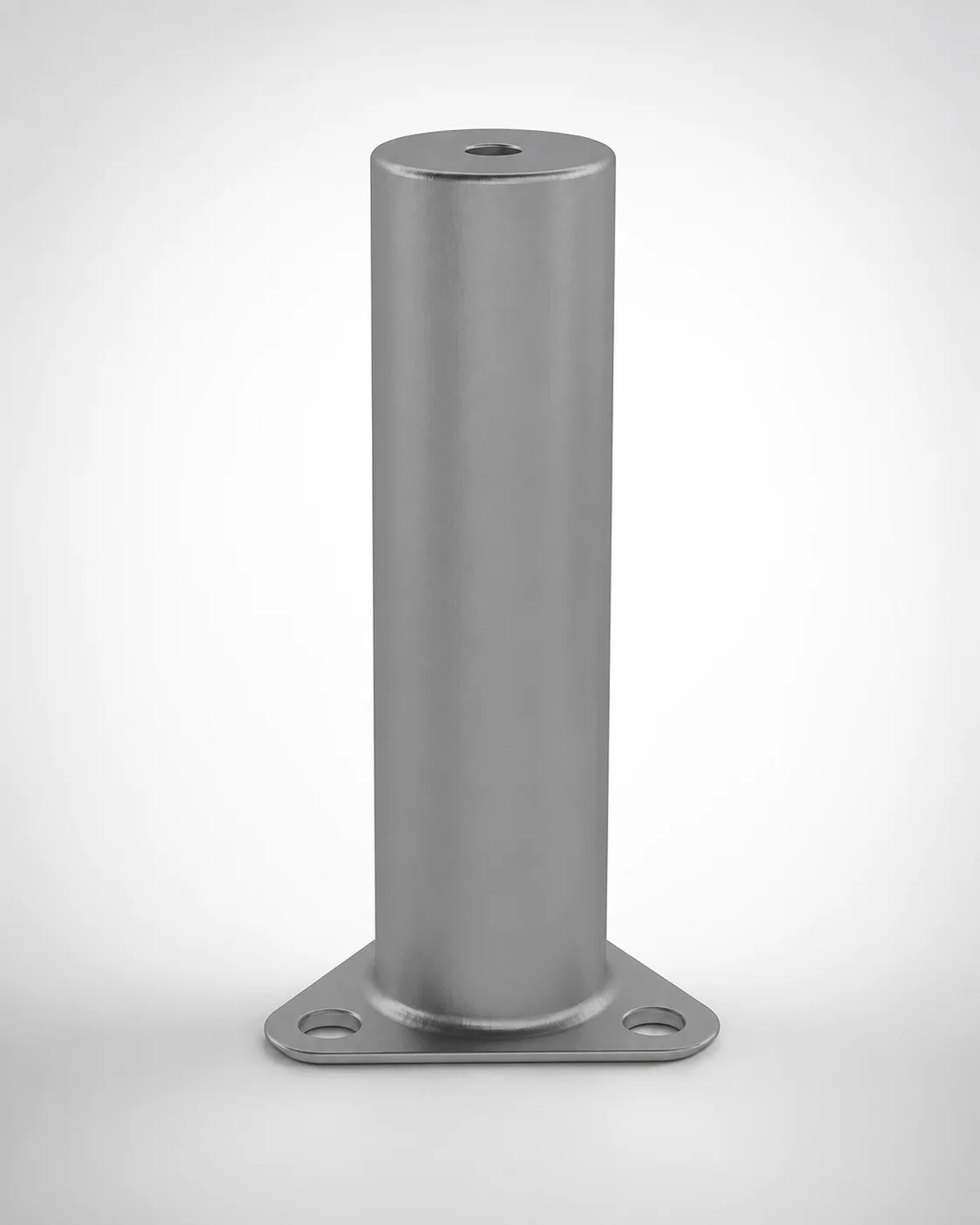
Spring Guards - Inch & Metric
Spring Guards - Inch & Metric protect critical press components from external impacts, helping reduce premature wear and extend service life. Built with robust steel construction for demanding production environments.
- Impact shielding helps safeguard components from premature wear
- Durable steel construction withstands high-stress operating conditions
- Supports both inch and metric applications for easier standardization
- Recommended for spring unit assemblies requiring reliable protection
Specifications
20 configurations available
| D (Outer diameter) (mm) | Spring Diameter (mm) | L (Guide length) (mm) | D (Outer diameter) (in) | Spring Diameter (in) | L (Guide length) (in) |
|---|---|---|---|---|---|
| 32 | 25 | 76 | 1-1/4" | 1" | 3" |
| 32 | 25 | 102 | 1-1/4" | 1" | 4" |
| 32 | 25 | 127 | 1-1/4" | 1" | 5" |
| 32 | 25 | 152 | 1-1/4" | 1" | 6" |
| 32 | 25 | 178 | 1-1/4" | 1" | 7" |
| 38 | 32 | 76 | 1-1/2" | 1-1/4" | 3" |
| 38 | 32 | 102 | 1-1/2" | 1-1/4" | 4" |
| 38 | 32 | 127 | 1-1/2" | 1-1/4" | 5" |
| 38 | 32 | 152 | 1-1/2" | 1-1/4" | 6" |
| 38 | 32 | 178 | 1-1/2" | 1-1/4" | 7" |
| 38 | 32 | 203 | 1-1/2" | 1-1/4" | 8" |
| 38 | 32 | 254 | 1-1/2" | 1-1/4" | 10" |
| 51 | 38 | 102 | 2" | 1-1/2" | 4" |
| 51 | 38 | 127 | 2" | 1-1/2" | 5" |
| 51 | 38 | 152 | 2" | 1-1/2" | 6" |
| 51 | 38 | 178 | 2" | 1-1/2" | 7" |
| 51 | 38 | 203 | 2" | 1-1/2" | 8" |
| 51 | 38 | 229 | 2" | 1-1/2" | 9" |
| 51 | 38 | 254 | 2" | 1-1/2" | 10" |
| 51 | 38 | 305 | 2" | 1-1/2" | 12" |
Product Guide
Application Scenarios+
Spring guards are used in injection molding and press tooling where coil spring assemblies run close to moving or vibrating mechanisms. They act as an external shield, protecting the spring and adjacent components from incidental knocks, debris, and contact with tooling hardware.
- Automotive and industrial part molding: in cam-actuated or spring-assisted release and return systems, the guard’s protective coverage helps reduce premature wear caused by repeated impacts at high cycle rates.
- Consumer goods and appliance molds: for spring unit assemblies that must maintain consistent motion, shielding improves long-term reliability when ejection linkages and slides operate in tight spaces.
- Medical device housing tooling: when process stability is critical, guards help maintain the integrity of spring function by limiting external disturbance to the spring region.
This inch & metric variant is suitable because it supports multiple guide outer diameters (32/38/51 mm or 1-1/4"/1-1/2"/2") and multiple spring diameters (25/32/38 mm or 1"/1-1/4"/1-1/2"), enabling standardization across global programs.
Material & Process Details+
These spring guards are manufactured from durable steel construction to withstand impact-prone press environments. Steel provides a good balance of stiffness and wear resistance, making it effective for protecting spring-related components subjected to intermittent contact or debris strikes.
- Hardness & wear/toughness trade-off: while the exact HRC value is not specified in the provided data, steel guards are typically selected to resist surface deformation under repeated impacts. Higher hardness generally improves abrasion resistance but can reduce toughness; selection should consider the severity of impacts and risk of chipping.
- Heat treatment: the provided information does not specify a heat-treatment condition (e.g., quenched & tempered or nitrided). If tighter wear performance is required, confirm the heat-treatment state with your supplier against your load and duty cycle.
If you compare options, steel guards are commonly chosen over softer alloys when impact protection and dimensional stability are priorities for long production runs.
Sizing & Selection Guide+
Select the spring guard by matching both the spring diameter and the guard outer diameter D to your spring unit geometry. This family supports outer diameter options of 32, 38, 51 mm (or 1-1/4", 1-1/2", 2") and spring diameters of 25, 32, 38 mm (or 1", 1-1/4", 1-1/2").
- Guide length L: choose 76 ~ 305 mm (or 3 ~ 12 in) to cover the critical region where protection is needed without interfering with spring travel.
- Fit & tolerance considerations: verify clearance around adjacent tooling features. Use appropriate tolerances for sliding or non-contact guarding so the guard shields impacts without binding during compression/extension.
- Core/cavity interaction: in mold assemblies, ensure the guard length aligns with the motion envelope of the spring so the shield covers the area most exposed to external impacts.
Dimensions are selectable within the listed ranges; confirm the exact configuration (inch or metric) for compatibility with the rest of the spring unit.
Frequently Asked Questions
Which outer diameter D should I select for a given spring diameter in these spring guards (in/mm)?+
Choose the guard D (Outer diameter) from the available options: 32, 38, 51 mm or 1-1/4", 1-1/2", 2". Then match the Spring Diameter to one of the supported values: 25, 32, 38 mm or 1", 1-1/4", 1-1/2". Using an incorrect diameter can reduce protection effectiveness or cause interference in the spring unit.
What guide length L range is available, and how do I ensure it covers the spring’s motion zone?+
The available guide length L range is 76 ~ 305 mm or 3 ~ 12 in. Select a length that covers the section of the spring that is exposed to external impacts while maintaining clearance for spring compression and extension. If the assembly includes adjacent slides or linkages, verify that the chosen L does not contact moving tooling during full travel.
Are these spring guards intended for inch and metric tooling programs without redesign?+
Yes. This series is explicitly offered in both inch and metric variants, with D options (1-1/4"/1-1/2"/2" or 32/38/51 mm) and spring diameter options (1"/1-1/4"/1-1/2" or 25/32/38 mm). Selecting the correct inch/metric configuration helps standardize procurement across global mold programs.
What material grade or heat treatment should I expect, and does it affect wear performance?+
The provided data specifies durable steel construction but does not list a specific steel grade or an explicit heat-treatment state. Hardness (HRC) and heat treatment (e.g., quenched & tempered or nitrided) should be confirmed for your exact part number if wear resistance requirements are high. If you are comparing alternatives, prioritize the heat-treatment condition and intended duty cycle to balance abrasion resistance and toughness.
How should I check tolerances/clearances when integrating spring guards into a mold assembly?+
Because the guard’s D and L dimensions must coexist with the spring unit and neighboring hardware, confirm that clearances remain available across the spring’s full operating stroke. The dataset provides D, spring diameter, and L ranges, but not tolerance values; therefore, perform a clearance check in the CAD stack-up using your mold’s specified tolerances. If any contact is expected, validate that it occurs only where intended impact protection is acceptable.
Related Products
Need Custom Specifications?
Our engineering team can help with custom configurations, material selection, and volume pricing.