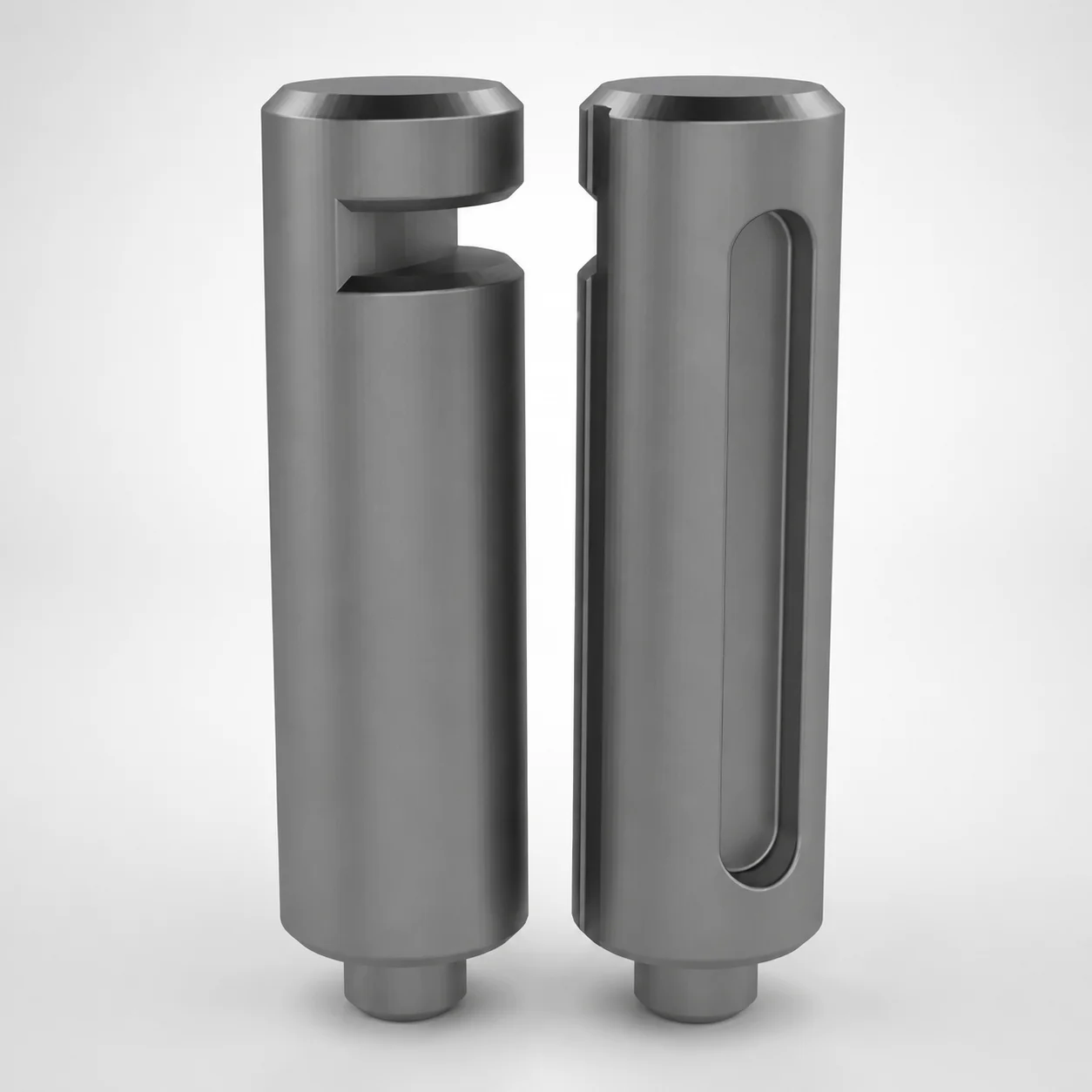
Mini Stock Lifters - Inch
Mini Stock Lifters - Inch (Lamina) provide reliable lifting support for spring components, helping operators handle and transport parts safely. The compact design maintains stability while reducing operator strain in material handling workflows.
- Compact mini-lifter geometry for use in tight industrial workspaces
- Robust steel construction designed for consistent lifting support
- Supports safe, efficient movement of coil spring-related components
- Inch-based lifter format for straightforward selection in U.S. tooling
Specifications
6 configurations available
| Length (in) | A Travel (in) | Diameter (in) |
|---|---|---|
| 1.250" | 0.25" | 3/8" |
| 1.440" | 0.44" | 3/8" |
| 1.630" | 0.63" | 3/8" |
| 1.280" | 0.25" | 1/2" |
| 1.470" | 0.44" | 1/2" |
| 1.660" | 0.63" | 1/2" |
Product Guide
Application Scenarios+
Mini Stock Lifters are used inside injection mold auxiliary stations and component handling fixtures to control the movement of coil-spring-related parts before and after molding operations. Their compact, inch-based format makes them well-suited for layouts where benchtop space and access clearances are limited, such as automotive and appliance mold shops.
One common scenario is automotive connector or latch subassembly molding, where spring components are staged and moved repeatedly between inspection, kitting, and assembly. The stable mini-lifter geometry provides consistent support for safe transportation of small spring-related components.
Another scenario is medical device housings and precision assemblies, where operators need predictable part handling to reduce mix-ups and contact damage during staging. The robust steel construction supports repeatable lifter function in frequent workflows, helping maintain safer material movement in tight work areas.
Material & Process Details+
The provided specification set identifies this product as a steel lifting support component; however, no alloy grade, heat-treatment condition, or hardness value (HRC) is specified in the available data. As a result, performance discussion is limited to application-relevant behavior for steel lifters (e.g., stable stiffness under handling loads).
Manufacturing process (general): steel lifter components are typically produced by forming and machining followed by surface conditioning to ensure reliable contact and consistent travel engagement. Final geometry accuracy and surface finish are critical for smooth motion and predictable support.
- Heat treatment: not specified—confirm the exact steel grade and whether the part is pre-hardened or through-hardened before selecting for wear-critical duty.
- Hardness / wear-toughness trade-off: without an HRC value, choose based on expected cycle count and contact conditions in your handling fixture.
Sizing & Selection Guide+
Select the lifter size by matching your fixture’s required shaft diameter, available installation space, and target A travel to the component’s engagement height needs.
- Diameter: choose between 3/8" and 1/2" based on the mechanical interface and clearance in your lifter guide or cam track.
- Length: available lengths are 1.250", 1.280", 1.440", 1.470", 1.630", and 1.660". Use length to ensure proper support span while staying within tight work envelope constraints.
- A Travel: select 0.25", 0.44", or 0.63" to match the needed lift/clearance for safe part transfer.
Tolerance & fit: because no tolerance band is provided, validate fit in your design by checking clearance between the lifter and mating elements (guides, seats, or stops) across the operating temperature range.
Frequently Asked Questions
Which dimension should control compatibility in a lifter guide: the shaft diameter or the overall length?+
Compatibility is primarily governed by the Diameter selection (3/8" or 1/2") because it determines the mechanical interface fit in the guide or track.
Then use the available Length options (1.250"–1.660" among listed values) to confirm the lifter’s support span fits the fixture envelope without interference.
How do I choose the correct A travel (0.25", 0.44", or 0.63") for safe spring component handling?+
Choose A Travel to match the required lift/clearance for your part transfer path. The available choices are 0.25", 0.44", and 0.63" inches.
If your fixture must lift components over a stop or avoid contact during movement, select the smallest travel that still clears the required height to minimize unnecessary motion.
Are these Mini Stock Lifters provided in a fixed configuration or can dimensions be configured?+
They are dimension-configured via selectable parameters. The data lists multiple Length values (1.250", 1.280", 1.440", 1.470", 1.630", 1.660"), Diameter (3/8" or 1/2"), and A Travel (0.25", 0.44", 0.63").
Confirm which combination your application requires before finalizing the lifter seat and guide geometry.
What steel grade or heat treatment is used in the Mini Stock Lifters - Inch series 250300462317?+
The available product data states steel construction but does not specify the steel grade, heat-treatment state, or hardness in HRC.
To assess wear resistance or cycle-life for high-contact handling, request the exact grade and heat treatment specification for series 250300462317.
For tight U.S. tooling layouts, how does the inch-based design influence selection?+
This series is explicitly listed as an Inch format, with inch-based Diameter, Length, and A Travel options. That simplifies matching to U.S. standard fixture components and drawings without metric conversion.
When designing the mating hardware, use the listed inch dimensions directly and re-check clearances since no tolerance values are included in the provided data.
Related Products
Need Custom Specifications?
Our engineering team can help with custom configurations, material selection, and volume pricing.