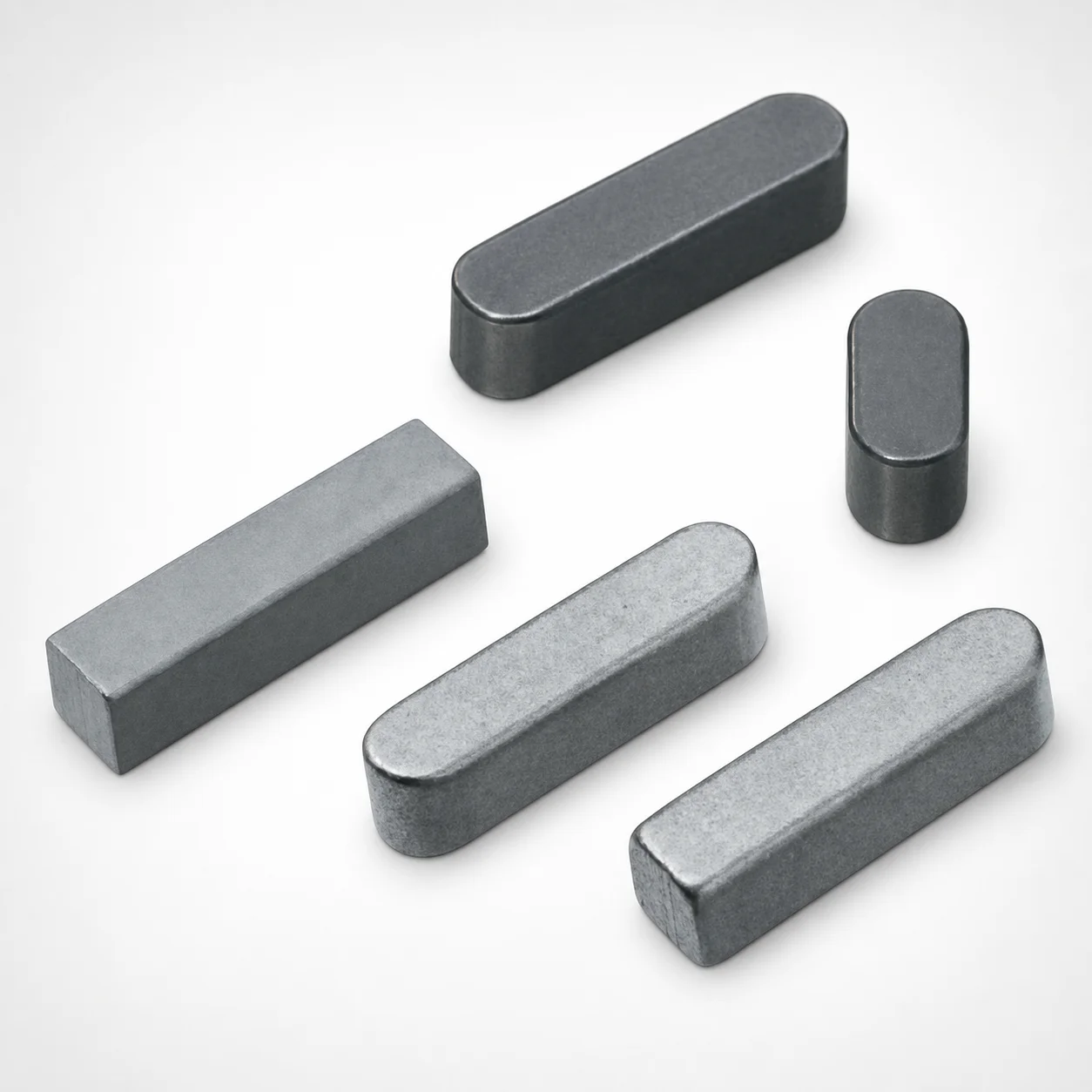
KE Type Key Flats for Punches Preventing Punch Rotation
KE type key flats for punches preventing punch rotation ensure stable alignment and positive engagement for punch assemblies. They improve torque transmission reliability and help prevent slippage or misalignment in production tooling.
- Key-flat design provides secure punch engagement and consistent positioning
- Durable construction supports reliable torque transfer under cyclic load
- Designed to minimize slip and misalignment for smoother press operation
- For use in punch-related tooling systems requiring controlled punch rotation
Specifications
7 configurations available
| L (L dimension) (mm) | type |
|---|---|
| 8 | - |
| 10 | - |
| 12 | - |
| 15 | - |
| 20 | - |
| 25 | - |
| 30 | - |
Product Guide
Application Scenarios+
KE type key flats are used in precision punch and die sets where the punch must maintain a fixed orientation under repeated press cycles. In automotive connector and terminal tooling, they help stabilize the punch position so the punch face stays aligned with the forming cavity, improving consistency in hole location and reducing rotation-driven wear.
They are also suitable for medical device housings and other regulated precision parts where predictable torque transfer is required during trimming and piercing operations. By providing positive engagement, these key flats reduce the risk of slip or misalignment that can lead to dimensional drift over time.
- Controlled rotation for punch assemblies that must resist twisting during cyclic loading
- Improved torque reliability to support stable punch actuation in press tooling
- Consistent positioning to reduce misalignment at the die interface
Material & Process Details+
The provided specification for this KE type key flat series includes the dimensional range (L = 8–30 mm) but does not list a specific steel grade or heat-treatment condition. As a result, the exact hardness (HRC) and wear/toughness trade-offs cannot be confirmed from the available data.
When selecting a key-flat material for punch rotation prevention, engineers typically balance wear resistance (to maintain engagement under friction) with toughness (to resist cracking or deformation under cyclic impact). If your system requires higher durability, confirm whether the supplier offers through-hardened, quenched & tempered, or surface-treated (e.g., nitrided) options for the specific part number.
- Confirm steel grade and heat treatment from the product’s technical sheet
- Verify target hardness (HRC) to match punch load and cycle life
- Choose wear-focused vs toughness-focused grades based on forming severity
Sizing & Selection Guide+
Use the series’ only provided variable, the L dimension, to select the correct key flat length for your punch engagement interface. For this KE type key flats series, L = 8–30 mm, so you should choose the length that matches the corresponding keyway/flat engagement region on the punch holder or punch body.
Start by measuring the required engagement length in your punch assembly (core/punch component interface where rotation must be prevented). Then select an L value within 8–30 mm that provides full contact along the key-flat area to avoid partial engagement, which can increase slip risk.
- Match engagement length: choose L that fully covers the key-flat interface
- Consider fit: verify that the mating features in the punch system are compatible to prevent rocking
- Configurable dimensions: L is variable within the listed range; other specs are not provided here
Frequently Asked Questions
What does the KE key-flat feature do for punch assemblies under press load?+
The KE type key flats are designed to prevent punch rotation by providing stable alignment and positive engagement in the punch assembly interface.
In practice, this reduces slip/misalignment that can develop from torque and cyclic loading, helping maintain consistent forming accuracy.
How do I choose the correct key-flat length (L) for my punch holder?+
Select the key flat length L to match the required engagement zone in your punch assembly. This series is specified for L = 8–30 mm.
Choose an L value that provides full contact along the key-flat interface to minimize partial engagement and rotation-driven drift.
Are there multiple material/heat-treatment options for this key-flat series?+
The provided input data does not specify a steel grade, hardness (HRC), or heat-treatment state for this series.
To confirm material options (e.g., quenched & tempered vs. nitrided) and hardness targets, reference the product’s technical sheet or request confirmation for the exact item code.
What tolerance/fit should I verify to ensure rotation prevention works reliably?+
The data provided only confirms the L dimension range (8–30 mm), not tolerances or fitting limits.
For reliable rotation prevention, verify that your punch holder and mating keyway/flat features provide the intended engagement without excessive clearance that could allow rocking or slip.
Can KE key flats improve torque transfer in trimming/piercing operations?+
Yes—by enabling secure punch engagement, KE key flats improve the consistency of torque transfer in punch-related tooling where the punch is prone to twisting.
They are intended for punch systems requiring controlled punch rotation to reduce misalignment over cyclic production runs.
Related Products
Need Custom Specifications?
Our engineering team can help with custom configurations, material selection, and volume pricing.