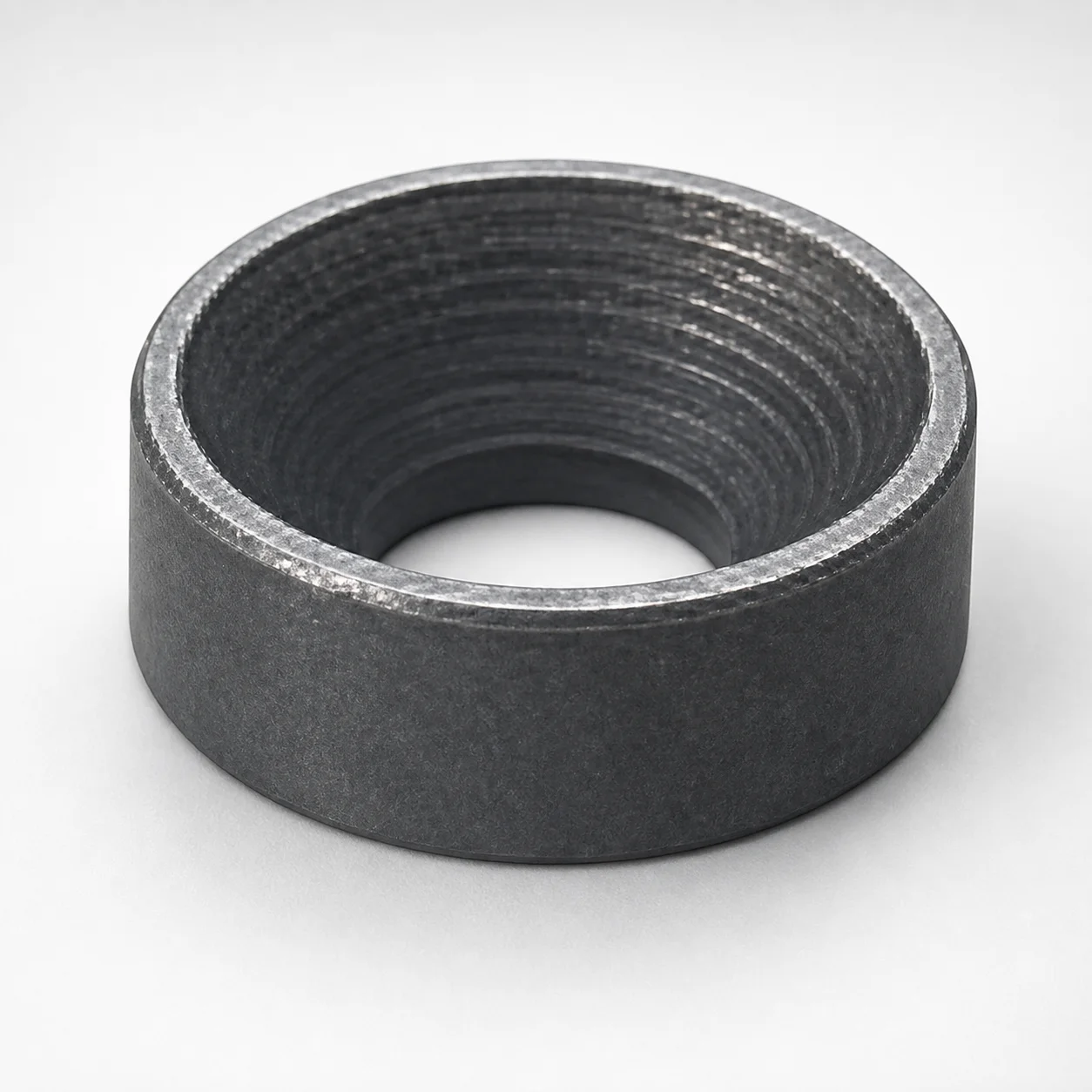
Fixing Keys for Punches with Key Grooves - Round, Countersink
Fixing Keys for Punches with Key Grooves - Round, Countersink are engineered to securely lock punches in place, improving alignment consistency and operational stability during repeated press cycles. Their shock-absorbing design helps protect punch components under high-demand machining.
- Round, countersink fixing key geometry for reliable punch positioning
- Locks with key grooves to support precise alignment and consistent accuracy
- Robust construction absorbs shock and vibration to reduce component stress
- Works with M4 or M5 screw applications for secure mounting
Specifications
4 configurations available
| T (Head thickness/plate thickness) (mm) | Specification | Material | type |
|---|---|---|---|
| 2.5 | For M4 screws | SKS3 | - |
| 3 | For M5 screws | SKS3 | - |
| 2.5 | For M4 screws | S45C | - |
| 3 | For M5 screws | S45C | - |
Product Guide
Application Scenarios+
These fixing keys are used in injection mold tooling where punch components (e.g., ejector/punch inserts and related machining features) must maintain stable positioning under repeated press cycles. In die-cavity machining setups, the round body with a countersink geometry helps seat the key firmly and supports consistent punch alignment, reducing drift during high-frequency operation.
- Automotive connector and bracket molds: use the keys to lock punches with key grooves to a backing plate using M4 or M5 screws, improving dimensional repeatability when vibration and shock are present.
- Medical device housing molds: the vibration-damping behavior supports stable punch location, which helps maintain gate/feature accuracy across large production runs.
- Consumer electronics tooling: the shock-absorbing design reduces stress concentration around the mounting interface, helping protect punch components during rapid cycling.
Material & Process Details+
Two material options are available: SKS3 and S45C. SKS3 is an oil-hardenable steel commonly selected for parts requiring reliable hardness and wear resistance at the locked interface; it offers a stronger balance of rigidity and long-term dimensional stability. S45C is a medium-carbon steel (referenced to typical S45C/AISI 1045-family performance) that can be selected when a more economical baseline toughness is prioritized.
- SKS3 option: supports stable locking performance under repeated shock and vibration; best suited where wear at the groove interface is a concern.
- S45C option: improves resistance to chipping through better toughness-to-hardness balance, though wear resistance may be lower than SKS3 in comparable conditions.
For either steel, the components are typically used in a heat-treated state appropriate for the application, such as quenched and tempered to achieve the target hardness and toughness trade-off for punch mounting stability.
Sizing & Selection Guide+
Select the fixing key variant based on screw size and the plate/head thickness to ensure proper seating and clamping force. The available head/plate thickness T values are 2.5 mm and 3 mm, and the product is specified for M4 screws or M5 screws.
- Match screw size: choose the “For M4 screws” version when the punch mounting uses M4 fasteners; choose “For M5 screws” when the tooling stack and tapped interfaces are M5.
- Match thickness T: use the T = 2.5 mm or T = 3 mm configuration to align the countersink seat with the mating plate thickness and maintain correct clamping geometry.
- Confirm groove compatibility: ensure the punch has the corresponding key groove profile so the fixing key seats fully and maintains alignment during cycling.
Because locking accuracy depends on contact seating, verify that mounting surfaces are clean and free of burrs; small fit variations at the groove and countersink interface can affect repeatability.
Frequently Asked Questions
Which screw size should I choose for these fixing keys—M4 or M5?+
How do I select the correct head/plate thickness T for the key?+
When should I choose SKS3 instead of S45C for punch fixing applications?+
What does the round, countersink geometry improve in punch mounting?+
Will these keys work with any punch as long as it has a key groove?+
Related Products
Need Custom Specifications?
Our engineering team can help with custom configurations, material selection, and volume pricing.