Gate Cut Springs
Flat wire gate cut springs engineered for automated runner separation in three-plate injection molds. Heat-resistant to 120°C or 200°C, these springs provide consistent gate shearing force throughout the mold opening sequence.
Gate Cut Springs
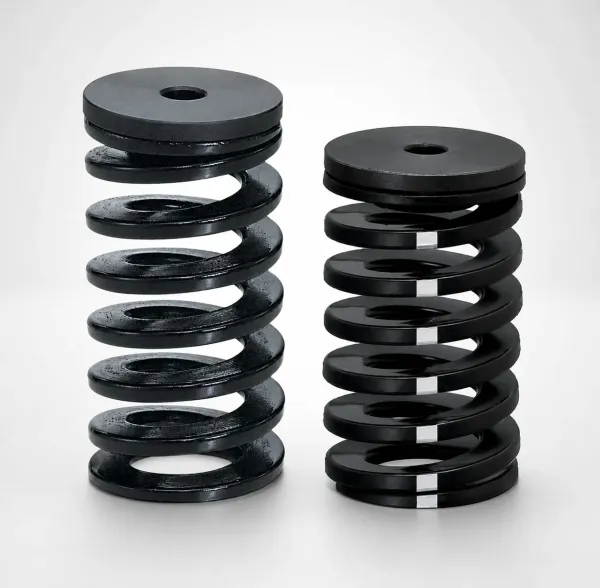
How Gate Cut Springs Work
In a three-plate injection mold, the runner system must separate from the molded part during mold opening. Gate cut springs provide the mechanical force that drives this separation:
- Mold closed: The gate cut spring is compressed between the runner stripper plate and the cavity plate, storing potential energy.
- Mold opens (Stage 1): The spring extends, pushing the runner stripper plate forward. The gate — the thin connection between runner and part — shears under this force.
- Mold opens (Stage 2): The runner drops free. The part remains on the core side for ejection by the ejector system.
Critical parameter: The spring must deliver enough force at the gate shear point to cleanly cut the gate without dragging or leaving a vestige. Insufficient force causes partial gate cuts, leaving a tab that requires secondary trimming.
Temperature Grade Selection
Gate cut springs are available in two temperature ratings. The choice depends on your mold base operating temperature:
| Rating | Max Temperature | Wire Material | Best For |
|---|---|---|---|
| Standard (120°C) | 120°C (248°F) | Carbon steel (SWP-A) | ABS, PP, PE, PS, and other commodity resins with mold temperatures below 80°C |
| Heat-Resistant (200°C) | 200°C (392°F) | SiCr alloy (SWOSC-V) | PC, PA, POM, PBT, and engineering resins with mold temperatures above 80°C |
Application Scenarios
Three-Plate Mold Runner Separation
Pain point: Manual gate trimming after molding adds labor cost and risks cosmetic damage to the part surface.
Why it fits: Gate cut springs automate the runner/part separation during mold opening, eliminating manual trimming. Clean shear at the gate point leaves a flush surface.
Recommended: Standard 120°C Gate Cut Springs for commodity resins
Hot Runner to Cold Runner Transition
Pain point: Converting from hot runner to cold runner system requires reliable automated degating to maintain cycle time.
Why it fits: Gate cut springs provide the consistent degating force needed to match hot runner cycle times. The 200°C rated version handles the higher mold temperatures common in hot-to-cold transition zones.
Recommended: 200°C Heat-Resistant Gate Cut Springs
Engineering Resources
How Gate Cut Springs Automate Runner Stripping
Working principle, force calculation, and installation guidelines for three-plate molds.
When to Use Gate Cut Springs vs Manual Trimming
Cost-benefit analysis: automated vs manual gate removal for different production volumes.
Frequently Asked Questions
How do I calculate the required gate cut spring force?+
Can gate cut springs be used in two-plate molds?+
How often should gate cut springs be replaced?+
Need a Custom Quote?
Send your specifications and receive a quote. MOQ: 1 piece. Custom dimensions available.