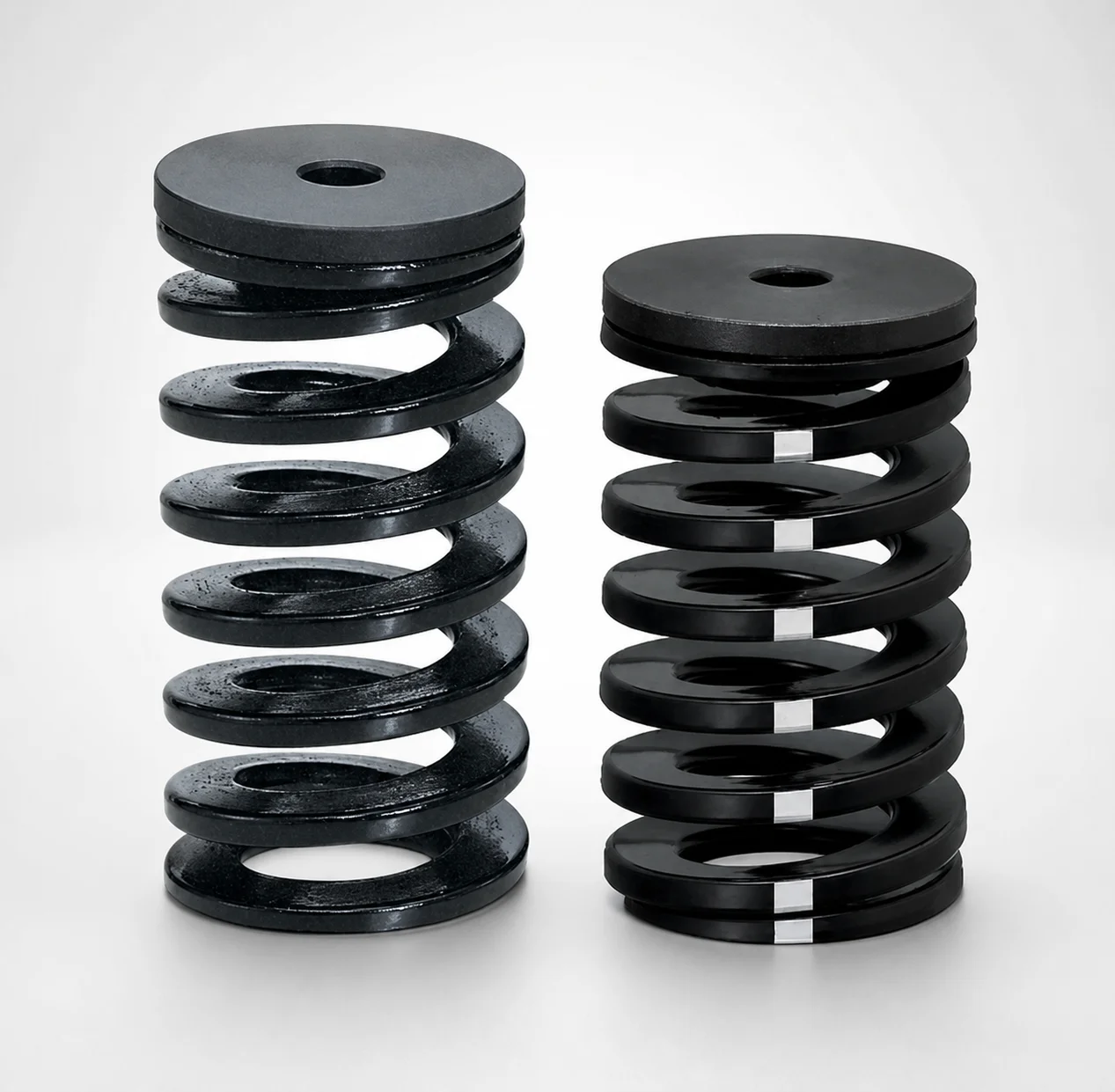
Gate Cut Springs Wire Flat
Gate Cut Springs Wire Flat are heat-resistant spring units engineered to deliver stable force for runner stripper plate systems under demanding operating conditions. Designed for consistent performance, they help protect equipment from vibration and shock during production.
- Wire flat gate cut geometry supports consistent force application
- Heat resistance to 120°C or 200°C for thermal-stable operation
- Optimized spring performance to maintain reliable load and deflection
- Suitable for MISUMI-style runner stripper plate spring applications
Specifications
46 configurations available
| D (Diameter) (mm) | L (Length) (mm) | d (Inner Diameter - Flat Type Only) | Heat Resistance Temperature | Spring Constant (N/mm) | Load (N) | Allowable Deflection (mm) | type |
|---|---|---|---|---|---|---|---|
| 16 | 20 | 9 | 200℃ | 32.7 | 163.4 | 5.0 | - |
| 16 | 25 | 9 | 200℃ | 26.2 | 196.1 | 7.5 | - |
| 16 | 30 | 9 | 200℃ | 21.8 | 196.1 | 9.0 | - |
| 18 | 20 | 11 | 200℃ | 39.2 | 196.1 | 5.0 | - |
| 18 | 25 | 11 | 200℃ | 31.4 | 235.4 | 7.5 | - |
| 18 | 30 | 11 | 200℃ | 26.2 | 235.4 | 9.0 | - |
| 20 | 25 | 11.5 | 200℃ | 39.2 | 294.2 | 7.5 | - |
| 20 | 30 | 11.5 | 200℃ | 32.7 | 294.2 | 9.0 | - |
| 20 | 35 | 11.5 | 200℃ | 28.0 | 294.2 | 10.5 | - |
| 20 | 40 | 11.5 | 200℃ | 24.5 | 294.2 | 12 | - |
| 22 | 25 | 12.7 | 200℃ | 49.0 | 367.7 | 7.5 | - |
| 22 | 30 | 12.7 | 200℃ | 40.9 | 367.7 | 9.0 | - |
| 22 | 35 | 12.7 | 200℃ | 35.0 | 367.7 | 10.5 | - |
| 22 | 40 | 12.7 | 200℃ | 30.6 | 367.7 | 12 | - |
| 22 | 45 | 12.7 | 200℃ | 27.2 | 367.7 | 13.5 | - |
| 25 | 30 | 15 | 200℃ | 54.5 | 490.3 | 9.0 | - |
| 25 | 35 | 15 | 200℃ | 46.7 | 490.3 | 10.5 | - |
| 25 | 40 | 15 | 200℃ | 40.9 | 490.3 | 12 | - |
| 25 | 45 | 15 | 200℃ | 36.3 | 490.3 | 13.5 | - |
| 25 | 50 | 15 | 200℃ | 32.7 | 490.3 | 15.0 | - |
| 30 | 45 | 17 | 200℃ | 41.4 | 559.0 | 13.5 | - |
| 30 | 50 | 17 | 200℃ | 37.3 | 559.0 | 15.0 | - |
| 30 | 55 | 17 | 200℃ | 33.9 | 559.0 | 16.5 | - |
| 16 | 20 | 9 | 120℃ | 36.8 | 279.5 | 7 | - |
| 16 | 25 | 9 | 120℃ | 29.4 | 294.2 | 10 | - |
| 16 | 30 | 9 | 120℃ | 24.5 | 294.2 | 12 | - |
| 18 | 20 | 11 | 120℃ | 42.9 | 326.1 | 7 | - |
| 18 | 25 | 11 | 120℃ | 34.3 | 343.2 | 10 | - |
| 18 | 30 | 11 | 120℃ | 28.6 | 343.2 | 12 | - |
| 20 | 25 | 11.5 | 120℃ | 44.1 | 441.3 | 10 | - |
| 20 | 30 | 11.5 | 120℃ | 36.8 | 441.3 | 12 | - |
| 20 | 35 | 11.5 | 120℃ | 31.5 | 441.3 | 14 | - |
| 20 | 40 | 11.5 | 120℃ | 27.6 | 441.3 | 16 | - |
| 22 | 25 | 12.7 | 120℃ | 53.9 | 539.4 | 10 | - |
| 22 | 30 | 12.7 | 120℃ | 45.0 | 539.4 | 12 | - |
| 22 | 35 | 12.7 | 120℃ | 38.5 | 539.4 | 14 | - |
| 22 | 40 | 12.7 | 120℃ | 33.7 | 539.4 | 16 | - |
| 22 | 45 | 12.7 | 120℃ | 30.0 | 539.4 | 18 | - |
| 25 | 30 | 15 | 120℃ | 61.3 | 686.5 | 12 | - |
| 25 | 35 | 15 | 120℃ | 49.0 | 686.5 | 14 | - |
| 25 | 40 | 15 | 120℃ | 42.9 | 686.5 | 16 | - |
| 25 | 45 | 15 | 120℃ | 38.1 | 686.5 | 18 | - |
| 25 | 50 | 15 | 120℃ | 34.3 | 686.5 | 20 | - |
| 30 | 45 | 17 | 120℃ | 43.6 | 784.5 | 18 | - |
| 30 | 50 | 17 | 120℃ | 39.2 | 784.5 | 20 | - |
| 30 | 55 | 17 | 120℃ | 35.7 | 784.5 | 22 | - |
Product Guide
Application Scenarios+
These gate cut springs are used in injection mold tooling where a runner stripper plate must open smoothly and return reliably after each cycle. Typical setups include runner stripper plate spring systems in multi-cavity molds, where vibration and shock can otherwise change spring force and affect part separation.
They are also common in thin-wall and precision automotive/consumer component molds that run high cadence. The spring wire flat gate-cut geometry helps maintain consistent force application, supporting stable stripper plate load and deflection across production.
For processes with elevated mold temperatures, choose the appropriate thermal rating (120°C or 200°C) to help keep spring behavior stable when the runner region experiences heat soak. That makes this variant suitable for long-run cycles and thermally demanding gating conditions.
- Runner stripper plates requiring stable spring force
- Cycle-intensive production where shock/vibration are present
- Runner zones operating at 120°C or 200°C
Material & Process Details+
The provided datasheet specifies performance ratings (load, deflection, spring constant, and heat resistance to 120°C or 200°C) but does not list a steel grade, case depth, or a specific heat-treatment condition (e.g., quench & temper, nitriding). Therefore, material-selection details such as exact hardness (HRC) and wear/toughness trade-offs cannot be stated from the supplied information.
From an engineering standpoint, the key differentiators for this part are its spring constant (21.8 ~ 61.3 N/mm) and allowable deflection (5 ~ 22 mm), which govern how the spring stores and releases energy under load. When selecting among sizes, match stiffness and deflection capability first to avoid overstressing or under-loading the stripper plate.
- Heat resistance: choose 120°C or 200°C variant per thermal environment
- Force/deflection matching: key to maintaining stable stripper plate behavior
Sizing & Selection Guide+
Selection is primarily driven by the required stripper plate spring behavior: spring constant, allowable deflection, and the resulting load. Use the target working deflection for your stripper plate stroke and choose a spring with an allowable deflection within 5 ~ 22 mm to prevent loss of performance from excessive travel.
Then ensure the required opening/return force is within the available range of load 163.4 ~ 784.5 N. If you have a desired stiffness, select the corresponding spring constant 21.8 ~ 61.3 N/mm so deflection produces the correct load for the runner stripping function.
- Diameter D (mm): 16, 18, 20, 22, 25, 30
- Length L (mm): 20 ~ 55
- Inner diameter d (flat type only): 9, 11, 11.5, 12.7, 15, 17
Finally, verify fit in your stripper plate/locating features by matching D and, for flat-type configurations, d. Tolerance values are not provided in the input data, so confirm clearances against your own mold tolerance and assembly requirements.
Frequently Asked Questions
How do I select the correct gate cut spring based on stripper plate stroke and deflection?+
Which heat resistance rating (120°C or 200°C) should I use for my runner region?+
What dimensional combinations are available for D and L, and how do they affect compatibility?+
For the flat type, how do I choose the correct inner diameter d?+
How do spring constant and load relate when designing for consistent runner stripping?+
Need Custom Specifications?
Our engineering team can help with custom configurations, material selection, and volume pricing.