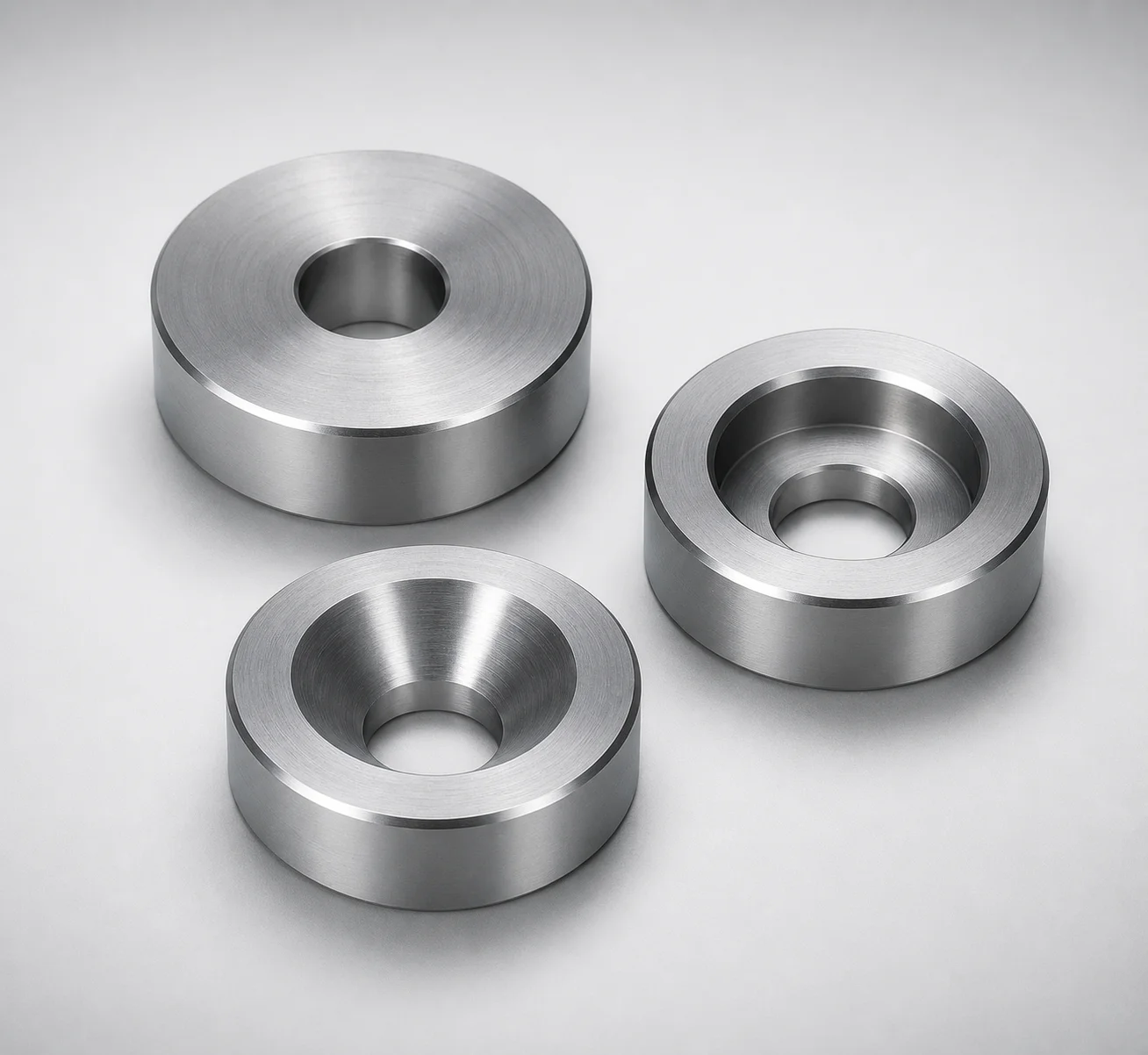
S45C Steel Free Washers for Countersunk Bolts
Free washers for countersunk bolts (S45C steel) provide stable load distribution by minimizing localized surface contact pressure. Built to support countersunk bolt seating, they help maintain a flush fit and reduce loosening wear in bolted assemblies.
- Flush fit for countersunk bolts to improve assembly appearance and function
- Made from S45C steel for robust durability in demanding bolted joints
- Plain or electroless nickel plated surface options to match corrosion requirements
- Designed for plain, countersunk bolt, and counterbore configurations
Specifications
12 configurations available
| Product Type | Surface Treatment | Hole Diameter d/P/V (mm) | Outer Diameter D (mm) | Thickness t (mm) | V (Hole diameter・Counterbore diameter) (mm) | H (Gimlet hole length) (mm) | type |
|---|---|---|---|---|---|---|---|
| For countersunk bolt | None | - | 5 ~ 20 | 1 ~ 50 | 3 ~ 70 | 0 ~ 49.9 | - |
| For countersunk bolt | None | - | 20.5 ~ 100 | 1 ~ 50 | 3 ~ 70 | 0 ~ 49.9 | - |
| For countersunk bolt | Electroless nickel plated | - | 5 ~ 20 | 1 ~ 50 | 3 ~ 70 | 0 ~ 25 | - |
| For countersunk bolt | Electroless nickel plated | - | 20.5 ~ 100 | 1 ~ 50 | 3 ~ 70 | 0 ~ 25 | - |
| Plain | None | - | 5 ~ 20 | 1 ~ 50 | 3 ~ 70 | - | - |
| Plain | None | - | 20.5 ~ 100 | 1 ~ 50 | 3 ~ 70 | - | - |
| Plain | Electroless nickel plated | - | 5 ~ 20 | 1 ~ 50 | 3 ~ 70 | - | - |
| Plain | Electroless nickel plated | - | 20.5 ~ 100 | 1 ~ 50 | 3 ~ 70 | - | - |
| Counterbore | None | 3 ~ 68 | 10 ~ 20 | 3 ~ 50 | 5 ~ 70 | 1 ~ 48 | - |
| Counterbore | None | 3 ~ 68 | 20.5 ~ 100 | 3 ~ 50 | 5 ~ 70 | 1 ~ 48 | - |
| Counterbore | Electroless nickel plated | 3 ~ 68 | 10 ~ 20 | 3 ~ 50 | 5 ~ 70 | 1 ~ 48 | - |
| Counterbore | Electroless nickel plated | 3 ~ 68 | 20.5 ~ 100 | 3 ~ 50 | 5 ~ 70 | 1 ~ 48 | - |
Product Guide
Application Scenarios+
Where used: These S45C free washers are used with countersunk bolts in injection mold assemblies to spread clamping force and stabilize seating under repeated tightening cycles. They help prevent localized surface contact pressure that can loosen fasteners over time.
Scenario 1 — Automotive connector molds: In multi-cavity connector tooling, the washer’s flush-fit geometry for countersunk bolt seating supports consistent clamping around load-bearing mold plates, especially in areas subject to vibration during press operations.
Scenario 2 — Medical device housings: For precision medical-grade mold components, electroless nickel plating provides a corrosion-resistant option while maintaining a clean, flush interface that supports dimensional stability during cleaning and maintenance cycles.
Scenario 3 — High-cycle tooling rebuilds: When tooling is disassembled and reassembled, the washer’s load-distribution role helps reduce wear at the bolt head-to-plate interface, improving repeatable assembly feel and reducing loosening risk.
- Available for plain, countersunk bolt, and counterbore configurations to match different seating layouts
- Plain or electroless nickel plated surfaces to address corrosion requirements
Material & Process Details+
Base material: S45C steel is selected for its balance of strength and toughness for clamped bolted joints in mold tooling. It is commonly used in applications where washers must withstand compressive loading without becoming brittle.
Surface options: Select none for standard environments or electroless nickel plated for improved corrosion resistance and better surface protection at the bolt seating interface.
- Hardness / wear–toughness trade-off: The steel’s hardness provides adequate wear resistance against fretting at the seating surface, while maintaining toughness to resist cracking under clamp load variations.
- Heat treatment state: These washers are supplied as S45C steel parts; your tooling supplier may apply machining preparation and any required finishing. If a specific target HRC is required for your assembly design, confirm the delivered material/heat-treatment documentation for this series.
Sizing & Selection Guide+
Step 1 — Match the hole size (d / V): Select a washer based on the specified hole diameter d (3 ~ 68 mm). For countersunk bolt seating or counterbore layouts, use the corresponding V dimension (3 ~ 70 mm or 5 ~ 70 mm) to match the bolt head or counterbore diameter in your plate.
Step 2 — Confirm overall diameter D: Choose the correct outer diameter D for the load-spreading area: 5 ~ 20 mm, 20.5 ~ 100 mm, or 10 ~ 20 mm depending on the series configuration. A larger D generally increases contact area and reduces local pressure.
Step 3 — Set thickness t and cavity clearances: Verify thickness t (1 ~ 50 mm or 3 ~ 50 mm) and gimlet hole length H (0 ~ 49.9 mm, 0 ~ 25 mm, or 1 ~ 48 mm) so the washer seats correctly without interference.
- Confirm whether your assembly uses plain, countersunk bolt, or counterbore product type to ensure flush seating.
- Use manufacturer-provided tolerances for d/V and countersunk/counterbore fit; for tight seating, avoid clearance that can lead to fretting.
Frequently Asked Questions
Which product type should I choose for a mold plate with countersunk bolt seating versus a counterbore layout?+
How do I size the washer hole diameter (d) and the V dimension to avoid incorrect bolt-head seating?+
When should I select electroless nickel plated washers instead of no surface treatment?+
How do D and thickness t affect load distribution in bolted mold assemblies?+
What should I verify about the gimlet hole length H for proper seating depth?+
Related Products
Need Custom Specifications?
Our engineering team can help with custom configurations, material selection, and volume pricing.