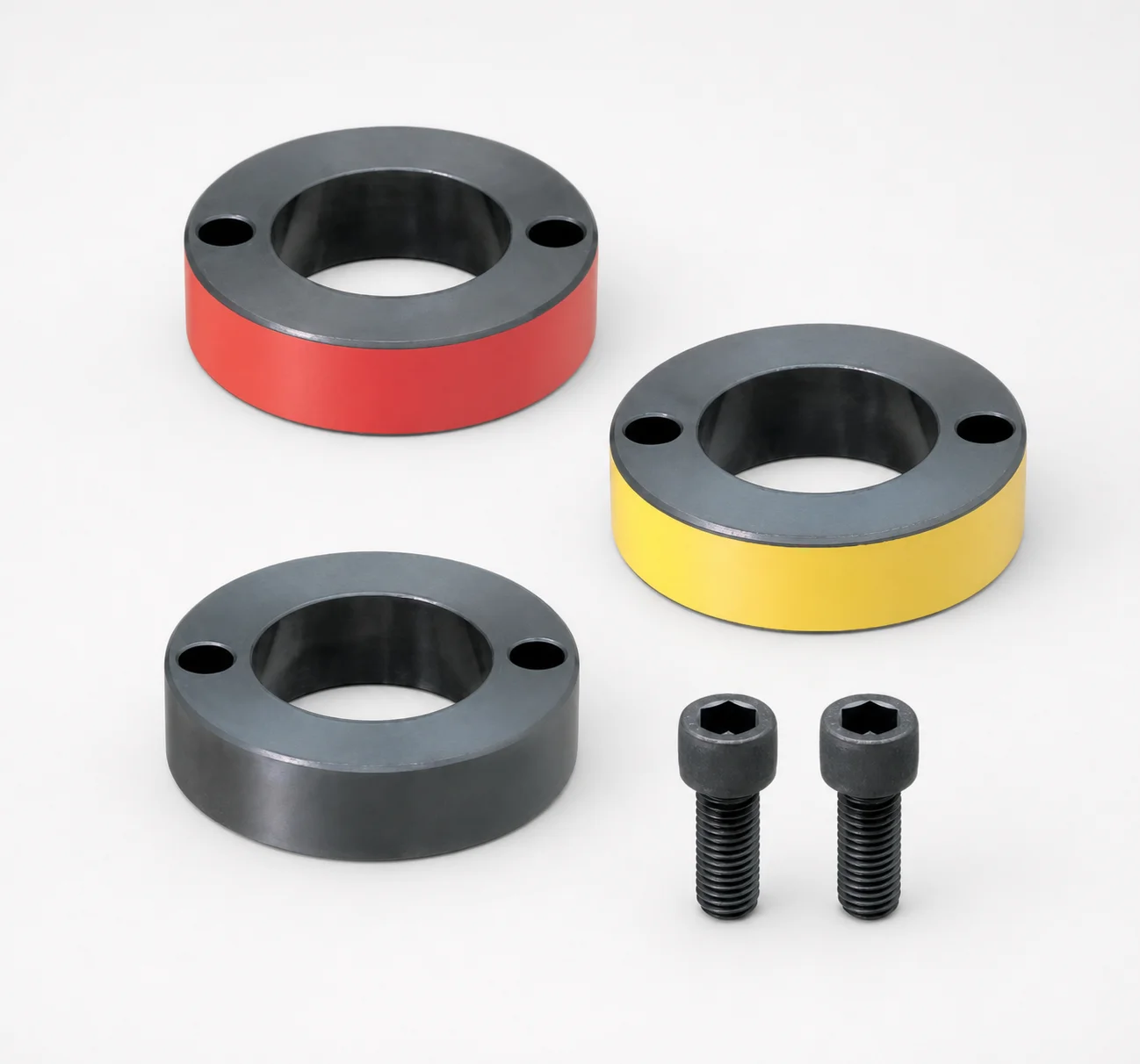
1045 Steel Stroke End Blocks for Press Fit Posts
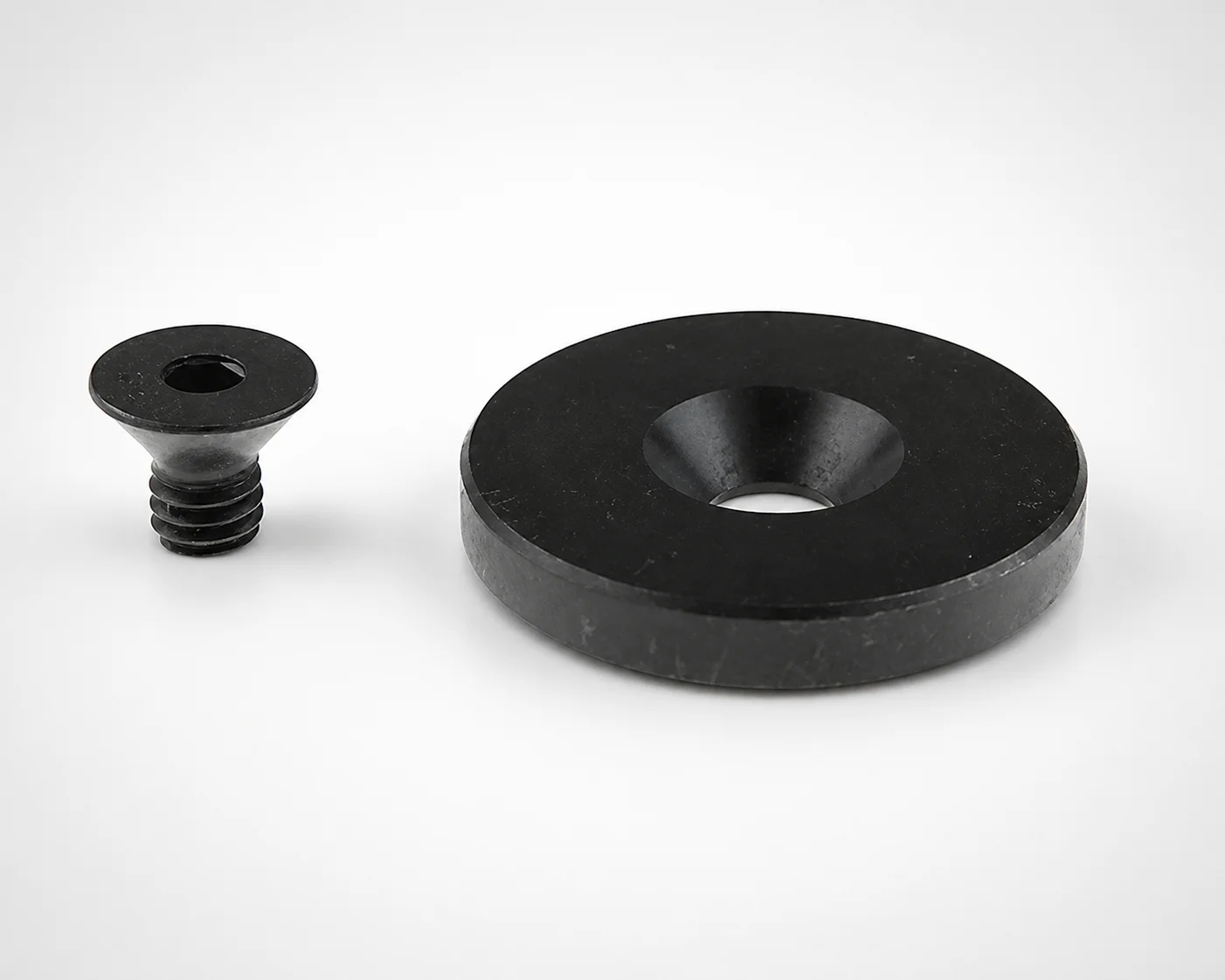
1045 Steel stroke end blocks for press fit posts deliver rigid stroke-end support to maintain alignment and stability during equipment cycling. Their durable steel construction helps absorb shock and protect machine components under repeated operation.
- Press-fit post interface designed for consistent positioning
- 1045 steel construction improves strength and wear durability
- Shock-absorbing support helps reduce misalignment during strokes
- Built for stroke-end stability in industrial press-fit assemblies
Specifications
16 configurations available
| Post diameter (mm) | T (Height) (mm) | Color: Secure color | type |
|---|---|---|---|
| 50 | 15 | N(Normal) | - |
| 50 | 15 | R(Red) | - |
| 50 | 15 | Y(Yellow) | - |
| 50 | 20 | N(Normal) | - |
| 50 | 20 | R(Red) | - |
| 50 | 20 | Y(Yellow) | - |
| 60 | 15 | N(Normal) | - |
| 60 | 15 | R(Red) | - |
| 60 | 15 | Y(Yellow) | - |
| 60 | 20 | N(Normal) | - |
| 60 | 20 | R(Red) | - |
| 60 | 20 | Y(Yellow) | - |
| 38 | 20 ~ 30 | N(Normal) / R(Red) / Y(Yellow) | - |
| 50 | 20 ~ 40 | N(Normal) / R(Red) / Y(Yellow) | - |
| 60 | 20 ~ 40 | N(Normal) / R(Red) / Y(Yellow) | - |
| 80 | 20 ~ 40 | N(Normal) / R(Red) / Y(Yellow) | - |
Product Guide
Application Scenarios+
Stroke-end support for press-fit posts is used inside injection mold and automated tooling to ensure the moving elements stop at the correct travel and remain aligned through repeated cycles. In automotive connector and small housing molds, these blocks help stabilize the ejector/leader system during high-frequency open-close motions, reducing the likelihood of end-face wear that can cause drift.
For industrial press-fit assemblies where posts are interference-mounted, consistent seating is critical. This steel variant is suited because it provides a rigid, shock-resistant contact surface that supports the stroke end while protecting surrounding components from misalignment caused by impact at travel limits.
- Automotive connector molds: helps maintain alignment under cycling loads.
- Medical/consumer device housings: supports repeatable end-stop positioning to improve dimensional stability.
- Press-fit post tooling: provides stable positioning at the interface to reduce drift and wear.
Material & Process Details+
This part uses 1045 steel, a medium-carbon structural steel commonly selected for its good balance of strength, machinability, and cost-effective durability. Compared with fully hardened tool steels, 1045 is typically not chosen for extreme wear at elevated hardness; instead, it offers robust stiffness and reliable performance for alignment support and impact buffering.
- Heat treatment state: supplied as a steel component intended for structural use; specific hardness (HRC) and heat treatment method are not provided in the supplied data.
- Wear resistance vs. toughness trade-off: 1045 emphasizes toughness and load-bearing stability, helping withstand shock at the stroke end while limiting the risk of brittle failure.
- Manufacturing relevance: the component is produced to support precise press-fit post interfaces for consistent positioning.
If your application requires higher surface wear resistance, consider using a dedicated tool-steel variant (not specified in the provided data) and verify hardness/heat treatment requirements.
Sizing & Selection Guide+
Select the correct block size by matching the post diameter and the height (T) to your mold’s stroke-end design and press-fit geometry. This product is available for post diameters of 38, 50, 60, and 80 mm, and T heights of 15 mm, 20 mm, 20–30 mm, and 20–40 mm depending on the specific configuration.
- Step 1: Identify the post diameter in the mold (the press-fit post OD) and choose the matching diameter option.
- Step 2: Set the stroke-end height by selecting the T value that provides correct support without interfering with adjacent components at full travel.
- Step 3: Verify fit behavior for the press-fit interface; ensure your interference/clearance strategy is consistent with your post tolerance stack-up. Tolerance guidance is not included in the provided data, so confirm with your engineering drawings.
Color (N/R/Y) is a configuration attribute and does not change the mechanical dimensions specified above.
Frequently Asked Questions
Which post diameter options are compatible with these 1045 steel stroke end blocks?+
These stroke end blocks are specified for post diameters of 38, 50, 60, and 80 mm. Select the diameter that matches the press-fit post design used in your ejector/leader tooling. Using a mismatched diameter can prevent proper press-fit seating and reduce stroke-end stability.
How do I choose the correct height (T) so the stroke end support doesn’t interfere with mold motion?+
T is available as 15 mm and 20 mm, and also as range configurations of 20–30 mm and 20–40 mm. Match T to the required stroke-end clearance so the moving assembly reaches full travel while the block provides support. Since tolerance details are not provided, confirm interference margins against your CAD/assembly drawing.
Does the steel type (1045) provide enough wear resistance for repeated stroke-end impacts?+
The component is made from 1045 steel, emphasizing strength and shock-end support rather than extreme tool-steel surface hardness. This suits applications where maintaining alignment and absorbing impact at the travel limit are key. If your duty cycle or contact conditions drive high surface wear, validate performance or consider a hardened tool-steel solution (not specified in the provided data).
What does the press-fit post interface requirement mean for mold assembly accuracy?+
The block’s interface is designed for a press-fit post to maintain consistent positioning. For best results, ensure your post diameter selection matches the specified options (38/50/60/80 mm) and your assembly process maintains the intended fit. Because tolerance guidance is not included, rely on your interference specification and tolerance stack-up.
Do the N/R/Y color configurations affect mechanical performance or only configuration?+
The color options are listed as N (Normal), R (Red), and Y (Yellow), with corresponding secure-color designations. The provided data does not indicate that color changes dimensions or material behavior. Treat color as a configuration attribute while sizing by post diameter and T height.
Related Products
Need Custom Specifications?
Our engineering team can help with custom configurations, material selection, and volume pricing.