Ejector Pins for Die Casting
H13 (SKD61) nitrided ejector pins rated for aluminum (660°C), zinc (420°C), and magnesium (650°C) die casting. 5 series covering straight, stepped, and D-type configurations with selectable or configurable dimensions.
Decision rule: H13 nitriding creates a 0.05–0.15 mm compound layer at 900–1,100 HV that resists the Fe₂Al₅ intermetallic reaction — the root cause of aluminum soldering. For detailed guidance, see our How to Extend Die Casting Ejector Pin Lifespan — Key Factors and Tips.
Products
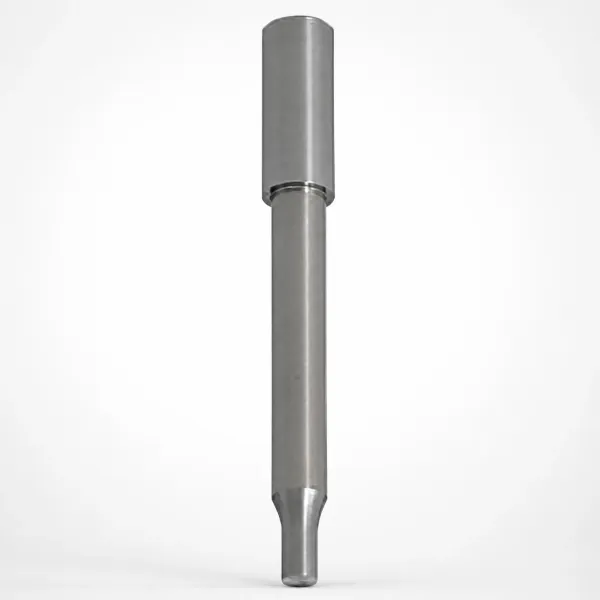
Round Stopper Punches - Single Stepped TiCN
High-wear TiCN coated single stepped round stopper punches for heavy-duty die casting and stamping mold actions.
View Details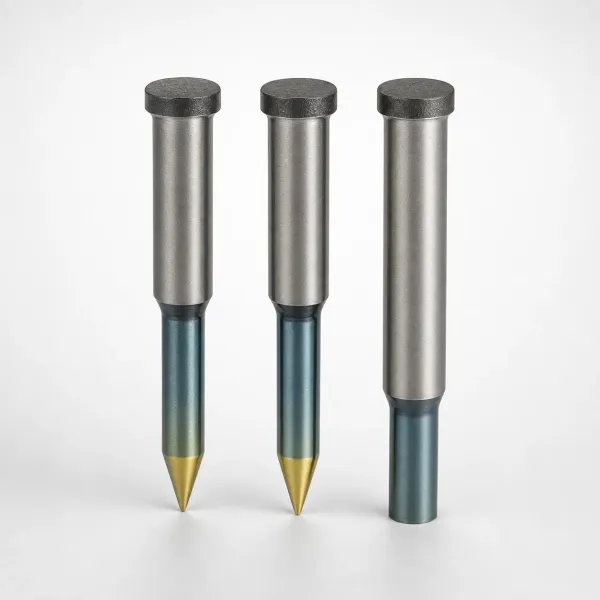
Powdered HSS Round Stopper Punches
Powder metallurgical HSS round stopper punches with superior toughness and thermal fatigue resistance under high clamp tonnage.
View DetailsHow to Choose the Right Ejector Pin
5 series of die casting ejector pins. Follow these two steps to select the right one.
Step 1: Select Pin Profile
| Criteria | Straight | Stepped |
|---|---|---|
| Ejection Surface | Flat or gently curved | Multi-level, counterbore, stepped boss |
| Bore Configuration | Through-bore, uniform Ø | Reduced bore at cavity, larger at plate |
| Force Distribution | Concentrated on pin tip | Distributed across step transition |
| Typical Applications | 80% of die casting ejection | Connector housings, valve bodies |
| Cost | $ | $$ |
Step 2: Select Dimension Configuration
D-Type is recommended for molds with ΔT > 100°C between pin and bore, or when pin seizing has been a recurring problem.
Decision rule: Match pin material hardness to alloy aggressiveness: aluminum requires full nitriding, zinc allows standard H13, magnesium needs nitriding plus anti-corrosion treatment. For detailed guidance, see our How to Extend Die Casting Ejector Pin Lifespan — Key Factors and Tips.
H13 Nitrided Steel — Engineering Specifications
All ejector pins in this category use H13 (SKD61) steel with ion nitriding surface treatment. The combination provides both bulk toughness (to resist thermal fatigue cracking) and surface hardness (to resist erosion and soldering).
| Property | Value | Why It Matters |
|---|---|---|
| Core Hardness | 44–48 HRC | Maintains toughness at 500°C+ operating temperature |
| Surface Hardness (Nitrided) | 900–1,100 HV | 3–5× erosion resistance vs through-hardened H13 |
| Compound Layer Depth | 0.05–0.15 mm | Diffusion barrier preventing aluminum soldering |
| Hot Hardness at 500°C | ~40 HRC | Retains structural integrity at die casting temperatures |
| Thermal Conductivity | 24.4 W/(m·K) | Moderate — slower than copper alloys but sufficient for pin applications |
| Charpy Impact at 500°C | 15–20 J | Resists thermal fatigue crack propagation |
Decision rule: H13 nitriding creates a 0.05–0.15 mm compound layer at 900–1,100 HV that resists the Fe₂Al₅ intermetallic reaction — the root cause of aluminum soldering. For detailed guidance, see our How to Extend Die Casting Ejector Pin Lifespan — Key Factors and Tips.
Application Scenarios
Aluminum Automotive Die Casting
Pain point: Engine blocks, transmission cases, and structural components require 300K+ shot molds with aggressive gate velocities (40–60 m/s). Pins near gates erode within 20,000–30,000 shots.
Why these pins: H13 nitrided construction with re-nitriding capability every 80K shots extends total life to 200K+ shots. Configurable diameter allows precise fit after bore wear.
Recommended: Straight Configurable + Stepped for multi-level features
Zinc Die Casting (3C Electronics)
Pain point: Thin-wall connector housings and EMI shields require very small pin diameters (Ø1.0–Ø3.0 mm) with tight positional accuracy. Pin marks must be invisible on cosmetic surfaces.
Why these pins: D-Type tolerance (-0.02 to -0.04 mm) prevents seizing in small bores where thermal expansion is proportionally larger. Lower zinc temperature (420°C) extends pin life to 300K+ shots.
Recommended: D-Type Straight, Standard or Specified Length
Magnesium Die Casting (EV Components)
Pain point: Magnesium alloy (AZ91D, AM60B) die casting for lightweight EV battery housings and seat frames operates at 650°C with aggressive chemical attack on unprotected steel.
Why these pins: Nitrided compound layer provides essential chemical barrier against magnesium corrosion. Must be combined with protective gas (SF₆ or alternatives) to prevent magnesium ignition at the pin-bore interface.
Recommended: Straight Selectable for standard sizes; Configurable for prototyping
Troubleshooting note: Pin sticking is the #1 maintenance issue in aluminum die casting. Proper die spray, nitrided pins, and correct pin-to-bore clearance (0.01–0.02 mm) prevent 90% of sticking incidents. For a systematic troubleshooting guide, see our How to Prevent Ejector Pin Sticking in Aluminum Die Casting.
Troubleshooting Guide
| Problem | Likely Cause | Fix |
|---|---|---|
| Casting sticks to pin | Nitrided layer worn through → aluminum soldering | Replace pin; schedule re-nitriding at 80K shots |
| Pin seizes in bore | Insufficient clearance for thermal expansion | Switch to D-Type tolerance (-0.02 to -0.04 mm) |
| Pin breaks at head-shaft transition | Thermal fatigue cracks from rapid heating/cooling | Use stepped pin for gradual section change; check cooling |
| Enlarged pin marks on casting | Tip diameter erosion > 0.05 mm | Replace; use configurable pin for exact diameter match |
| Flash ring around pin mark | Bore worn; clearance exceeds 0.05 mm | Re-bore, install next size up; or use oversized pin |
Decision rule: Pin sticking has three root causes: aluminum soldering (chemical), thermal fatigue cracking (mechanical), and insufficient draft angle (geometric). Address all three for lasting resolution. For detailed guidance, see our How to Prevent Ejector Pin Sticking in Aluminum Die Casting.
About Ejector Pins for Die Casting
This category contains 5 product series covering all ejector pin configurations for die casting applications. All pins are manufactured from H13 (SKD61) steel, vacuum heat-treated to 44–48 HRC, and ion-nitrided to 900–1,100 HV surface hardness. Available in diameters from Ø1.0 mm to Ø25 mm with standard, selectable, and fully configurable length options.
Frequently Asked Questions
Straight vs stepped ejector pin — which is better for die casting?+
What is a D-type ejector pin and when should I use it in die casting?+
How often should die casting ejector pins be replaced?+
What causes ejector pin sticking in aluminum die casting?+
Engineering Resources
How to Select Die Casting Ejector Pins — 5-Step Decision Tree
Step-by-step guide to choosing the right pin type, material, and dimensional configuration for your die casting application.
How to Prevent Ejector Pin Sticking in Aluminum Die Casting
Root cause analysis of aluminum soldering and 7 proven prevention strategies.
How to Extend Die Casting Ejector Pin Lifespan — Key Factors and Tips
How gate proximity, alloy type, and nitriding schedule affect pin life. Includes replacement interval calculator.
Need Die Casting Ejector Pins?
Specify your casting alloy, pin diameter, length, and quantity. Tell us your current pin life and any sticking issues — we will recommend the optimal series and surface treatment.