Gas Release Straight Ejector Pins
Built-in venting channels allow trapped air to escape during injection, preventing burn marks and diesel marks in deep cavities and blind ribs. Also known as vented ejector pins. 14 product series in M2 and H13 steels.
Products (14 Series)
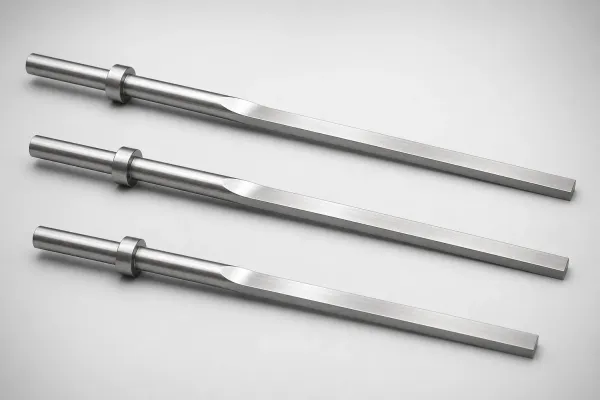
Gas Release — M2 Steel, Single Groove
Single longitudinal vent groove for standard venting.
View DetailsGas Release — M2 Steel, Multi-Groove
Multiple grooves for enhanced venting capacity.
View DetailsGas Release — H13 Nitrided
For high-temperature resins (PA+GF, PPS, PEEK).
View DetailsGas Release — Flat Type
Flat ground along shaft for maximum vent area.
View DetailsAbout Gas Release Ejector Pins
Venting Mechanism: As the resin front advances through the cavity, air ahead of it must escape or it compresses, heats (adiabatic compression can exceed 400°C), and ignites the resin — creating diesel/burn marks. Gas release pins provide an escape path through grooves along the pin shaft, routing trapped gas from the cavity face through the ejector plate to atmosphere.
Groove Design Parameters: Groove depth is critical: too shallow (below 0.015mm) and venting is insufficient; too deep (above 0.06mm) and resin flashes into the groove. The sweet spot is 0.02-0.04mm depth for most unfilled resins. Glass-filled resins can tolerate 0.03-0.05mm due to higher viscosity.
Placement Strategy: Position gas release pins at the last-to-fill locations in the cavity — these are where air collects. Common locations: blind rib ends, boss bottoms, weld line areas, and gate-opposite surfaces. Complement with standard venting at the parting line.
Application Scenarios
Deep-Rib Structural Parts
Automotive structural parts with reinforcement ribs 15-30mm deep where parting-line vents cannot reach rib bottoms.
Why gas release fits: Pins placed at rib bottoms vent trapped air directly. No need for complex side venting or vacuum-assisted molding.
Recommended: Multi-groove, H13 nitrided for glass-filled PA
Boss Features in Consumer Electronics
Mounting bosses in phone cases and laptop shells where burn marks at boss bottoms cause customer rejection.
Why gas release fits: Single-groove pins at boss bottoms eliminate trapped air without adding venting complexity to the mold design.
Recommended: Single-groove, M2 steel, ø1.5-3.0mm
Frequently Asked Questions
How does a gas release ejector pin vent trapped air?+
What venting capacity (area) do gas release ejector pins provide?+
Can gas release pins be used in high-temperature resins?+
Engineering Resources
Need a Custom Quote?
Specify groove type, diameter, length, and material.