Ball-Lock Punches
Quarter-turn quick-change punches for progressive, compound, and transfer dies. Available in ejector, regular, point-larger-than-shank, blank, and specialty configurations. Heavy Duty and Light Duty ratings in inch and metric with 14 coating options including CRN, TiN, TiCN, and DLC.
Punch Types
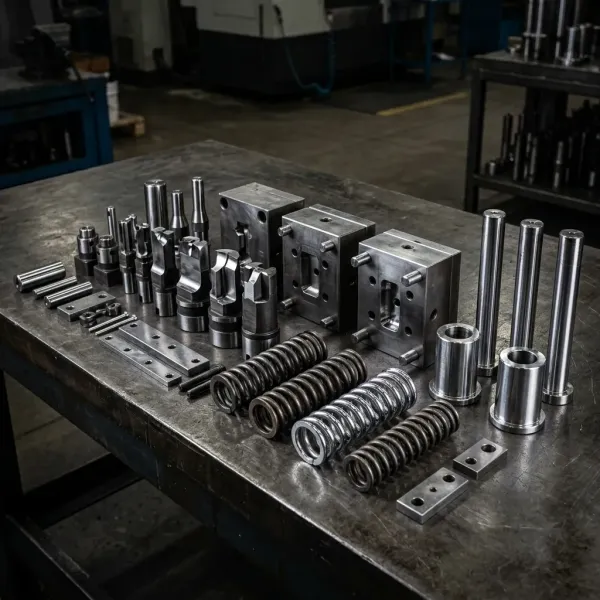
Ejector Punches
Built-in spring ejection mechanism for automatic slug stripping. 64 configurations in Heavy Duty and Light Duty.
Browse 64 ProductsRegular Punches
Solid shank punches for piercing and blanking applications. 56 configurations across all load classes.
Browse 56 ProductsPoint Larger than Shank
Oversized working tip for large-hole piercing through standard-bore retainers. 112 products in ejector and regular types.
Browse 112 ProductsPunch Blanks
Pre-hardened blanks for in-house custom tip machining. Ejector and regular types in Heavy and Light Duty.
View 8 ProductsHeavy Load & Specialty
Economy heavy-load punches and wrench flat configurations for extreme stamping conditions.
View 10 ProductsEjector vs Regular vs Point Larger — Which Punch Type?
Three punch architectures serve different stamping requirements. Choose based on slug management needs, hole size, and retainer constraints:
| Dimension | Ejector Punch | Regular Punch | Point Larger |
|---|---|---|---|
| Slug Management | Built-in spring ejects slug automatically | Slug falls through die clearance (gravity) | Same as ejector or regular (both types available) |
| Best For | Thin materials, slug pulling prevention | General piercing, blanking, moderate thickness | Large holes through standard-bore retainers |
| Working Tip vs Shank | Tip = shank diameter | Tip = shank diameter | Tip > shank diameter (oversized head) |
| Available Load Classes | Heavy Duty, Light Duty, Heavy Load, Light Load | Heavy Duty, Light Duty | Heavy Duty only |
| Product Count | 64 | 56 | 112 |
Heavy Duty vs Light Duty — Load Class Selection
| Dimension | Light Duty | Heavy Duty | Heavy Load (Economy) |
|---|---|---|---|
| Shank Cross-Section | Standard | Reinforced | Maximum |
| Material Thickness | Up to 1.5mm mild steel | Up to 3mm mild steel | Up to 6mm+ (AHSS capable) |
| Stripping Force | Low to moderate | Moderate to high | Extreme |
| Typical Application | Electronics, thin gauge | Automotive, appliance | Structural, thick plate |
| Cost | Baseline | 10-15% premium | Economy pricing |
When to Use Ball-Lock vs Standard Fixed Punches
Ball-lock punches are not always the right choice. Consider these decision factors:
- Use ball-lock when: Your press performs 2+ die changeovers per week, you need tool-less punch replacement, or your plant is implementing SMED (Single Minute Exchange of Die).
- Stay with fixed retention when: The die runs continuously with infrequent changeovers, you need maximum rigidity for ultra-tight tolerances (±0.005mm), or your existing die plates cannot accommodate retainer bores.
- Consider retrofitting when: Downtime costs exceed $500/hour and you have measurable changeover delays due to punch alignment or setscrew issues.
Quick Specification Lookup
| Spec | Range Available | Standard |
|---|---|---|
| Shank Diameter | 1/16" to 1-1/4" (inch) / 2mm to 32mm (metric) | DAYTON / MISUMI |
| Overall Length | 1.5" to 8" (inch) / 40mm to 200mm (metric) | Custom available |
| Material | M2 HSS (HRC 62-64), A2 Tool Steel, Carbide | ASTM / JIS |
| Coatings | CRN, TiN (XN), TiCN (XCD), TiAlN (XNA), DLC (XVP), 10+ more | DAYTON DayTride® |
| Measurement System | Inch and Metric | ANSI / JIS |
Engineering Resources
Ejector vs Regular Ball-Lock Punches
Decision framework for choosing the right punch architecture based on material, slug behavior, and die design.
How to Select Punch Coatings — CRN vs TiN vs DLC
Coating comparison for ball-lock punches: wear resistance, friction, temperature, and cost analysis.
Ball-Lock vs Fixed Retention — When to Switch
ROI analysis and decision criteria for transitioning from setscrew to ball-lock retention.
Application Scenarios
Ball-lock punches solve different engineering challenges depending on the stamping application:
High-Speed Progressive Stamping
Progressive dies running 300-800 SPM producing automotive and electronics parts. Requires ejector punches to prevent slug pulling at speed.
Ejector punches with TiCN coating provide 5-7× life extension. Combined with ball-lock retention, changeover for a 20-station die drops below 10 minutes.
Close-Pitch Piercing Layouts
Dies with multiple punch stations at tight spacing, where the punch diameter is larger than the shank diameter.
Point larger punches allow a larger cutting diameter while maintaining the smaller shank size needed for tight station spacing.
Custom Punch Shapes (In-House)
Die shops that fabricate custom-geometry punches in-house using wire EDM from heat-treated blanks.
Pre-hardened blanks with ball-lock groove already machined save 40-60% vs custom-ordering finished punches. Same-day turnaround for urgent replacements.
Frequently Asked Questions
What is the difference between ejector and regular ball-lock punches?+
How do I choose between heavy duty and light duty ball-lock punches?+
When should I use point-larger-than-shank punches?+
Need a Custom Quote?
Send your specifications and receive a quote. MOQ: 1 piece. Custom dimensions available.