Support Blocks
European standard precision support elements in hardened tool steel (58 HRC, 1.2162). Designed for fixture alignment, workpiece elevation, and anti-deflection support in CNC and inspection setups.
Support Blocks — 1 Product
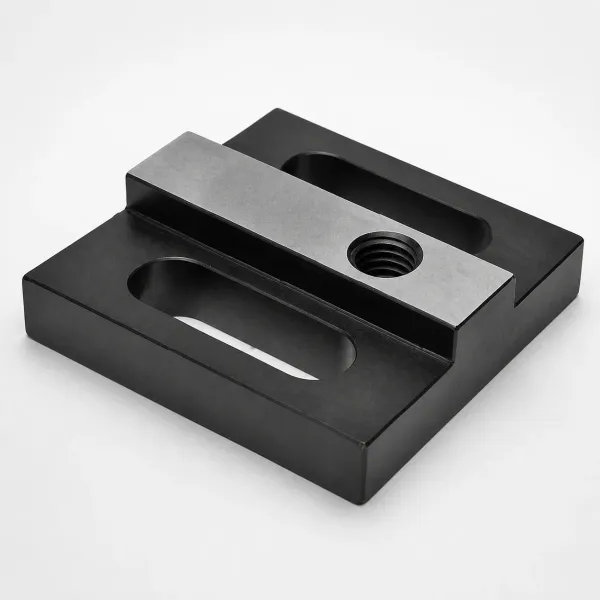
Support Blocks A1
European standard precision support element. Hardened tool steel (1.2162), 58 HRC. Ground contact surfaces for maximum flatness and repeatability.
View DetailsHow Support Blocks Achieve Positioning Accuracy
The A1 support block achieves its precision through three engineering choices:
- Material — 1.2162 tool steel, hardened to 58 HRC: This nickel-chromium case-hardening steel provides a hardened surface that resists indentation under repeated point loads, while maintaining a tough core that absorbs impact without fracturing.
- Surface grinding — ≤Ra 0.8 μm: All contact surfaces are precision ground after hardening, achieving flatness within 0.005 mm across the full support face. This eliminates rocking that would introduce positioning errors.
- Dimensional stability: Tool steel 1.2162 has excellent dimensional stability after heat treatment — no creep or growth over time, unlike case-hardened mild steel which can distort months after installation.
Learn more: See What Is the Difference Between Support Blocks, Parallels, and Adjustable Supports? for a detailed boundary guide.
Load capacity: At 58 HRC, the support surface can sustain contact pressures exceeding 2,000 N/mm² without permanent deformation — well above the typical 200–500 N/mm² range in fixture applications.
Support Blocks vs. Parallels vs. Adjustable Supports
Three common support solutions serve different needs. Choose based on your setup requirements:
| Feature | Support Blocks (A1) | Parallels (Equal-Height Spacers) | Adjustable Supports (Jack Screws) |
|---|---|---|---|
| Height Adjustment | Fixed — precision ground to nominal | Fixed — sold in matched pairs | Adjustable via thread (±5–10 mm range) |
| Accuracy | ±0.005 mm flatness | ±0.01 mm (matched pair) | ±0.1 mm (thread-dependent) |
| Hardness | 58 HRC | Typically 45–50 HRC | Varies (often unhardened body) |
| Best For | Permanent fixtures requiring repeatable support | Vise setups requiring even height | Setups with variable workpiece height |
| When to Switch | — | Use parallels when you need matched pairs for vise jaw support | Use adjustable supports when workpiece height varies between batches |
Deep dive: Read How to Integrate Support Blocks into Modular Fixture Systems for brand-specific compatibility details.
Modular Fixture System Compatibility
Support blocks interface with modular fixture systems through standard grid-hole or T-slot patterns. Key compatibility considerations:
- Proprietary ecosystems: Major fixture system brands (Erwin Halder, AMF, Roemheld, Kipp) each use proprietary grid dimensions and hole patterns. A1 support blocks can interface with any system via adapter plates or custom-machined mounting holes.
- Universal T-slot compatibility: For machine-table-mounted fixtures, A1 blocks fit standard T-slot widths (12, 14, 16, 18 mm) when paired with DIN 508 T-slot nuts.
- Custom modification: We can machine mounting holes, dowel bores, or thread patterns into A1 blocks to match your specific fixture system. Contact us with your base plate drawing.
Application Scenarios
CNC Workpiece Elevation
Pain point: Workpiece deflects during milling because the unsupported span between vise jaws is too wide.
Why it fits: A1 blocks placed under the workpiece centerline provide rigid, repeatable support at 58 HRC — no compression or creep under cutting forces.
Recommended: Support Blocks A1, positioned at calculated deflection-critical points
Mold Base Support
Pain point: Large mold bases sag under their own weight during machining, causing cavity misalignment.
Why it fits: Precision-ground A1 blocks provide ±0.005 mm flatness, ensuring the mold base remains level across all support points.
Recommended: Support Blocks A1, 4-point support layout
Engineering Resources
Application Scenarios
Precision Fixture Base Support
Pain point: Softened or worn support elements cause fixture plates to deflect under cutting forces, introducing 0.02-0.05 mm positional error.
Why it fits: Tool steel A1 blocks hardened to 58 HRC resist surface indentation under repeated point loads, maintaining flatness within 0.005 mm over years of use.
Workpiece Elevation in Multi-Axis Machining
Pain point: Standard parallels shift during heavy cuts and their limited height range doesn't match non-standard workpiece datums.
Why it fits: Precision-ground A1 support blocks provide fixed-height support with ground contact surfaces (≤Ra 0.8 μm) that eliminate rocking.
Frequently Asked Questions
What is the difference between a support block and a parallel (equal-height spacer)?+
What hardness and material grade is the A1 support block made from?+
How do I ensure proper alignment when using support blocks in a fixture?+
Is the A1 support block compatible with modular fixture systems?+
Related Product Categories
Need Support Elements?
Specify the quantity and any custom modifications (mounting holes, thread patterns). MOQ 1 piece.