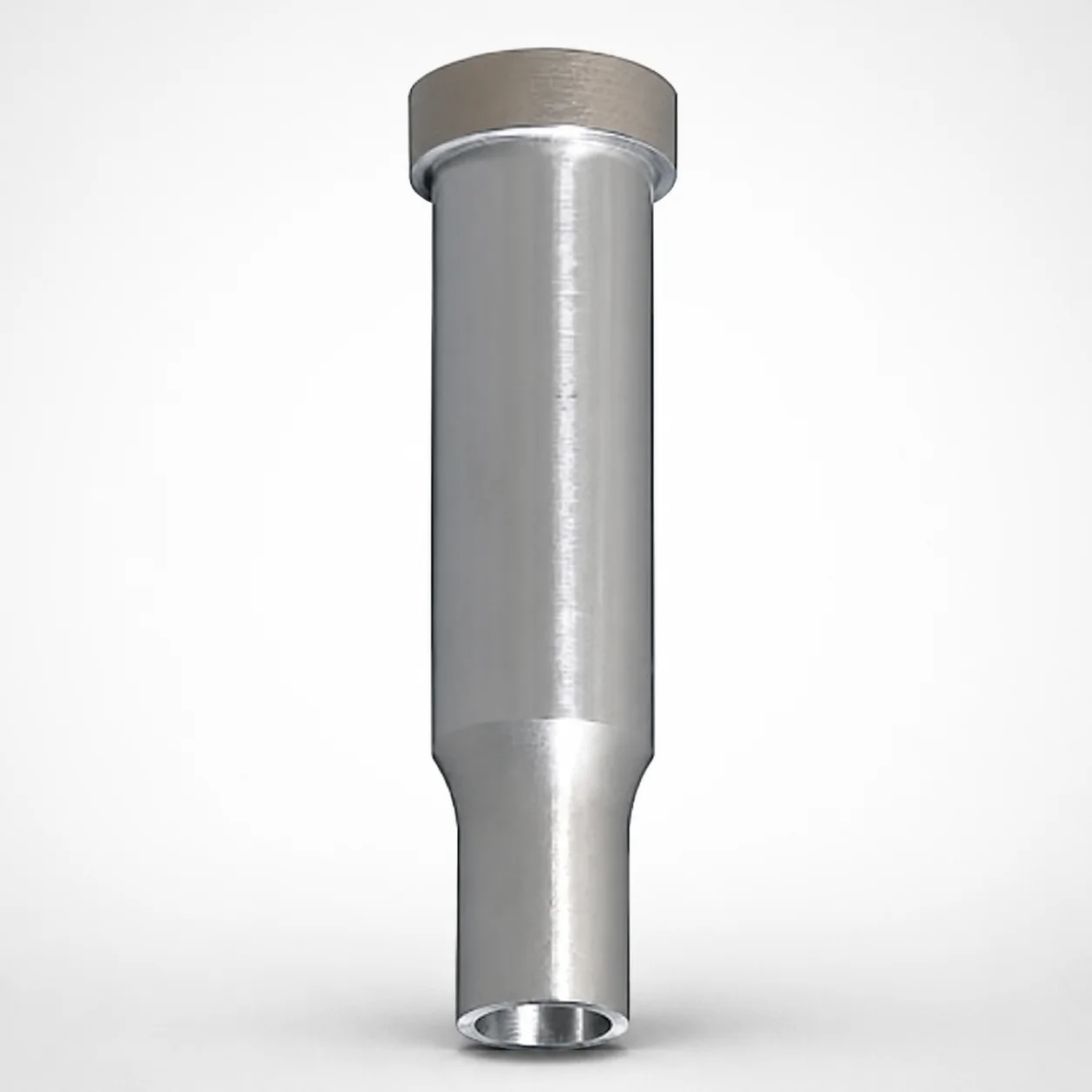
SPCPD Single-Stepped Blanking Punches
SPCPD single-stepped blanking punches (SKD11 equivalent steel) are designed for stable tool engagement in progressive or single-stage punching. The SPCPD shank type and stepped geometry help maintain reliable positioning and punching repeatability.
- Single-stepped shank design supports consistent alignment in press tooling
- SKD11-equivalent hardened steel construction improves wear resistance during runs
- Supports m5 shank diameter fit for controlled installation in die sets
- SPCPD mounting style for streamlined integration with standard blanking applications
Specifications
7 configurations available
| D (Shank diameter) (mm) | P (Tip dimension) (mm) | L (L dimension) (mm) | B (Tip length) (mm) | G (Head side hole diameter) (mm) | S (Tip side hole length) (mm) | V (Tip side hole diameter) (mm) | type |
|---|---|---|---|---|---|---|---|
| 8 | 4.8 ~ 7.99 | 35 ~ 60 | 4 ~ 19 | 2 ~ 4.6 | 3 ~ 10 | 1.5 ~ 4.29 | - |
| 10 | 4.8 ~ 9.99 | 35 ~ 60 | 4 ~ 19 | 2 ~ 5.8 | 3 ~ 10 | 1.5 ~ 5.3 | - |
| 13 | 5.8 ~ 12.99 | 35 ~ 60 | 4 ~ 19 | 2 ~ 7.5 | 3 ~ 10 | 1.5 ~ 7 | - |
| 16 | 9.8 ~ 15.99 | 35 ~ 60 | 4 ~ 25 | 3 ~ 9.5 | 3 ~ 10 | 2.5 ~ 9 | - |
| 20 | 12.8 ~ 19.99 | 35 ~ 60 | 4 ~ 25 | 4 ~ 11.5 | 3 ~ 12 | 3.5 ~ 11 | - |
| 25 | 17.8 ~ 24.99 | 40 ~ 60 | 4 ~ 25 | 5.5 ~ 14.5 | 3 ~ 12 | 5 ~ 14 | - |
| 32 | 19.8 ~ 31.99 | 40 ~ 60 | 4 ~ 25 | 8 ~ 19 | 3 ~ 15 | 7.5 ~ 18.5 | - |
Product Guide
Application Scenarios+
These single-stepped blanking punches are used in progressive die sets and single-stage punching stations where stable feed positioning and repeatable tool engagement are critical. The stepped geometry and standardized shank form help maintain alignment during cycling, reducing variation between successive hits.
- Automotive and appliance housings: Suitable for precision blanking of thin sheets where high run consistency affects part edge quality. The SKD11-equivalent hardened steel construction supports longer tool life against abrasive wear.
- Electrical connector and terminal strip production: Used when consistent hole formation and part-to-part repeatability matter. The single-stepped shank supports reliable installation fit in die blocks, helping maintain stable punching depth.
- General industrial brackets and covers: Works well for mixed-thickness production runs, especially when the press requires dependable tool positioning over extended cycles.
This variant’s controlled shank diameter range and hardened wear resistance make it well suited for repeatable blanking outputs in production environments.
Material & Process Details+
SPCPD blanks punches are made from SKD11-equivalent steel (often referenced to AISI D2 in equivalence practices). This alloy is typically selected for its combination of high wear resistance and good support for precision cutting edges in punching service.
- Hardness: The hardened SKD11-equivalent condition is intended for high surface hardness (commonly around the mid-to-high HRC range for D2-family steels). Exact HRC depends on the supplier’s heat treatment recipe, but the design intent is stable cutting-edge wear behavior.
- Heat treatment: Generally supplied quenched and tempered to balance hardness and toughness, limiting edge chipping risk under impact.
- Trade-offs: Higher hardness improves wear resistance but can reduce toughness if over-hardened; tempered condition helps manage this balance.
Compared with lower-alloy pre-hardened grades, the SKD11-equivalent approach better resists abrasive wear during long blanking runs, improving tool life consistency.
Sizing & Selection Guide+
Select dimensions by matching the punch shank for guided stability and the tip features for the blanking geometry. For this series, D (shank diameter) is specified as 8 ~ 32 mm, and the punch overall configuration uses the single-stepped form to support repeatable positioning in the press.
- Match D: Choose the D size that corresponds to your die guide/bushing and punch holder bore for proper alignment. Use the recommended fit for installation to avoid tool wobble during cycling.
- Define the cutting profile: Set the tip dimension P in the range 4.8 ~ 19.8 mm and the tip length B in 4 ~ 19 mm or 4 ~ 25 mm options depending on the required reach.
- Check L (L dimension) for stroke and clearance: Select L = 35 ~ 60 mm or L = 40 ~ 60 mm so the active edge engages at the correct depth without interfering with the die shoe or stripper.
- Side hole features (as applicable): Use G = 2 ~ 8 mm, S = 3 ~ 10 / 3 ~ 12 / 3 ~ 15 mm, and V = 1.5 ~ 7.5 mm to match any alignment or fastener-side requirements in your tooling design.
Where multiple options exist (e.g., L and B ranges), pick the configuration that preserves required working engagement while maintaining clearance for stripper action.
Frequently Asked Questions
How do I choose the correct shank diameter (D) for SPCPD single-stepped blanking punches in my die set?+
What tip dimensions (P and B) should I verify to ensure the blanking cavity geometry and required cutting edge length match?+
How should I select the L dimension to avoid interference while achieving the required punching depth?+
The material is SKD11-equivalent—what does that imply for wear resistance and tool life in punching?+
What side hole parameters (G, S, V) are available, and when do I need them for tooling compatibility?+
Related Products
Need Custom Specifications?
Our engineering team can help with custom configurations, material selection, and volume pricing.