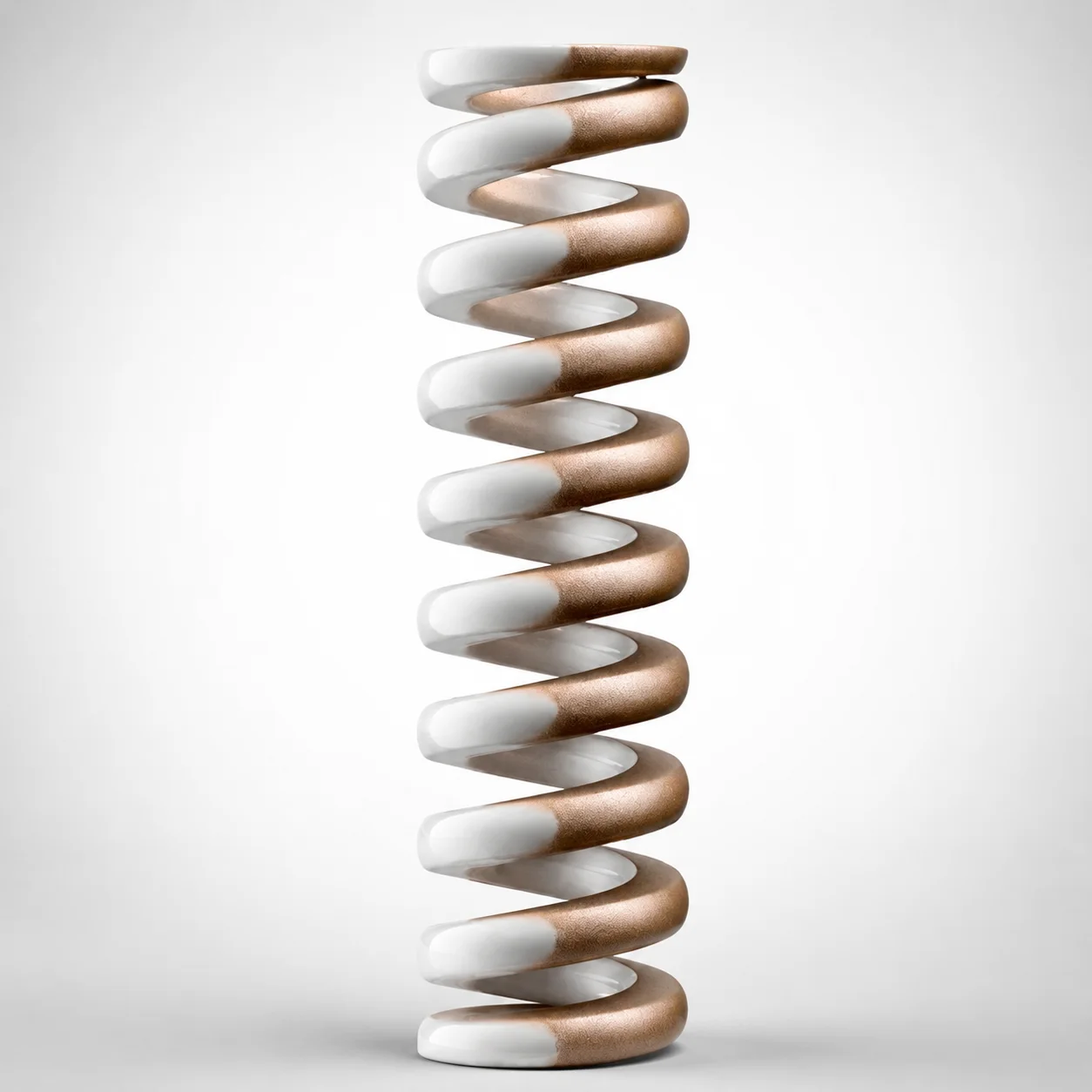
PCS Coil Springs - Heavy Pressure - Inch
PCS Coil Springs - Heavy Pressure - Inch are built from hardened alloy steel and finished with an E-coat for reliable corrosion protection in demanding industrial assemblies. Optimized free-length control supports stable load behavior across long service cycles.
- Gold/Silver color-coded spring identification for fast procurement and kitting
- E-coat surface protection improves corrosion resistance in humid or exposed conditions
- Heavy-pressure design offers controlled deflection and long life free-length options
- Max operating temperature up to 482°F (250°C) for high-heat applications
Specifications
6 configurations available
| Dd (Rod Diameter) (in) | DH (Hole Diameter) (in) | Lo (Free Length) (in) | R (Spring Rate +/-10% ) (lbs/.10 Inch Deflec.) |
|---|---|---|---|
| 3/16" | 3/8" | 1" | 11.6 |
| 3/16" | 3/8" | 1-1/2" | 8 |
| 1/2" | 1" | 1-1/2" | 120 |
| 5/8" | 1-1/4" | 2-1/2" | 117.6 |
| 3/4" | 1-1/2" | 3" | 130 |
| 1" | 2" | 7" | 82 |
Product Guide
Application Scenarios+
PCS heavy-pressure coil springs are used as returning or maintaining elements in injection mold tooling where consistent deflection translates into stable parting, ejection, or clamp-assist performance. The hardened alloy steel construction and E-coat corrosion resistance make this variant well-suited for mold bases and movable components exposed to wash-down, humidity, or incidental coolant contact.
- Automotive and electrical connector molds: heavy-pressure load behavior helps maintain reliable movement over long production runs, especially when the spring cycles repeatedly and requires controlled free-length for repeatability.
- Medical device housing and cover molds: the corrosion-protective E-coat supports durability in cleaner, moisture-prone environments while preserving consistent spring action for ejector or lifter systems.
- Consumer goods molds with frequent shut-offs: the heavy-pressure design supports stable load response across long service cycles, reducing the risk of drift in high-frequency operation.
Gold/silver color coding also speeds kitting and ensures the correct spring rate and dimensions are matched to each station.
Material & Process Details+
This series uses hardened alloy steel to deliver a balance of wear resistance and toughness for repeatedly compressed spring duty inside mold tooling. The hardened condition improves resistance to permanent set and helps maintain the specified spring rate tolerance over service life.
- Corrosion protection: an E-coat surface finish improves resistance to corrosion in humid or exposed conditions, supporting long-term stability of the spring surface.
- Hardness and performance: while this page specifies hardened alloy steel, exact HRC is not provided in the supplied data; engineers should verify hardness from the material/heat-treatment certificate for acceptance criteria.
- Heat treatment state: described as hardened; for most alloy-steel coil springs this typically corresponds to a quenched-and-tempered or similar hardened state to achieve the needed elasticity and durability.
- Trade-off: higher hardness supports deflection stability and wear resistance, but excessive hardening can reduce toughness—verify fit to your expected shock/load cycles.
Sizing & Selection Guide+
Select the spring by matching its rod (wire) diameter Dd, hole/space diameter DH, and free length Lo to the available spring pocket and the motion stack-up in your mold assembly. This series offers these ranges: Dd = 3/16", 1/2", 5/8", 3/4", 1"; DH = 3/8", 1", 1-1/4", 1-1/2", 2"; Lo = 1", 1-1/2", 2-1/2", 3", 7".
- Core/cavity movement fit: confirm the spring can compress within your stroke allowance without bottoming, using your intended deflection and travel limits.
- Load stability: choose the spring rate variant (R with ±10% tolerance) aligned to your required force at the working deflection (R is given in lbs per 0.10 inch deflection).
- Clearance and tolerance: ensure DH and the surrounding guide/pocket geometry provide adequate clearance for free spring operation; use your mold’s dimensional tolerances to avoid rubbing or binding during motion.
- Configurable vs. fixed: dimensions are fixed per SKU configuration (the listed Dd/DH/Lo options). Select the matching configuration rather than modifying dimensions.
Frequently Asked Questions
Which dimension parameters must match for replacing a PCS heavy-pressure coil spring in an existing mold?+
For replacement, match at least the listed Dd (rod/wire diameter), DH (hole/space diameter), and Lo (free length) from the available options (Dd: 3/16" to 1", DH: 3/8" to 2", Lo: 1" to 7").
Also confirm the required spring rate R variant so the force at your working deflection stays within the specified ±10% tolerance.
How do the spring rate options (R) affect force selection for mold lifter or ejector return?</+
The spring rate R is specified as lbs per 0.10 inch deflection with ±10% tolerance. Use your expected working deflection to compute approximate force and select the closest rate option (e.g., 82, 117.6, 120, 130, 11.6, or 8).
For heavy-pressure applications, choose the higher-rate options to maintain return force and reduce the impact of deflection drift over cycles.
Is E-coat suitable for molds exposed to coolant mist or humid production environments?+
Yes—this series is finished with an E-coat, which is specifically noted for improved corrosion resistance in humid or exposed conditions. This helps protect the hardened alloy steel surface in environments where moisture and residue contact can occur.
For high-chemical exposure, engineers should still validate against your specific fluids and cleaning methods.
What are the available Dd/DH/Lo combinations when designing a spring pocket and travel stop?+
The available options are fixed per configuration: Dd = 3/16", 1/2", 5/8", 3/4", 1"; DH = 3/8", 1", 1-1/4", 1-1/2", 2"; Lo = 1", 1-1/2", 2-1/2", 3", 7".
When laying out the spring pocket, ensure the spring can compress across your stroke without bottoming and that DH clearance prevents binding.
Does “hardened alloy steel” specify an exact hardness (HRC) for qualification?+
The provided metadata states the springs are made of hardened alloy steel, but it does not provide an exact HRC value. For hardness qualification, request the heat-treatment/material certification tied to this SKU.
Performance selection should also consider the provided max operating temperature of 482°F (250°C).
Related Products
Heat Resistant Round Wire Spring - 60% Deflection (WFH Series)
WLH Series Heat Resistant Round Wire Spring - 50% Deflection
WHH Series 35% Deflection Heat Resistant Coil Spring
Heat Resistant Round Wire Spring 40% Deflection (WMH Series)
Super-High Deflection Coil Spring - 60% Deflection
Ultra-High Deflection Coil Springs - 65% Deflection SWY Series
Need Custom Specifications?
Our engineering team can help with custom configurations, material selection, and volume pricing.