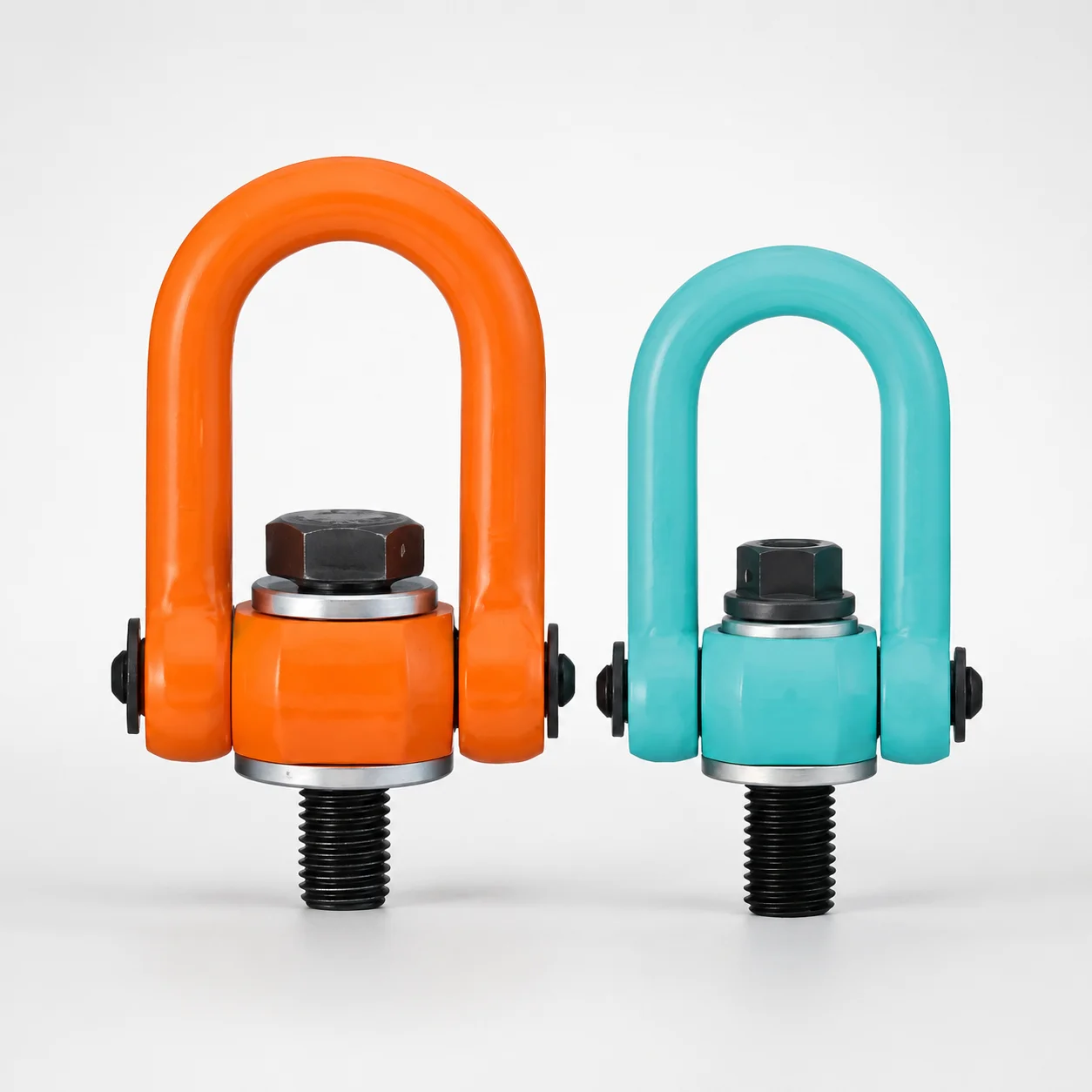
SLEB Type Swivel Eyebolts
SLEB type swivel eyebolts (swivel head) are engineered for safe lifting when the load direction can change. The rotating eye helps maintain proper alignment and supports smooth handling during rigging operations.
- Swivel head design supports controlled rotation under dynamic lifting loads
- Rigid SLEB type construction helps maintain safety and stability while lifting
- Designed to reduce side loading effects for improved equipment wear performance
- Typical use in industrial rigging, lifting assemblies, and machinery positioning
Specifications
9 configurations available
| M (Screw diameter) (mm) | type |
|---|---|
| 8 | - |
| 10 | - |
| 12 | - |
| 16 | - |
| 20 | - |
| 24 | - |
| 30 | - |
| 36 | - |
| 42 | - |
Product Guide
Application Scenarios+
SLEB Type swivel eyebolts are used in injection mold tooling for lifting and positioning when the load direction may shift during rigging. In practice, they’re common in automation cell mold changes, where the crane angle and hoist geometry can vary as the mold is guided onto the press bed.
They also fit high-cycle maintenance scenarios, such as removing sprue/runner or ejector-side components, because the rotating eye helps keep the rigging aligned as the load swings slightly.
For multi-point lifting assemblies (mold frames, yoke lifting, and handling fixtures), the swivel head design manages dynamic load behavior, reducing unwanted side loading. This variant is suited to these applications because its controlled swivel action improves rigging control and supports safer handling of dynamic or off-axis loads.
- Automotive connector mold handling where lift direction can change during alignment
- Medical device housing mold maintenance with smoother rigging control
- Multi-point lifts that benefit from reduced side-loading effects
Material & Process Details+
The provided specification data for this SLEB type swivel eyebolts includes the screw diameter range (M8–M42), but it does not specify the steel grade, hardness (HRC), or heat treatment condition. Therefore, material properties such as wear resistance, toughness, and any heat-treated state (e.g., quenched & tempered, nitrided) cannot be stated from the input.
For engineering selection, confirm the supplier’s datasheet for the exact steel grade and heat treatment. If multiple material options are offered for the same size, the primary trade-off typically involves hardness vs. toughness: higher hardness improves abrasion/wear resistance, while tempered toughness reduces risk of cracking under shock or dynamic lifting.
- Verify steel grade and process for load-rating compliance
- Confirm hardness (HRC) to support durability under repeated dynamic loads
- Match corrosion protection requirements to the shop environment
Sizing & Selection Guide+
Selection of the correct swivel eyebolt size is primarily based on the screw diameter (M). This product variant is specified for M8 to M42 (mm), so engineers should match the eyebolt’s thread size to the mating lift point thread installed in the mold base, lifting plate, or adapter.
To size the component accurately:
- Identify the lift point thread specification on the mold (nominal M size within 8–42).
- Choose the matching SLEB swivel eyebolt size so the thread engagement meets your required retention length and load path.
- Consider tolerance and fit: ensure thread class and any seating surface conditions are compatible so the eyebolt fully seats without binding.
If your lift point uses a fixed threaded insert, the dimension is typically configurable only by selecting the correct M size; the swivel-head function is inherent to the SLEB type construction.
Frequently Asked Questions
Which thread sizes are supported for SLEB Type swivel eyebolts in this series?+
How does the swivel head help during mold lifting with changing angles?+
What should I verify about material properties before approving for high dynamic lifting duty?+
How do I match the eyebolt to the mold’s lifting point to ensure correct fit?+
Can I use this swivel eyebolt in multi-point lifting fixtures for large injection molds?+
Related Products
Need Custom Specifications?
Our engineering team can help with custom configurations, material selection, and volume pricing.