Gas Springs for Plastic Mold
Compact nitrogen gas springs delivering high initial force and near-constant pressure throughout the entire stroke length. Ideal for demanding ejection systems where coil springs cannot provide sufficient force or where constant force is required across the full ejection travel.
Gas Springs
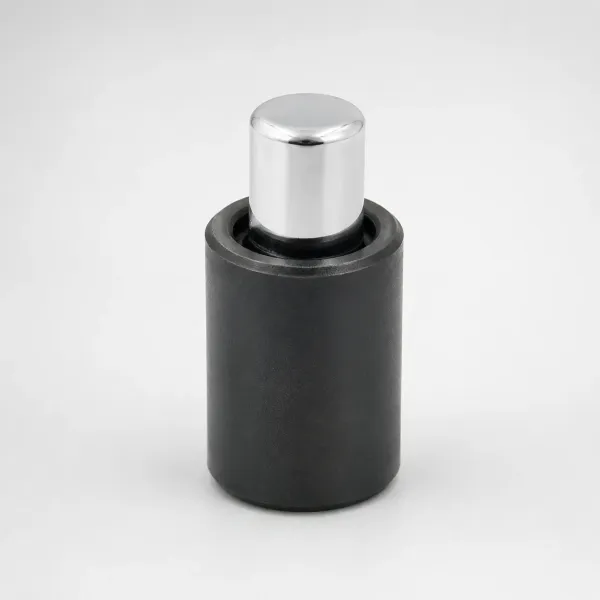
When to Switch from Coil to Gas Springs
Gas springs complement coil springs in the mold designer's toolbox. The key differences that drive the selection:
- Force profile: Coil springs produce linear force (F = kx, increasing with compression). Gas springs produce near-constant force throughout the stroke. This matters when consistent ejection force is needed from start to finish.
- Force density: A single gas spring can replace 4-8 coil springs, reducing the number of spring pockets needed in the ejector retainer plate.
- Long strokes: Coil springs become impractical for strokes above 50mm (the required free length exceeds available pocket depth). Gas springs handle strokes up to 100mm+ in a compact package.
Trade-off: Gas springs cost 10-20x more than equivalent coil springs and require nitrogen recharging (every 100K-500K cycles depending on usage). Use them only when coil springs genuinely cannot meet the force or stroke requirement.
How to Calculate Gas Spring Force
Initial force (F1): The force at full extension (no compression). This is the rated force of the gas spring and should exceed the required ejection force.
Force buildup ratio: Gas springs typically have a force buildup of 1.0-1.3x from extended to fully compressed position. This means the force at full stroke is 1.0-1.3x the initial force.
Sizing formula:
- Required gas spring force = Total ejection force / Number of gas springs
- Total ejection force = Part surface area × Part-to-core adhesion stress × Safety factor (1.5-2.0)
- Adhesion stress varies by resin: PP = 0.1-0.3 MPa, ABS = 0.3-0.5 MPa, PC = 0.5-1.0 MPa
Application Scenarios
Deep-Draw Part Ejection
Pain point: Deep parts with large core contact area require high, sustained ejection force that coil springs cannot deliver consistently.
Why it fits: Gas springs deliver near-constant force throughout the long ejection stroke, preventing part sticking or deformation during release.
Recommended: Gas Spring with stroke matching ejection distance + 5mm margin
Large Mold with Limited Spring Pockets
Pain point: The ejector retainer plate lacks space for enough coil springs to generate required ejection force.
Why it fits: One gas spring replaces 4-8 coil springs, freeing pocket space for other components while delivering equal or greater total force.
Recommended: Gas Spring rated at 4-8x individual coil spring force
Engineering Resources
Frequently Asked Questions
How long do gas springs last before recharging?+
Can gas springs be used in heated molds?+
What happens if a gas spring fails?+
Need a Custom Quote?
Send your specifications and receive a quote. MOQ: 1 piece. Custom dimensions available.