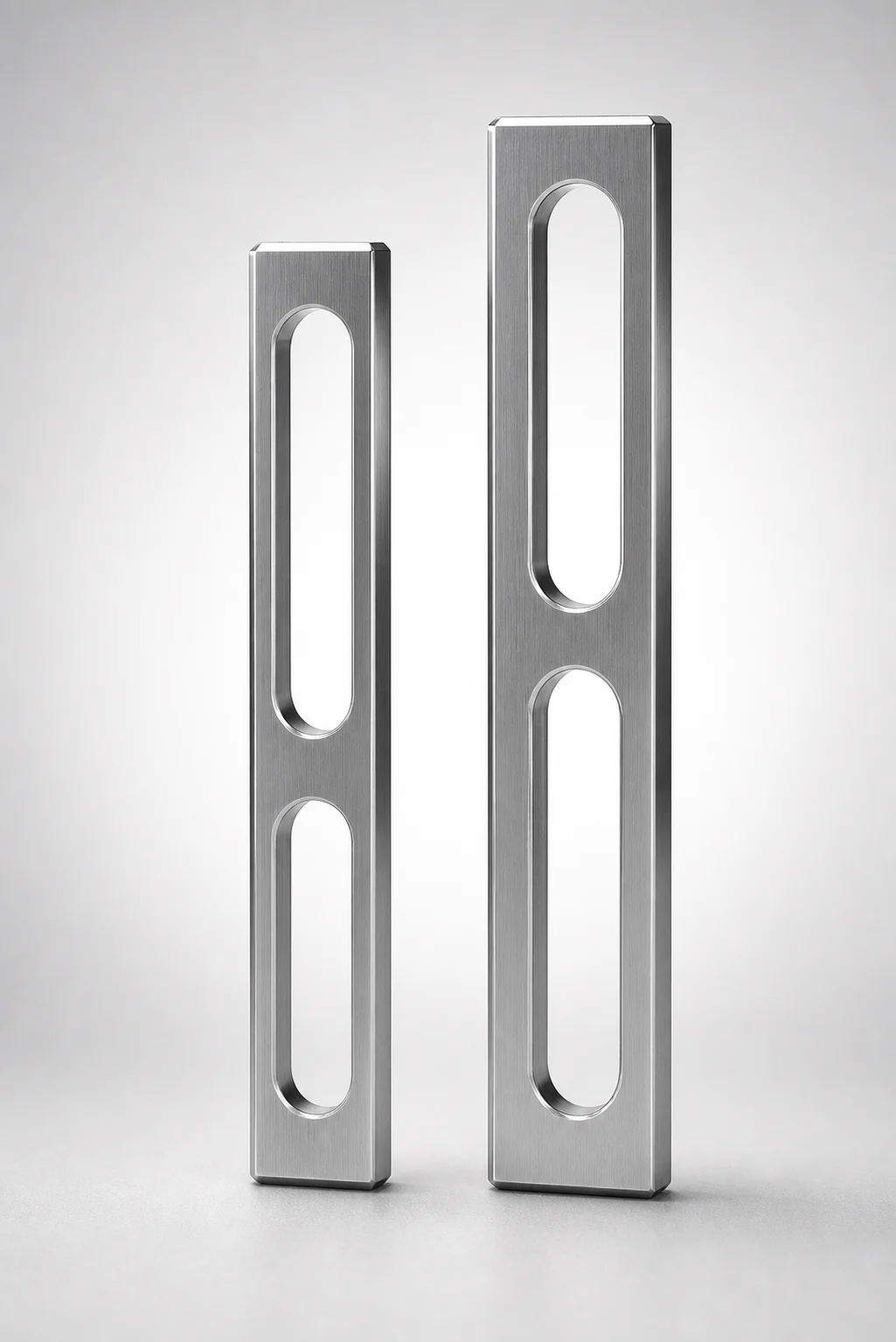
Tension Links Two Configurable Oval Hole Length in 5 mm Increments
Tension Links for stroke adjusting assemblies with two configurable oval hole lengths in 5 mm increments, enabling efficient alignment during machine setup. Optimized slotted geometry helps maintain stable linkage behavior under load.
- Stroke adjusting link design for controlled linear motion
- Two configurable oval hole lengths in 5 mm increments
- Slotted hole layout supports flexible installation within travel ranges
- Built for industrial automation, fixturing, and machine tooling
Specifications
32 configurations available
| Thickness (mm) | A (Tension Link Width) (mm) | S (Slotted hole pitch) (mm) | L (L dimension) (mm) | SC (S dimension alteration) (mm) | T (Slotted hole pitch) (mm) | TC (T dimension alteration) (mm) | type |
|---|---|---|---|---|---|---|---|
| 9 | 19 | 15 ~ 130 | 100 ~ 320 | - | 40 ~ 140 | - | - |
| 9 | 19 | 15 ~ 130 | 100 ~ 320 | - | - | 41 ~ 139 | - |
| 9 | 19 | - | 100 ~ 320 | 16 ~ 129 | 40 ~ 140 | - | - |
| 9 | 19 | - | 100 ~ 320 | 16 ~ 129 | - | 41 ~ 139 | - |
| 9 | 25 | 15 ~ 135 | 115 ~ 335 | - | 40 ~ 140 | - | - |
| 9 | 25 | 15 ~ 135 | 115 ~ 335 | - | - | 41 ~ 139 | - |
| 9 | 25 | - | 115 ~ 335 | 16 ~ 134 | 40 ~ 140 | - | - |
| 9 | 25 | - | 115 ~ 335 | 16 ~ 134 | - | 41 ~ 139 | - |
| 9 | 32 | 25 ~ 140 | 140 ~ 385 | - | 50 ~ 180 | - | - |
| 9 | 32 | 25 ~ 140 | 140 ~ 385 | - | - | 51 ~ 179 | - |
| 9 | 32 | - | 140 ~ 385 | 26 ~ 139 | 50 ~ 180 | - | - |
| 9 | 32 | - | 140 ~ 385 | 26 ~ 139 | - | 51 ~ 179 | - |
| 9 | 38 | 25 ~ 150 | 150 ~ 410 | - | 50 ~ 185 | - | - |
| 9 | 38 | 25 ~ 150 | 150 ~ 410 | - | - | 51 ~ 184 | - |
| 9 | 38 | - | 150 ~ 410 | 25 ~ 149 | 50 ~ 185 | - | - |
| 9 | 38 | - | 150 ~ 410 | 25 ~ 149 | - | 51 ~ 184 | - |
| 16 | 19 | 15 ~ 130 | 100 ~ 320 | - | 40 ~ 140 | - | - |
| 16 | 19 | 15 ~ 130 | 100 ~ 320 | - | - | 41 ~ 139 | - |
| 16 | 19 | - | 100 ~ 320 | 16 ~ 129 | 40 ~ 140 | - | - |
| 16 | 19 | - | 100 ~ 320 | 16 ~ 129 | - | 41 ~ 139 | - |
| 16 | 25 | 15 ~ 135 | 115 ~ 335 | - | 40 ~ 140 | - | - |
| 16 | 25 | 15 ~ 135 | 115 ~ 335 | - | - | 41 ~ 139 | - |
| 16 | 25 | - | 115 ~ 335 | 16 ~ 134 | 40 ~ 140 | - | - |
| 16 | 25 | - | 115 ~ 335 | 16 ~ 134 | - | 41 ~ 139 | - |
| 16 | 32 | 25 ~ 140 | 140 ~ 385 | - | 50 ~ 180 | - | - |
| 16 | 32 | 25 ~ 140 | 140 ~ 385 | - | - | 51 ~ 179 | - |
| 16 | 32 | - | 140 ~ 385 | 26 ~ 139 | 50 ~ 180 | - | - |
| 16 | 32 | - | 140 ~ 385 | 26 ~ 139 | - | 51 ~ 179 | - |
| 16 | 38 | 25 ~ 150 | 150 ~ 410 | - | 50 ~ 185 | - | - |
| 16 | 38 | 25 ~ 150 | 150 ~ 410 | - | - | 51 ~ 184 | - |
| 16 | 38 | - | 150 ~ 410 | 25 ~ 149 | 50 ~ 185 | - | - |
| 16 | 38 | - | 150 ~ 410 | 25 ~ 149 | - | 51 ~ 184 | - |
Product Guide
Application Scenarios+
Tension link components like this are used in injection mold stroke adjusting mechanisms where precise linear travel must be set and re-verified after maintenance. In automotive connector and housing molds, they help align mold-opening and closing linkage so the actuator stroke can be tuned during machine setup without changing the entire assembly geometry.
They are also suited to industrial automation fixturing that uses guided motion over a controlled travel range. The two configurable oval hole lengths in 5 mm increments allow engineers to select an effective linkage length quickly, improving repeatability when multiple product sizes share the same base tooling.
For multi-cavity production lines, the slotted layout supports flexible installation within the required travel envelope, reducing downtime during dimension changes. The robust, slotted hole geometry maintains stable linkage behavior under load, which is important when adjusting stroke while the mechanism experiences cyclic forces.
Material & Process Details+
The provided product data does not specify a steel grade, heat treatment condition, or hardness. For accurate material-property matching, confirm the actual alloy and heat-treatment state from the manufacturing documentation for series code 110200109470.
- Material selection impact: The steel grade and heat treatment primarily determine wear resistance at the slotted-hole bearing areas and the toughness needed to resist bending loads during repeated stroke adjustments.
- Heat treatment considerations: Common mold link steels are typically supplied either pre-hardened or after quench-and-temper; nitriding or surface hardening may be used when abrasion resistance is critical.
- Trade-offs: Higher hardness improves wear resistance around fastener interfaces, but can reduce toughness if not properly tempered.
If multiple material options are available for this series, compare hardness (HRC), expected cycle life, and corrosion requirements before finalizing the linkage design.
Sizing & Selection Guide+
Select the tension link dimensions by matching the linkage geometry requirements of your mold-opening stroke adjusting mechanism. This variant supports two configurable oval hole lengths, allowing adjustment in 5 mm increments, which helps tune the effective stroke alignment during commissioning.
- Thickness: Choose 9 mm or 16 mm to match available mounting envelope and load capacity of your linkage assembly.
- Link width (A): Select from 19, 25, 32, 38 mm based on bracket spacing and stiffness needs.
- Set hole geometry: Use the required slotted-hole pitch (S) in the range 15–130, 15–135, 25–140, or 25–150 mm (depending on the configuration family). Then select the corresponding L range: 100–320, 115–335, 140–385, or 150–410 mm.
- Dimension alterations: Ensure SC and TC alteration ranges align with your design: SC 16–129 (or 16–134/26–139/25–149) and TC 41–139 (or 51–179/51–184), matching the intended pin/fastener spacing.
Because specific tolerances and fits are not listed in the input data, verify pin/bolt clearances against your fastener diameter and mounting standards before assembly.
Frequently Asked Questions
How do I choose the correct oval hole length when adjusting mold stroke?+
This tension link provides two configurable oval hole lengths with adjustment in 5 mm increments. Select the length that yields the required mold-opening stroke alignment during commissioning, then lock the linkage using the chosen oval-hole positions.
When selecting the hole length, ensure the resulting linkage geometry still fits within your required slotted-hole pitch range (S) and the associated configuration family.
What thickness should I select for this tension link: 9 mm or 16 mm?+
The product offers Thickness (mm): 9 or 16. Choose 16 mm when you need higher stiffness and better resistance to bending under cyclic stroke-adjustment loads.
Select 9 mm when the mounting envelope is limited, but validate that the assembly maintains stable linkage behavior across the expected travel range.
How do I match the slotted-hole pitch (S) and L dimensions to my mold mechanism?+
You should start from the required pin/fastener spacing and travel envelope, then match S and L from the provided ranges. Available slotted-hole pitch ranges are 15–130, 15–135, 25–140, or 25–150 mm, while the corresponding L ranges are 100–320, 115–335, 140–385, or 150–410 mm.
Confirm that the chosen family also satisfies SC and TC alteration ranges for your assembly geometry.
What do SC and TC dimension alteration ranges mean for design compatibility?+
SC and TC describe allowable changes to the reference dimensions in the configuration family. For this product, SC spans 16–129, 16–134, 26–139, or 25–149 mm, while TC spans 41–139, 51–179, or 51–184 mm depending on the selected configuration.
Use these ranges to ensure your bracket offsets and linkage mounting positions stay within the engineered geometry of the series.
Is there enough information to select material grade and hardness for this tension link?+
The provided dataset includes dimensional specifications but does not list a steel grade, heat-treatment state, or hardness (HRC). As a result, you cannot reliably select wear-resistance performance or toughness characteristics solely from the input data.
For load, cycle life, and abrasion expectations, request the steel grade and heat-treatment documentation for series code 110200109470.
Related Products
Need Custom Specifications?
Our engineering team can help with custom configurations, material selection, and volume pricing.